Friday, 27 January 2023

Public Health at a crossroads again: meeting the challenge of a reformed system in England

Posted by David Hunter, Newcastle University, Peter Littlejohns, King’s College London, and Albert Weale, University College London


With health policy understandably preoccupied with the pressures on, and changes occurring in, the NHS arising from the impact of COVID-19, implementation of the Health and Care Act 2022, and various strikes among the workforce, it is imperative not to overlook the public health system reforms in England.

Public Health England’s (PHE) sudden demise in August 2020 followed mounting criticisms of its performance during the early stages of the pandemic and general unpreparedness.1 Rather than consider how PHE might be reformed, the government rushed to replace it with two new bodies: UK Health Security Agency (UKHSA), and Office for Health Improvement and Disparities (OHID). Like PHE, the UKHSA is an executive agency with close ministerial oversight while still permitting ‘independence in the delivery of policy advice’. It will act as a ‘system leader’ for health security with responsibility for pandemic preparedness and external threats across the UK while bearing in mind that health is a devolved responsibility.

PHE’s remaining functions in respect of the wider public health, including health improvement and population health, lie with OHID. Located within the Department of Health and Social Care (DHSC) and jointly accountable to the Secretary of State for Health and Social Care and the Chief Medical Officer for England, it enjoys even less independence than the UKHSA. Building on the work of PHE, OHID’s priorities include tackling obesity, improving mental health, promoting physical activity and other population health issues, notably inequalities.

There is merit in taking stock to identify any lessons which might be gleaned from the mixed life of PHE and whether the new bodies offer hope to do things better.2

Learning the lessons

The findings from a research project to explore the circumstances surrounding the rise and fall of PHE may assist with the learning process.3 Five broad underlying issues were identified in the research which contributed to PHE’s demise.
  • PHE did not possess the capacity to undertake a testing regime
     of the size and complexity required by the pandemic
    Severe funding cuts in public health spending, nationally and locally, since 2010 meant that PHE functioned with reduced capacity when the pandemic struck
  • PHE did not possess the capacity to undertake a testing regime of the size and complexity required by the pandemic, the absence of which was the basis of the case against the organisation
  • The governance of PHE as an executive agency meant it lacked independence
  • While decisions made by PHE at the start of the pandemic were later considered mistakes (and judged outside the law by a judicial review) at the time there was little information about the nature and possible effects of the virus and limited capacity in the health system which required tough prioritisation decision to be made
  • The sudden closure of PHE without any consultation was widely reported to be due to blame-avoidance behaviour on the part of key actors, principally Dominic Cummins (as former Chief Advisor to the Prime Minister, Boris Johnson) and Matt Hancock (as former Secretary of State for Health and Social Care). There was also a view that the decision was based on policy favouring use of the private sector and contracting out functions like test and trace.
Key lessons from these findings centre on two major areas of concern: the respective remits of the new bodies, and their governance.

Remits


The respective remits of UKHSA and OHID need to be clearer and more transparent if the risk of fragmentation is to be avoided. A welcome feature of PHE was its attempt to bring together the key public health functions that had previously operated in separate silos. As things now stand, separating communicable diseases (CDs) from non-communicable diseases (NCDs) is a retrograde move since, as the pandemic highlighted in stark terms, close links exist between them when it comes to those groups and communities which suffered most in terms of illness and death. A syndemic understanding of diseases and their underlying social factors is pivotal in preventing disease in the future and avoiding fragmentation.4

Governance


Governance of the new public health bodies requires careful attention. As an executive agency, PHE was criticised for its lack of independence from government which restricted its ability to ‘speak truth to power’. Given UKHSA enjoys the same status, it remains unclear how it intends to avoid a similar fate. The problem is a deep-seated and pervasive one within government. The idea that OHID being housed in the DHSC will allow it to exercise greater influence and have a closer collaboration with ministers could be a good move, or, more likely if history is any guide, it may be overly optimistic. There is a risk that OHID may disappear into Whitehall and become invisible, lacking even the limited degree of independence PHE had. To succeed, OHID has to be visible and have allies inside government.

A further issue concerning the governance and working style of both agencies, especially OHID, centres on their ability to operate effectively across government. Public health comprises numerous ‘wicked issues’, that is, multi-faceted problems that are complex and for which there are no simple or single solutions. Confronting them will be especially challenging for a government which, for all its rhetoric about ‘levelling up‘, remains topic- and department-focused, operating in silos rather than concerned with cross-government issues.5

OHID has a steep hill to climb if it wants to lead a transformational agenda across the wider determinants of health which demands a whole-of-government approach. The hill just got steeper following government delays in tackling child obesity and its failure to implement a national food strategy. In keeping with the prevailing political ethos, there is a renewed focus on individual behaviour change and lifestyle choices rather than tackling the influence on health of commercial interests via taxation and regulation.6,7 If significant inroads into the population health agenda are to be made, then confronting powerful vested interests in, and lobbying from, the food and drinks industry and their ’friends’ in government engaged in what has been termed ’institutional corruption’ cannot be avoided.8 Whether OHID has either the backing from government or competences for such a struggle remains doubtful in the extreme.

Conclusion

Public health once again finds itself at a crossroads. It can either continue to ‘muddle through’ with a broken political and public policy system that is not fit for purpose.9 Or there is an opportunity to construct a strong and confident public health system that is well-placed to confront the challenges facing it. The aftermath of COVID-19 should make the choice of options self-evident. However, as things stand, it is unlikely that the UK’s broken political system with its focus on short-term fixes is up to the challenge. Without major systemic change aimed at overhauling the UK’s political system, a risk of further deterioration in the state of the public’s health may be unavoidable.


References:
  1. Calvert J, Arbuthnott G. Failures of state: the inside story of Britain’s battle with coronavirus. London: Mudlark, 2021. https://harpercollins.co.uk/products/failures-of-state-the-inside-story-of-britains-battle-with-coronavirus-jonathan-calvertgeorge-arbuthnott?variant=39528280391758
  2. Vize R. Controversial from creation to disbanding, via e-cigarettes and alcohol: an obituary of Public Health England. British Medical Journal 2020; 371:m4476 http://dx.doi.org/10.1136/bmj.m4476
  3. Littlejohns P, Khatun T, Knight A, Hunter DJ, Markham S, Coultas C, Kelly MP, Ahuja S. (2022) Lessons from the demise of Public Health England: where next for UK public health? London: NIHR ARC South London. https://arc-sl.nihr.ac.uk/sites/default/files/uploads/files/public-health-report-sept-2022-final.pdf
  4. Horton R. Offline: COVID-19 is not a pandemic. The Lancet 2020; 396: 874. https://doi.org/10.1016/S0140-6736(20)32000-6
  5. Pope T, Shearer E, Hourston P. What levelling up policies will drive economic change? The need for a long-term focus on skills and cities. London: Institute for Government, 2022. https://www.instituteforgovernment.org.uk/publications/levelling-up-policies?
  6. British Broadcasting Corporation (BBC). Junk food: obesity strategy falling apart, Jamie Oliver says. 15 May 2022 https://www.bbc.co.uk/news/uk-61449921
  7. Ralston R, Smith K, O’Connor CH, Brown A. Levelling up the UK: is the government serious about reducing regional inequalities in health? British Medical Journal 2022; 377:e070589 https://doi.org/10.1136/bmj-2022-070589
  8. Draca M. Institutional corruption? The revolving door in American and British politics. SMF-CAGE global perspectives series: 1. 2014. http://www.smf.co.uk/wp-content/uploads/2014/10/Social-Market-FoundationInstitutional-Corruption-the-revolving-door-in-American-and-British-politics.pdf
  9. Ricketts P. Hard choices: the making and unmaking of global Britain. London: Atlantic Books, 2022. https://atlantic-books.co.uk/book/hard-choices

David J Hunter, Emeritus Professor of Health Policy and Management, Population Health Sciences Institute, Newcastle University

Peter Littlejohns, Emeritus Professor of Public Health, Centre for Implementation Science, Institute for Psychiatry, Psychology and Neurosciences, King’s College London

Albert Weale, Emeritus Professor of Political Theory and Pubic Policy, University College 
London


The views and opinions expressed by the authors are those of the authors and do not necessarily reflect those of Newcastle University, King’s College London, University College London, or Fuse, the Centre for Translational Research in Public Health.

Friday, 6 January 2023

What’s really going on when a child is ‘overtired’ – and how to help them have a silent night in the New Year

Posted by Helen Ball, Professor of Anthropology, Director of the Durham Infancy & Sleep Centre (DISC), and Fuse Associate at Durham University

Anyone who’s cared for a young child will recognise the signs. They’ve had too little sleep or missed a nap, they’re cranky, tearful, and stroppy, and they can’t or won’t fall asleep. They are “overtired”. But is such a thing really possible – to be more tired than tired?

What we tend to call overtiredness happens when an emotional state, such as anxiety, distress or fear, blocks our ability to go to sleep even when we’re really tired. This is a survival response that helps us to stay awake when in danger, no matter how tired we are. It suggests overtiredness can be reframed to help us better respond to our child’s needs when it happens.

At the end of the day, the feeling we have of needing to sleep is called sleep pressure. The longer we stay awake the more sleep pressure rises. Typically, the higher it gets, the easier it is to fall asleep. If we stay awake for long enough, eventually we’ll fall asleep even if we are trying not to.

The sensation of sleep pressure is caused by the build-up of chemicals (called adenosines) in the brain. These are proteins that are removed from our brains while we sleep, and build up again while we are awake.

For adults, this process takes about 14-16 hours. When we delay sleep past this point the build-up of adenosines cannot go on unchecked. At some point, eventually, we must sleep.

Babies’ sleep pressure builds up more quickly than adults. Young babies often fall asleep after being awake for an hour or two. As children get older, sleep pressure builds more slowly. But it takes several years until a child is able to stay awake all day.

What stops us sleeping?

To fall asleep we must be calm, relaxed and able to switch off our brains so that the build up of sleep pressure can tip us into sleep. When something blocks the action of sleep pressure, such as fear, pain or racing thoughts, we may struggle with sleeplessness.

In the same way, sleep happens more easily for a baby or child when sleep pressure is high, they are in a calm relaxed state, and nothing is preventing sleep onset. But sometimes babies and children need help to become calm before sleep pressure can kick in and they can nod off.

When a baby or young child’s sleep pressure is high and the need to sleep is strong, but they are emotionally unable to calm themselves, or they are in a situation where they cannot relax – where there is noise, lights, or activity – we may label them as overtired. Emotional exhaustion, which is a form of stress, prevents both children and adults from sleeping and makes them cranky.

Some responses to overtiredness are heavy-handed. Ordering a child to their room, putting them to bed in the face of distress or punishing them for not falling asleep when told to do so will dial up the child further and push sleep further from reach. After all, none of us can fall asleep on command.

Helping babies to sleep

In this situation, we must remember that babies and young children need our help to manage their emotions. It is our job as parents to help them become calm, dial down, and relax in preparation for sleep.

We can do this in many ways. Physical contact such as cuddling, rocking, stroking or patting works for most children, although it must be remembered that some neurodivergent children can find touch irritating rather than calming.

Non-contact methods also work. The presence of a relaxed slow breathing adult can calm a child, as can listening to gentle talking, singing and humming. In the Czech Republic, there is a specific word for lying with and helping a child to relax so they can fall asleep: uspávání.

There is no name in English for the process of helping a child relax so that sleep pressure can tip them into slumber, so we often don’t discuss or acknowledge it. We can use it, though. And we can understand that what we have named “overtiredness” is the conflict between sleep pressure being high and something blocking the effect of that sleep pressure.

In this situation actively removing the blockage – fear, pain, anxiety – by helping babies and children to become calm is the quickest way to help them fall asleep.

Next time your baby is having a meltdown at bedtime, or your child is throwing a tantrum at the end of the day, hug them, cuddle them, talk gently to them and calm them. Let sleep pressure do its thing, and they’ll be snoozing in no time.


The Durham Infancy & Sleep Centre (formerly the Parent-Infant Sleep Lab) is a research centre of the Department of Anthropology. It is the home for a group of researchers examining various aspects of infant and child sleep and parenting behaviour since 1995. Its work with more than 5,000 parents and babies during the last 20+ years has substantially increased parents' understanding of babies' sleep, how best to care for babies during the night, and how best to keep them safe when asleep. 


This article is republished from The Conversation under a Creative Commons license. Read the original article.

Friday, 16 December 2022

Walking football for people with chronic breathlessness – has it got legs?

Posted by Callum Bradford, Research Associate, Teesside University

Following on from the recent success of the England Women’s football team, and with the Men’s World Cup final just around the corner, now seems like a good opportunity to talk about our walking football project, designed exclusively for people with chronic breathlessness. What is walking football you ask? Well it's football, without running (you don’t say?!), and the physical contact is a bit more restricted. Thankfully, FIFA hasn't got its hands on walking football just yet, with the World Cup being an example of why we perhaps should avoid such a thing.


Chronic Breathlessness is predominantly caused by pulmonary conditions, such as chronic obstructive pulmonary disease (COPD), impacting 75 million people globally. With Covid-19 and an ageing population this number is expected to rise, increasing the burden on families, carers, and health and social care services. For individuals, breathlessness is associated with a lower quality of life, decreased capacity to do exercise, and higher levels of anxiety and depression

Pulmonary rehabilitation is recommended for everyone with breathlessness. Consisting of both exercise and education, its benefits on health are unequivocal, however, any benefits gained by patients are often reduced three months after completion. This is primarily because patients go back to doing less physical activity once the programme has finished and support from healthcare professionals is removed. With this in mind, we wanted to develop an intervention that could step-in when patients finish their rehabilitation, offering a form of exercise maintenance and continued social support. Given the nation's love of football (most of the time), we believed walking football might have potential.

To develop the intervention, we initially consulted pulmonary physiotherapists, and a local walking football team. The physios were initially very sceptical, raising concerns that the pace would be too fast, and highlighting the number of people with breathlessness who required oxygen or walking-aids. Walking-aids?! Oxygen?! I hadn't even considered that. I was starting to worry that this idea might be a complete non-starter.

So next stop was to see some walking football for myself at Middlesbrough’s Herlingshaw Centre. I left the session with mixed feelings. They played three-touch, meaning everyone got the opportunity to play, forcing that one player who thinks they're Allan Saint-Maximin to pass the ball. It was also proactively refereed to the benefit of everyone, with players encouraged to talk to the ref if they felt the pace of the game was too fast. However, after giving it a go myself, the pace was still surprisingly quick, despite what Father Ted might have you believe, bringing back concerns as to whether it would be too high an intensity. What I really needed to know was what patients themselves thought of walking football.

So we linked up with Breathe Easy Darlington, a local support group for people with lung conditions. Describing the input from Breathe Easy members as invaluable to our research over the last few years would be a massive understatement. So much so that, as a small thank you, we held a fundraiser for them last month on World COPD Day, raising £1120.76.

Their opinions would be vital to walking football’s success... however, they were also dubious of the idea. Again, concerns were raised about the speed, the walking-aids, and the balance required to play. So I asked, under what circumstances – if any – would they consider giving walking football a go? They stated that if the football was exclusive to people with breathlessness like themselves, they would give it a try, as they would be able to dictate the pace of the game and not feel too self-conscious of their footballing abilities. Our original plan involved asking patients to join onto sessions at the Herlingshaw. Luckily, by consulting with Breathe Easy members, I now understand how that plan – to mix people with and without breathlessness - would have likely ended in disaster, demonstrating the importance of including end-users when designing research studies.

Twelve Breathe Easy members agreed to play and the stage was set for our walking football taster sessions, and as you can see from our video, I don't think it could have gone much better.

The players embraced the competitive aspect of football, stating that “On the pitch you forget about breathlessness”; and the concern for walking-aids was turned on its head after we agreed that hitting the ball with a walking-stick is a perfectly fine way to score a goal. Our coach, Monty Towers, was key to its success, mixing up the session with fun games, while allowing everyone to play football at their own pace. In our follow-up conversations, members also suggested implementing a buddy system, where more experienced participants take responsibility for introducing new patients to the group so they feel more welcome – a brilliant idea that we intend to implement in the future.

Throughout 2023 we will be assessing the feasibility of walking football following pulmonary rehabilitation in collaboration with both North Tees & Hartlepool and South Tees NHS Foundation Trusts, plus the North Riding FA; and I’m confident if it’s anything like our sessions with Breathe Easy members, it will be a great success.

And if you’re still upset about the World Cup, don’t worry, I’m sure our walking football team will bring it home next year.


The views and opinions expressed by the author are those of the author and do not necessarily reflect those of Teesside University or Fuse, the Centre for Translational Research in Public Health.

Friday, 9 December 2022

What support do children and young people actually want when their parents use drugs and alcohol?

Posted by Cassey Muir, Fuse & NIHR School for Public health Research (SPHR) funded PhD Researcher from Newcastle University and Kira Terry, Lived Experience Expert. 


“No-one has ever asked me about how I feel in any of this.”


I found the powerful quote above from a young person during my research exploring parent drug and alcohol (or substance) use from the young person’s perspective. Since then the question of ‘what support do children and young people ACTUALLY want?’ has remained central to my PhD research in this area.

Most schemes focus on the parents themselves, to reduce the risk to young people. While these interventions are needed it should be alongside and in addition to support for the child or young person as well. There are currently a very limited number of evidence-based interventions for young people whose parents use substances, with low quality effectiveness. The distribution of support services for children and young people whose parents use substances is also patchy across the country, with practitioners doing really great work with little funding and resources.

In a recently published review of the research in this area, I aimed to understand the experiences, perceived impacts, and coping strategies of young people whose parents used substances. The review was extensive - covering the perspective of over 700 children and young people from across twenty different countries - and I hope that it can help to inform practice and policy through illustrative cases of young people’s experiences, as well as giving insights into what support could be useful.

Feeling different and isolated

Working with PROPS Young Person’s Project, a group of young people with lived experience supported the early stages of this review to help us understand the findings. One area that the young people felt was missing and may not have been explored across the current studies was the experience of feeling different to their peers, and how they felt isolated and like they had to keep everything hidden from others. This idea, relating to the experience of stigma, helped me to explore the data from a different perspective.

Children and young people described living highly disrupted and chaotic lives, characterised by unpredictability and insecurity within their relationships. They also often experienced adversity occurring at the same time in childhood, such as parents with mental health problems, domestic violence and abuse, as well as poverty. Children and young people were impacted both emotionally and socially from their experiences of parental substance use, which often extended beyond their parents stopping use, further highlighting that child-focused support is crucial. The painful experience of shame, stigma, and discrimination due to their close association and relationship with a parent who uses substances, was often further compounded for those who had experienced poverty or lower socioeconomic status.

Resisting and coping

Most of the studies described the negative impacts of parental substance, without recognising children and young people’s agency and attempts to change, control, and resist their experiences or impacts. Children and young people tried to manage and mitigate vulnerabilities and be resilient to unpredictable, adverse, and stigmatising experiences. While it is not a child’s role to resist and cope with the negative impacts of parental substance use, they were trying to do this anyway, often without formal support in place. Formal support was often thought of as something children and young people only have at times of crisis and due to the stigma and fear of speaking out it was also difficult for young people to seek support for themselves before a crisis point.

What can we do to support?

The findings had little to say about how young people wanted to be supported following their experiences. So, as part of my PhD I have been chatting with young people, and the practitioners that support them, around what we can do to support and build on their strengths, agency, resistance, and resiliency. For instance, young people and practitioners thought it would be good to develop a digital app that teenagers and young adults can access themselves at any time of day. They can choose what topics or sessions they want to go through and hear about other young people’s stories. Such digital interventions could be used alongside in-person support with a practitioner or act as a gateway to more formal support, with the aim of helping reduce the stigma of speaking out and accessing help. Additionally, young people wanted free text support lines that they can access out of hours, usually in the evening when things may be worse at home. Text and chat-based support lines provide young people with the opportunity to safely get support without having to physically talk to somebody and gives them more flexibility. Both young people and practitioners wanted in-depth training for professionals (e.g. teachers or first responders) around the experiences and impacts of parental substance use on children and young people and how to signpost to support.

Finally, one of the main areas that the young people and practitioners wanted to focus was on the co-production of resources to be used in primary and secondary schools. Young people wanted parent drug and alcohol use to be talked about in schools, as many reflected that it had never been spoken about making them feel more alone and isolated. Having lessons around the emotional and social impacts of family substance use within secondary school, or having story books read out loud in primary school about a child whose parent drinks alcohol or uses drugs would begin to reduce the stigma and fear of speaking about such a hidden and taboo subject.

“I’ve really enjoyed that chat, thanks for reaching out to me and wanting to hear about my experiences and how to support young people.”
Young person after taking part in this study


“He has told us he has gotten so much out of chatting with you and is really happy to have been involved and listened to regarding what might help others.”
Practitioner on behalf of a young person 

The young person’s voice

In any decisions made throughout my PhD, I have tried to ensure that the young person’s voice is lasting and at the forefront. Young people have been involved in this project from the start, guiding the research questions, designing research materials, contributing to ethics procedures, analysing data, and presenting results to over 100 practice and policy professionals. To finish this blog post, Kira shares her thoughts on contributing to this project as a Lived Experience Research Advisor and what she thinks is needed to support young people whose parents use substances:

“It has been an absolute honour to be involved as part of this project. To use my ‘negative’ life experience and be able to turn it into a positive impact for other children like me in the future: to help speak for those who feel they don’t have a voice and aren’t seen by people around them in the position they are in. The main part of supporting young children is accessing them and communicating with them. Reaching out to young people in general about parental substance use issues, getting the knowledge out there about it is important. This in turn will help the young people experiencing parental substance use, as the subject isn’t so hidden anymore as it usually feels hidden in the home. And through that we must back up with access to different support links. Some children aren’t ready, some don’t want help, some we won’t reach, but to push and be as present for as many children as possible, as long as possible and to reduce the isolation of the stigma around it is vital.”


Find out more about this research in the first Public Health Research and Me Fuse Podcast: How can we promote resilience in children and young people affected by parental substance use?


  1. Photo by Polina Zimmerman from Pexels: https://www.pexels.com/photo/young-woman-talking-with-therapist-3958461/
  2. PROPS Family Recovery Service logo. Copyright © 2022 - All Right Reserved - PROPS North East: https://props.org.uk/

Friday, 25 November 2022

How can we give our communities the Best Start in Life?

Posted by Liam Spencer, ARC North East & North Cumbria Mental Health Fellow, Newcastle University

Having had a background in youth and community work within a local authority, the question contained in the title of this blog is one close to my heart.

It is also the name that South Tyneside Council gave to one of their projects - the Best Start in Life (BSIL) Alliance - which really struck a chord with me, especially as my research interests focus on children and young people’s mental health.

I first learned about the project back in May 2019, when I attended an AskFuse brokering event for the Public Health Practice Evaluation Scheme (PHPES) of the NIHR School for Public Health Research. At this event Anna Christie, the Public Health Knowledge and Intelligence Lead for South Tyneside Council, presented on the BSIL Alliance, focussing on three initiatives: Locality Hubs; Mental Health Champions; and Young Health Ambassadors.

This was the beginning of a partnership between Fuse researchers and South Tyneside Council, and after successfully being shortlisted and then submitting a full-length application, in October 2019 we were delighted to learn that our proposal had been accepted – out of 91 registrations of interest for the 2019 PHPES funding call, ours was one of only 10 proposals that were successfully funded!

Best-laid plans

By the time the project started in April 2020, we were living in very different times to when we planned the evaluation, due to the Covid-19 pandemic.

We had hoped as researchers to be embedded within South Tyneside Council; this was not possible.

We had planned to include the Locality Hubs within our evaluation; these were not able to be launched.

Routine data we had planned to include in a cost consequence analysis (a form of economic evaluation where separate costs and a range of outcomes are presented to allow readers to form their own opinion on the relevance and relative importance of interventions) were either not collected or were severely impacted.

Moving from Plan A, to Plan B, to Plan C is commonplace in research, however, throw a global pandemic into the mix and you can find yourself quickly wheeling through all the letters of the alphabet whilst trying to stick to the original plan for your research! Despite the hurdles we had to overcome – the dedication and commitment from our colleagues at South Tyneside Council, and the Fuse team endured, and we were all determined to deliver on the project.

Insightful discussions at the Fuse Research Event in South Tyneside
Fast-forward to the present day and we have completed our evaluation. Thankfully, only being able to meet virtually is a thing of the past and on Wednesday 12 October we were joined by practitioners from local authority and third sector organisations, researchers, and students from across the region, for a Fuse Research Event at The Customs House in South Shields, to finally share learning from our evaluation! The event included academic contributions from myself, Ruth McGovern (study lead), and Sam Redgate, along with Anna Christie, Tom Hall (Director of Public Health), and Chrissy Hardy (Public Health Practitioner, Children & Young People) from South Tyneside Council.

Supporting young people’s mental health

Our findings showed that the successful implementation of Alliances in public health and social care related services within Local Government is dependent upon achieving a system level approach, whereby thinking, methods, and practice are applied to better understand public health challenges and identify collective actions across services. Placing local people at the heart of the system, and creating a cultural shift is also key to a successful Alliancing approach. Mental Health Champions and Young Health Ambassadors were found to influence system change by generating mental health awareness and facilitating more inclusive and supportive environments for children and young people.

As well as sharing findings from the evaluation, we wanted this in-person event to be interactive and collaborative, and asked those who attended to think about the similarities and differences between the Mental Health Champion and Young Health Ambassador initiatives. I thought it was really interesting that people recognised that these initiatives share a similar ethos, with commonality of goals and outcomes – to support young people’s mental health, in both proactive and reactive ways. Attendees felt it was important that both approaches are organic, with ideas emerging ‘from the bottom-up’. Volunteers can utilise the Alliance in a productive way, by accessing training and events, and securing buy-in from senior stakeholders, with support from Chrissy, the facilitator of both initiatives. I was so grateful for all the meaningful and insightful contributions provided, which are proving to be very useful in guiding the write-up of our findings – ensuring that they are as relevant to practice as possible.

We are very thankful to our colleagues at South Tyneside Council for collaborating with us on this project (despite the barriers we faced along the way!) – and we really hope that the findings from this work will help shape their future policies and practices. Personally, this evaluation provided me with an opportunity to learn more about current local initiatives, engage with passionate practitioners and young people, and build some really fantastic relationships with colleagues at South Tyneside Council. I thought that the event was a wonderful way to bring people together from across the region, to share our findings, and to draw the project to the close. A big thanks to the Fuse team for making it happen!

Find out more:


Friday, 4 November 2022

My passion for research comes from always asking "why?"

Posted by Pascal Landindome Navelle, FRSPH, Public Health Research Operations Officer and Doctor of Public Health Student at Teesside University.

In today's Fuse blog, Pascal gives his top tips for anyone starting out in research, and shares his own experience which began working with Fuse and Teesside University.

His advice? A passion for the "why?" question and accessing the right mentorship.

As part of the NIHR ‘Your Path In Research’ campaign.
 
After working as a clinician for several years, I felt that my impact on service users was limited. So, upon a thorough reflection, I was inspired to progress into public health research, where I felt I would have a broader impact on society.

Research work is fascinating as it provides a clear pathway to contributing to advancing the knowledge of the disciplinary sector to which I am dedicated. The importance of research should go beyond conceiving theoretical works that would only find a physical location in a library. Research should be "living", circulating, interacting, multidisciplinary, and impacting the environment.

What I enjoy about research is that it allows me to pursue my interests, learn something new, hone my problem-solving skills and challenge myself in several unique ways. Working on a faculty-initiated research project enables me to work closely with a mentor–a faculty member, and other experienced researchers. With a self-initiated public health research project, I can leave the community with a service that represents the distillation of my interests and studies and, possibly, a real contribution to knowledge.

There are many training and support systems that I have found valuable during my career. Researchers usually embark on increasingly diverse careers, where collaboration, networking and interdisciplinarity have become more important. Critical reading, academic writing and critical analysis are valuable training and support required of a researcher. Transferable skills, such as effective communication and problem-solving abilities, have helped me operate more effectively in different work environments.

Starting a research career can be daunting but exciting! The challenge of getting the support needed to achieve my dream came true when I enrolled at Teesside University for a research degree. This began by getting involved with AskFuse (Fuse’s responsive research and evaluation service) and with Associate Professor Dr Peter van der Graaf, working on an enquiry to evaluate Northumbria NHS Foundation Trust’s staff health and wellbeing resources during the pandemic, as part of my PhD research. This then led to working on the South Tees Arts Project (STAR) with Peter, a pilot study to co-produce wellbeing measures with primary school children, their parents, teachers, and artists for a school-based dance intervention. I supported the data collection, analysis and report writing for the STAR project as a Research Assistant and even wrote a song for the engagement activities with children in the research!

I had the opportunity of getting mentorship and some academic resources to enhance my knowledge. I connected and contacted very experienced researchers in the field of public health who supported my interest in growing as a research professional. Through the people I’ve met, I have had the opportunity to work on exciting but substantial research projects that have had a massive impact on the public health community.

My top three tips for somebody starting out in research are:
  1. First and foremost, you should be motivated, passionate, and curious about your research topic – do it for science, not tenure! No one ever became a successful scientist with the sole premise of being awarded the Nobel Prize. And remember that plans rarely work out the way you thought they would.
  2. Be prepared for a challenging career. Research is ever-changing. Be prepared for the change that research comes with strengthening your problem-solving skills to enhance the fun aspect of research. Problem-solving skills refer to handling difficult situations and overcoming complex challenges. They involve breaking a problem down into its parts, thinking critically about each element, analysing the information you find and using that information to form an effective solution. Having strong problem-solving skills will help make you an asset in your research practice and help you advance your research career.
  3. Finally, be proactive, network and connect more with like-minded professionals. Sometimes, the key to getting to places is not what you know but who you know. We can learn a lot from talking to peers and senior colleagues. Attending symposiums, seminars and conferences is a great way to meet people who share common interests with you but have different experiences.
The NIHR has supported my career development through the provision of training, access to leadership development opportunities, networking events, mentoring and guidance on research funding.


The NIHR launched the Your Path In Research campaign this week. Better research leads to better services for the public. That’s why the NIHR want to encourage organisations and social care and public health professionals to play an active role in research, as a way to deliver even better services.

The Your Path in Research campaign highlights how people can make research part of their careers. Some amazing researchers have shared their experiences, how they started in research and what advice they can give to researchers that are considering adding research to their careers.

Take your first step in research today.

Friday, 21 October 2022

Stigma: Where’s the Harm?

Posted by Dr Michelle Addison, Assistant Professor, Durham University

Stigma is a knotty, ugly problem we have in society: it marks out (often painfully) what is considered shameful, abject or contra to social norms, and impacts vulnerable and marginalised people the most. It seems intuitive to say it is unfair and unjust, but why then does it persist? 

Discussions of stigma are not new; we are all generally aware that stigma is something to be avoided and we could all very likely give some examples of it in action – benefit claimants, people who use drugs and ex-offenders are often easy targets and regularly feature in news headlines because stigma continues to be sensational – it elicits a voyeuristic feeling that is both intoxicating and a warning to us too. The use of stigma is further exacerbated by the ‘Cost of Living Crisis’, ‘Rising Interest Rates’, Fuel and Food poverty, and the withholding of the Government White Paper on Health Inequalities. We understand then that stigma is harmful, and yet we recognise it is powerful to those who can wield it.  

Erving Goffman discussed stigma using the concept of the ‘spoiled identity’ whereby certain aspects of who you are become discredited and devalued in his now infamous work Stigma: Notes on the Management of Spoiled Identity (1963/1990). This notion of a spoiled identity is also implicit in his observations of patients residing in ‘asylums’, the conditions impacting these people, and the roles of those working there (1961). Indeed, Goffman was acutely interested in the medicalisation and performance of roles in these settings and how behaviour was shaped by social expectations of ‘in-mates’, ‘guards’ and ‘medical staff’. The treatment of patients, he noted, was complexly bound up with expectations of socially acceptable roles and the reinforcement of discredited behaviours and identity.

What we learnt from this is that stigma matters in the social organisation and hierarchies of people and places in medicalised and wider social settings. But what tends to fly under the radar in early stigma research is the question of ‘in whose interests’ does stigma serve?  Professor Imogen Tyler later critiques Goffman’s work (2020) in her book ‘Stigma: The Machinery of Inequality’ for overlooking the power relations that are integral to how we understand stigma, and why indeed, stigma continues to persist. Tyler shows us that there is a ‘craft’ to how mechanisms of stigma operate and function to maintain political power and a social order that hinges on systemic and structural inequalities around class, race, gender (and not limited to) to reproduce privilege for the dominant factions. This is a hugely important step in stigma research because it draws attention upstream to how and why stigma is weaponised (Scambler, 2018) and the social harms that impact marginalised and minoritised individuals and communities in society – which is the subject of my forthcoming article (Addison, 2023). This is further evident in the recent Stigma Kills (2021, 2022) campaign launched by the NHS Addictions Provider-Alliance which gives credence in particular to the impact that stigma has on the health and wellbeing of those communities that are most harmed through health and social inequality.

This growing concern about the effects of stigma on health and wellbeing, arising out of social harm, led to our recent Fuse event Inequalities, Social Harm and Weaponised Stigma: Emerging Research and future priorities which brought together academics, practitioners and the public to discuss these key issues. I presented work from my Wellcome Trust research looking at stigma and how this relates to health inequalities amongst people who use drugs. In this study I highlight how the weaponisation of stigma is harmful, negatively impacts physical and mental health, and inhibits health seeking behaviours for fear of being judged and marginalised by service providers and the wider public.

Joanne McGrath discussed her NIHR funded research into women living with multiple disadvantage and complex needs and how they access services. In this talk she highlighted how escalating problems around homelessness, stigma and deteriorating physical and mental health have a cumulative impact in women’s lives.

Our ‘expert by experience’, Margaret Ogden, shared moving insights into the effects of stigma on her own life and how her mental health was harmed as a result.

Later, Mark Adley discussed his Doctoral work (which is funded by the NIHR Applied Research Collaboration (ARC) North East and North Cumbria (NENC)) and his recently published paper which explores stigma within-groups towards people who use the drug Spice. In this talk, Mark showed how intersections of identity mattered and how increased contact with people who used Spice helped to reduce levels of stigma. He highlighted the role of education programmes within service provision to help draw attention to the harms arising out of stigma and how practitioners might mitigate these effects.

This event was also an opportunity to launch our new Palgrave edited collection Drugs, Identity and Stigma (Addison, McGovern and McGovern, 2022). Our book calls attention to the impact of stigma experienced by people who use illicit drugs, and through this we show that stigma is powerful: it can do untold harm to a person and place with longstanding effects. Through an exploration of themes of inequality, power, and feeling ‘out of place’ in neoliberal times, this collection focuses on how stigma is negotiated, resisted and absorbed by people who use drugs. Dr Kelly Stockdale, a contributor to the book, spoke at our Fuse event and shared insights from our research into the challenges of navigating a custodial environments (prison and police) and the impacts of stigma from the point of view of people who use novel psychoactive substances (NPS). Collectively, our work in this area brings together a range of frameworks and data and draws attention to the damaging effects stigma can have on health inequalities, recovery, mental health, recidivism, and social inclusion.

Our knowledge and understanding of the harms that stigma does to health and wellbeing is still growing – as such, it is critical that developing stigma research becomes a priority in future inequalities research agendas, against a backdrop of political and economic crises. Whilst the social determinants of health are often tangible and measurable, providing the much-needed evidence base to tackle widening health inequalities, it is imperative that we think differently and critically about how stigma operates. In my own research I have tried to show that stigma operates at a symbolic level meaning it is not possible to treat stigma as something which is material and objective, to say ‘here is stigma’ – we must think more deeply about stigma as inscribed with meaning that becomes apparent through its effect on and between people (see also Addison, McGovern and McGovern, 2022).

I called this blog ‘Stigma: Where’s the harm?’ to be a little provocative to you, reader – on the one hand, stigma is so normalised in our society that we forget to see it, so I encourage you to pause and reflect on where the harm resides – like a million little paper cuts, stigma is painful and gets under the skin doing very real harm. On the other hand, my question is also a call to action to understand how and why stigma is weaponised, and how it leads to social harm amongst under-heard and underserved people. It is my strong belief that this is vital work if we are to tackle and reduce widening health and social inequalities right now.  


References:

Addison, M. (forthcoming, March 2023) ‘Framing Stigma as an Avoidable Social Harm that Widens Inequality’ in Emery, J., Powell, R., and Crookes, L. (eds.) The Sociological Review Special Issue

ADDISON, M., MCGOVERN, W. & MCGOVERN, R. E. (eds.) (2022) Drugs, Identity and Stigma, Houndsmill, Basingstoke and Hampshire, Palgrave Macmillan.

ADLEY, M., ATKINSON, A. M. & SUMNALL, H. R. (2022). Including the multiply excluded: a mixed methods study exploring intragroup stigma towards people who use synthetic cannabinoid receptor agonists. Drugs: Education, Prevention and Policy. DOI: 10.1080/09687637.2022.2025766

GOFFMAN, E. (1990) Stigma: Notes on theManagement of Spoiled Identity, London, Penguin Books

GOFFMAN, E. (1961) Asylums: Essays on the Condition of the Social Situation of Mental Patients and Other Inmates, London, Penguin Books

SCAMBLER, G. (2018). ‘Heaping blame of shame: 'Weaponising stigma' for neoliberal times’. The Sociological Review Monograph, 66, 766 - 782.

SINGH, S. (2019) available at: https://samiasingh.com/

TYLER, I. (2020). Stigma, The Machinery of Inequality, London, Zed Books.


Images:

1) Artwork by Samia Singh, https://samiasingh.com @samiasingh_art

2) Book: Drugs, Identity and Stigma, © 2022 Springer Nature Switzerland AG. Part of Springer Nature, ISBN : 978-3-030-98285-0, https://link.springer.com/book/10.1007/978-3-030-98286-7#about-this-book

Friday, 14 October 2022

Media representations of disabled people

Posted by Laura Navin, Health and Social Care student, Northumbria University

Picture by Laura Navin
Negative media representations of disabled people still exist in society and this needs to be addressed. I have dyspraxia which is a learning difficulty, and I sometimes struggle with my co-ordination, communication, processing and speed but it has not stopped me from achieving my goals!

In the media, disability tends to be portrayed through a medical or deficit model, with disabled people often treated as pathetic.1,2,3 TV charity shows such as Children in Need encourage pity for disabled people2 and people with disabilities are still seen as “the heavy burden of care”; “the helpless victim”.3 Yet even when well-meaning, encouraging pity is discriminatory as it creates stereotypical and negative assumptions about disabled people2. These negative representations can decrease a disabled person’s self-esteem and make them feel like they are not part of society.1,4

The issue is heightened by the absence of disabled people and their voices within mainstream media which might help to reclaim the narrative and counter negative stereotypes. As Caroline Casey, founder of The Valuable 500, a global movement putting disability on the business leadership agenda, has suggested “from daytime TV to adverts on social media, to the articles which publications run, representation and visibility of persons with disabilities simply does not reflect our society”. This was brought to light recently for example, when Sia’s decision to cast a neurotypical actress in the role of an autistic female protagonist in her upcoming film was widely criticised.

There are more positive portrayals of disability in the media however. Harry Potter star, Daniel Radcliffe has dyspraxia and acted as an inspiration to many when saying, “do not let it stop you. It has never held me back.”. In 2018, Lee Ridley from the North East won Britain’s Got Talent and in 2021, EastEnders star Rose Ayling-Ellis became the first deaf contestant on Strictly Come Dancing. Even these more positive representations are emblematic of the failure to represent disabled people as everyday, ordinary citizens however. As Lee Ridley claims, “Our government has a very weird relationship with disabled people. We are either seen as superhuman or as some sort of burden”.

Portrayals of disabled people as a burden on society have been shown throughout both austerity and the Coronavirus pandemic. Disabled people have been mocked as ‘scroungers’ in television shows and newspapers, with arguments that incapacity benefit had become a ‘lifestyle choice’ for the lazy, and that a disability benefit crisis was responsible for the UK economic crash resulting in the disproportionate targeting of disabled people within austerity measures.5,6 Covid has been argued to be one of the biggest media outbreaks medicalising disabled people.1,7 During the pandemic, disabled people were seen as ‘vulnerable’ and had to isolate from society.5,8 ‘Vulnerable’ is a label that is often rejected by people with disabilities and its adoption does not portray the importance of disabled people’s rights and viewpoints.9 Labels such as ‘vulnerable’ or ‘immunocompromised’ when used to explain differential susceptibility to illness have also been argued to result in an unreasonable, unpleasant message about the value of disabled people’s lives. The sunflower lanyard which could be worn by disabled people to show they were exempt from wearing face masks helped in some ways to increase disability awareness and create more understanding, support and respect towards disabled people. However, this is another form of labelling, and not all disabled people want to identify their disability to the world. Greater understanding and training on disability ethics is urgently needed to avoid this sort of discrimination and support disabled rights more systemically.9,10


It is also important that disabled voices are heard in society and that the media represents disabled people in a more positive light. Sometimes when I tell people about my dyspraxia they feel pity for me, but this is not what I want. I am telling my story to inspire others, not create sympathy, so please do not feel sad for me, feel happy for me! I have succeeded in my academic studies and graduated from university with second-class honours as a student with dyspraxia. I have been involved in podcasts and dissertation writing to raise my voice as a disabled person and in doing so I hope to give others the confidence to do the same. I am now studying for a postgraduate certificate in education (PGCE) to teach health and social care. I hope to continue to raise my voice and to inspire others.


Part of our Fuse blog Student Series
The Fuse blog Student Series showcases posts by students who have been challenged to write a blog as part of their studies at one of the universities in the Fuse collaboration, the NIHR School for Public Health Research, or perhaps further afield. The authors may be new to blogging and we hope to provide a 'safe space' for the students to explore their subject and find their voice in the world of public health research.

The views and opinions expressed by the author are those of the author and do not necessarily reflect those of Northumbria University or Fuse, the Centre for Translational Research in Public Health.


References

1) Cameron, C. (2014) Disability Studies: A student’s guide. London: SAGE Publications Ltd.

2) Barnes, C. (1992) Disabling imagery and the media: an exploration of the principles for media representations of disabled people. Halifax, England: The British Council of Organisations and Disabled People and Ryburn Publishing Limited.

3) Goethals, T. et al. (2020) ‘I am not your metaphor: frames and counter-frames in the representation of disability’, Disability & Society, 12 (1), pp.1-19. DOI: https://doi.org/10.1080/09687599.2020.1836478.

4) Casey, C. (2020) ‘Where all the disabled people on screen? We must increase representation or risk reinforcing damaging stereotypes’, Independent, 1 December. Available at: Where are all the disabled people on screen? We must increase representation or risk reinforcing damaging stereotypes | The Independent (Accessed: 22 March 2022).

5) Ryan, F. (2019) Crippled: austerity and the demonization of disabled people. London: Verso.

6) Briant, E. et al. (2013) ‘Reporting disability in the age of austerity: the changing face of media representation of disability and disabled people in the United Kingdom and the creation of new ‘folk devils’, Disability & Society, 28 (6), pp.874-889. DOI: 10.1080/09687599.2013.813837.

7) Shakespeare, T. et al. (2021) ‘Triple jeopardy: disabled people and the COVID-19 pandemic’, The Lancet, 397(10282), pp.1331-1333. DOI: https://doi.org/10.1016/S0140-6736(21)00625-5.

8) Courtenay, K. and Perera, B. (2020) ‘COVID-19 and people with intellectual disability: impacts of a pandemic’, Irish Journal of Psychological Medicine, 37, pp.231-236. DOI: 10.1017/ipm.2020.45.

9) Singh, S. (2020) ‘Disability ethics in the coronavirus crisis’, Journal of Family Medicine and Primary Care, 9 (5), pp.2167-2171. DOI: 10.4103/jfmpc.jfmpc_588_20.

10) McLean, S. and Williamson, L. (2007) Impairment and disability: Law and ethics at the beginning and end of life. Oxon: Routledge-Cavendish.

Friday, 30 September 2022

Going beyond research to empower involvement and smash stereotypes

Posted by Sheena Ramsay, Professor of Public Health & Epidemiology, (and team: Emma Joyes, Emma Adams, Laura McGowan) in collaboration with Fulfilling Lives Newcastle Gateshead Experts by Experience

The way researchers approach some groups is often not sensitive to or inclusive of their needs. For example, the information can use technical language (such as ‘licit substances’ or ‘quasi-experimental’) which can be difficult to understand and off-putting. This can lead to people not wanting to take part in studies. Which means that new research insights, including changes to practice, can exclude those who are often most impacted.

Over the last two years, we have been working with Fulfilling Lives Newcastle Gateshead and their Experts by Experience Network of individuals with lived experience of multiple disadvantage. We have explored perceptions of services and programmes relating to oral health and related health behaviours - such as substance use, smoking, and diet - for people who experience severe and multiple disadvantage (a combination of homelessness, substance misuse, and offending). From the beginning, the Experts by Experience Network has shaped our work and helped us ensure it is accessible to those we want to speak to the most.

One of the ways that the Network has shaped our research is by helping us to create a video to help reach out to potential participants for our research - particularly people who are often excluded in research studies, such as people experiencing homeless.


Our team worked with the Experts by Experience Network to look at ways to get people involved in the research. We wanted to work with those who had insights into the issues we hoped to study, so that we could communicate the research in a way that would resonate with people. Together, we co-created an animated video as a means of reaching out to people, so they could find out about the research and how to take part.

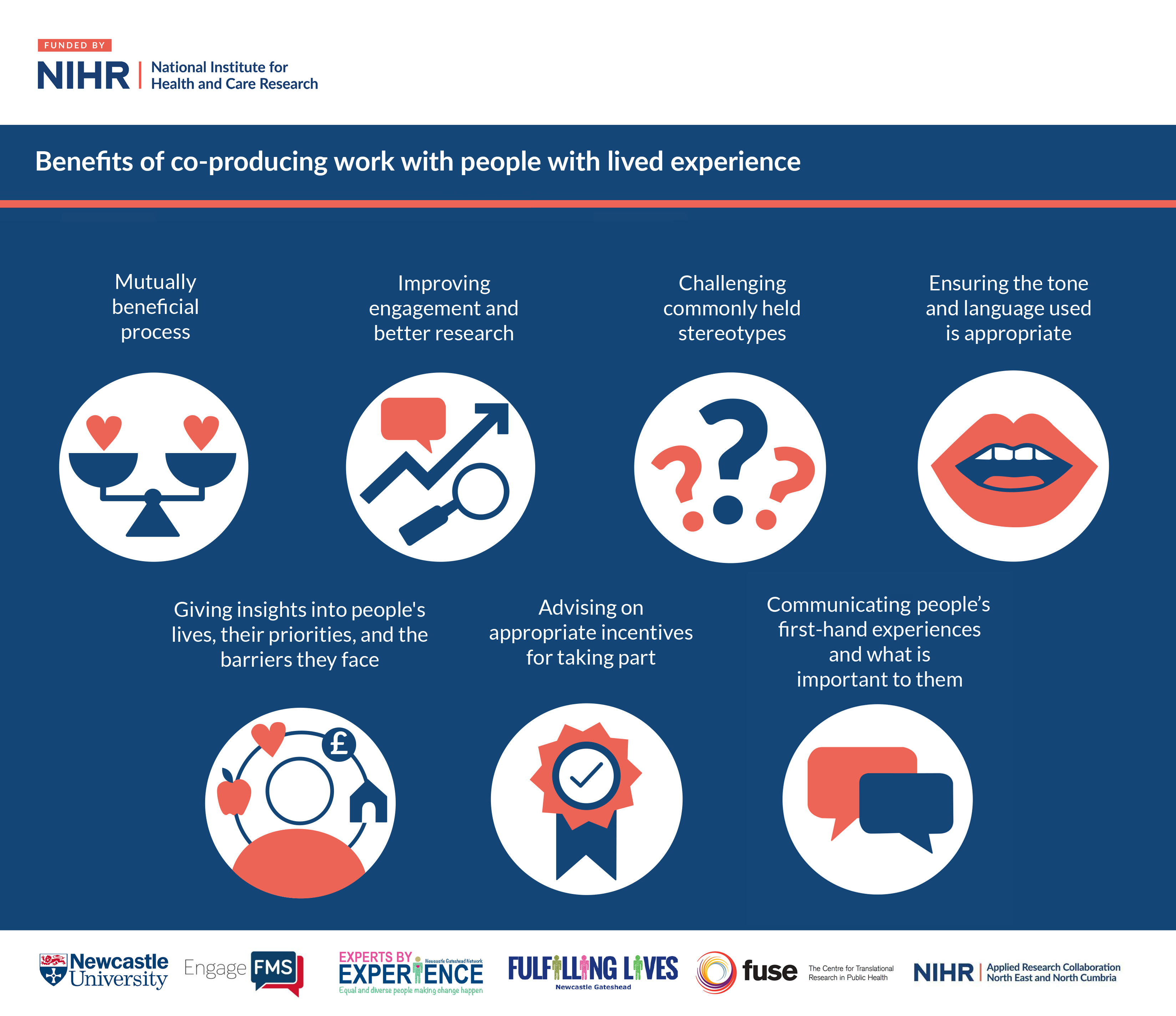
The infographics in this blog show what we have learnt from this process of co-creating the video and the value of co-production.


Creating a video provided an easy way in which organisations (such as Crisis, Fulfilling Lives, and other providers) and local Expert by Experience networks could share information about the study.

Those involved in creating the video were able to draw upon their experiences to help shape the content. One of the members of the group shared their experience of the process:
“Some of us in the Network feel really strongly about this issue and have personal experience of it ourselves so we were keen to be involved and share our ideas and opinions.”
Another member said:
“I joined this project because my own oral health has been something I've been embarrassed about in the past so I thought I could add something useful to this work.”
We have tried to map out how we designed our video in the image below.


The video has also been shared nationally with a wide range of organisations that support severe and multiple disadvantage groups in Newcastle and Gateshead, London, and Plymouth to promote engagement with policy and commissioners, local authority, criminal justice system, primary care, and third sector organisations. Producing a video was no easy feat, but it was a simple way of sharing our research with people who are pressed for time. You can check out the video below.


A clear benefit of engaging with people with lived experience was having their input on how best to communicate our research widely. They provided real-life stories and examples, which helped create the narrative for the video. They helped challenge stereotypes of ways in which people can be portrayed in research studies - this resulted in modifying the images and language used in the video which were much more realistic and sensitive to the people we were wanting to engage. This has helped our research team become more aware of and appreciate the importance of stereotyping and how it can result in putting people off taking part in research.

The benefits reached beyond the research team and the video (the below infographic highlights some of these), as many of the Experts by Experience echoed how involvement has led to them feeling empowered and one member wrote a blog about their experience.


We plan to build on this collaboration as we continue our research and gain further input on findings from our study and next steps.


This study ‘Improving the oral health and related health behaviours of adults experiencing severe and multiple disadvantage: evidence synthesis and qualitative stakeholder research’ is funded by the NIHR Policy Research Programme (grant reference NIHR200415). The video was supported by Newcastle University Engage FMS. The views expressed are those of the author(s) and not necessarily those of the NIHR or the Department of Health and Social Care.

Friday, 2 September 2022

Levelling Up: welcome news or overly ambitious and unrealistic?

Posted by Chloe Beck, Health and Social Care student, Northumbria University

Before his resignation, Boris Johnson unveiled his flagship ‘Levelling Up’ plan. Hailed as the ‘defining mission’ of his Government, this new plan strives to transform the United Kingdom by increasing opportunities and prospects for the whole population. It aims to shift Government focus onto the so-called ‘forgotten communities’ of Great Britain, through a decade long project consisting of twelve missions that have been given status within UK law. Although changes are now afoot in the Government, both candidates to replace Johnson - Liz Truss and Rishi Sunak - have stated their continued commitment to the policy. It seems therefore, that levelling up is here to stay (for a bit longer at least). But what might this mean for inequality in the UK and are its goals likely to be reached?

Levelling up fund boost for historical landmark and high street in Yarm (cropped)
Rishi Sunak visiting Yarm in North East England, December 2021
As might be expected with such a bold promise, the Levelling Up plan has been both welcomed, and branded as overly ambitious (Wood and Swift, 2022). Some see the policy as a serious attempt at understanding and reacting to the regional inequalities that exist within the United Kingdom (HM Government, 2022; Wood and Swift, 2022). Supporters view the policy as a sensible plan, with missions that are collective and recognise the links between health, skills, education and the economy (Wood and Swift, 2022). It’s certainly clear that Levelling Up promises some huge and much needed changes to healthcare services and for the population within the UK (including upgrades to hospitals, increased GP appointments, new fruit and vegetable prescriptions to help tackle food insecurity, changes to the school curriculum to support healthy eating, and community hubs to tackle diagnostic backlogs). Whether these changes are do-able in the context of continued staff shortages and already under-funded health services remains to be seen.

The Labour party has described Levelling Up as a rehash of recycled policies (Harari et al., 2022), with others stating that it is too aspirational and impractical (Pope, 2022). It is argued that the policies breadth and scope may make it hard for the Government to maintain focus and could create a scattered approach (Newman et al., 2022; Pope, 2022; Wood and Swift, 2022).

One of the major problems appears to be a lack of long-term funding into the whole Levelling Up plan, with funds only extending to 2030 (Swinney, 2022). Levelling up may not be fully achieved if funds dwindle once 2030 comes around. Calls for Government to extend Levelling Up plans beyond 2030 (Swinney, 2022), to ensure its longevity and successfulness are unlikely to be met, especially in a political environment where short-termism is the norm and where the maximum term of a Parliament is five years (Marsh, 2013). Likewise, critics suggest that an agreement needs to be made between political parties to ensure Levelling Up is not scrapped once a new Government comes into power (Davenport and Zaranko, 2020; Swinney, 2022).

Even despite levelling up actions, differences in productivity between areas within the United Kingdom will likely remain (Atherton and Webb, 2022). This is because different places have different roles within the economy, with London being top of the chart for professional services, and Wales for the manufacturing sector for example (Sykes and Lisle, 2021). Setting area specific goals and targets (Atherton and Webb 2022), and implementing types of spending (Mason 2022) which take into account the specific demographics and economy of an area may help to combat this issue. Though, of course, this local variation may pose alternative challenges due to mixed ideologies and inconsistency with ideas laid out in the original white paper.

Setting aside concerns about feasibility, it has also been found that many disadvantaged areas are not prioritised within the plan (Atherton and Webb, 2022). This demonstrates a lack of attention and care towards the very thing that the plan is aiming to fix: inequalities! Data journalists at The Guardian found that some of the most deprived localities are receiving far less financial support than some of the most affluent areas, with Bromsgrove in Worcestershire receiving £148 per person and Knowsley in Merseyside receiving no money per person for example. This chimes with Rishi Sunak’s comments about redirecting funding away from disadvantaged areas and towards wealthier towns.

Overall, the new Levelling Up plan has both its positives and negatives. It is a clear start at aiming to try and reduce longstanding inequalities within the United Kingdom. However, the extent to which these policies will be followed as they have been set out is unclear, and only time will tell whether it manages to achieve its missions and ‘level up’ the country.

The cynic in me thinks that this push for equity may also have something to do with attracting votes...


Part of our Fuse blog Student Series
The Fuse blog Student Series showcases posts by students who have been challenged to write a blog as part of their studies at one of the universities in the Fuse collaboration, the NIHR School for Public Health Research, or perhaps further afield. The authors may be new to blogging and we hope to provide a 'safe space' for the students to explore their subject and find their voice in the world of public health research.


The views and opinions expressed by the author are those of the author and do not necessarily reflect those of Northumbria University or Fuse, the Centre for Translational Research in Public Health.

Image: HM Treasury, OGL 3, via Wikimedia Commons