Thursday, 31 May 2012

From PhD to PI in ten 'easy' steps

Posted by Martin White

Recently I’ve been reflecting on what it takes to make it in academia. In part, this was prompted by an invitation to take part in an event at the UK Society for Behavioural Medicine conference last year. ‘Senior’ academics from a range of disciplines formed a panel to take questions informally over lunch from a baying mob of PhD students and post-doc researchers.
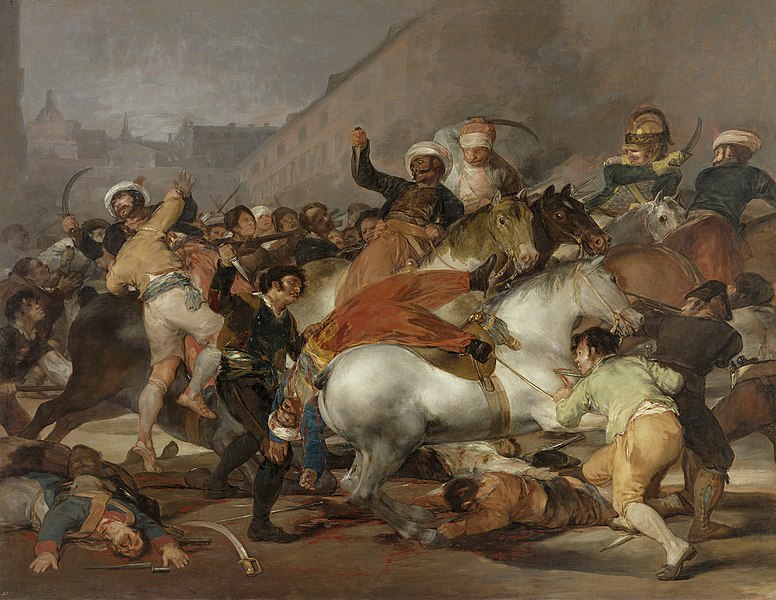
The baying mob: El dos de Mayo de 1808, by Fancisco de Goya y Lucientes
The questions primarily focused on career development and how to achieve rapid and effective progression. The members of the panel were readily able to identify ways in which their careers had been atypical. But despite our idiosyncrasies, we agreed on many pieces of advice.

Here's my top ten tips for success:

1. Get a doctorate early on in your academic career – preferably while you are young and need less sleep, and while you can tolerate a student stipend for 3-4 years.

2. Learn to work independently, demonstrating that you have an enquiring mind and are able to define original research questions. This is the foundation of academia and one of the X-factors which will set you apart as PI material.

3. Learn how to write well, for both scientific and non-academic audiences. Get advice or training on how to do this. Practice every day (e.g. by writing blog posts - Ed.).

4. Publish your work. Start while you are doing your PhD - leaving these papers until later creates a backlog which you may never be able to tackle. Writing papers before the relevant thesis chapters will help you develop a concise, clear style for your thesis and prove it is of a 'publishable standard'.

5. Get a mentor. Identify an academic ‘hero’, or at least a good role model. Look outside your institution and don’t be afraid to ask very senior  people. They will be flattered and pleased to help shape someone else’s career. Meet with them at least once a year.

6. Be genuinely interested in your subject area; choose carefully! A lack of enthusiasm shows through any veneer you put on for project meetings or interviews.

7. Sell yourself. Think carefully about how you can make a case for your future employment. Make yourself indispensible and demonstrate how you can add value to any team. Take every opportunity to present at conferences, workshops, select committees, etc.

8. Get personal funding. While post-doc research posts, working on other people’s projects, will earn your crust and keep you busy, they provide limited opportunities to hone your skills as a PI. Fellowships are available at every level and will give you incredible freedom to develop and shine as an independent researcher.

9. Collaborate. Spread your wings and make new relationships with the most interesting and brightest people you can find. Involve policy and practice partners in your research whenever possible to help bring relevance and impact to your research.

10. Learn to love criticism – she's your best mate. You will not get anywhere unless you welcome objective peer review and understand how to give and receive it. The best way to learn this is to become a peer reviewer for journals and grant funding bodies. This also carries esteem and will open up doors for you through the contacts you make.

Lastly, enjoy yourself and don’t be afraid to break the rules!

Wednesday, 30 May 2012

Let’s get out of the office and see what’s really happening

Posted by Dorothy Newbury-Birch

When putting bids together for research we have to think carefully about how a project can happen ‘in the field’. We look at the evidence to date and often ask people who are working in said 'field' for advice on how things can work. But is this enough?

I would argue not always – for us to really understand what we are asking people who take part in research to do, we need to get out there and look for ourselves how things could work in practice. For example if I am working on a project where I would like ambulance staff to screen patients for alcohol use disorders how can I really know what normal practice is like without observing it for myself?

Hanging out with an ambulance crew - good fun, good research
I have, to date, carried out observational work for these very reasons, in an Accident and Emergency Department (AED) on black Friday - the Friday before Christmas. I quickly realised that asking AED staff to ask lots of questions about alcohol wasn’t really a good idea. In fact, just getting a cup of coffee that night was barely feasible. However, using a shorter questionnaire, perhaps at the triage stage, might be.

I also spent two weekends with an ambulance crew and learned that paramedics make small talk in the back of the ambulance with a lot of patients whilst they are being transferred to the AED. This makes it an ideal opportunity for research to take place. I also realised that quite a few people who paramedics are called to see, are not transferred to hospital. The paramedics were frustrated about not being able to do anything with these people (another opportunity for research).

I spent a night with the maxillofacial team in AED where I learned that they are slightly separate to the core AED staff and in the main do have more time (yet another opportunity for research). Finally I spent a couple of nights on a project with police and paramedics where I’m not sure what I learned, but it was fun.

Of course, there are loopholes to get through in order to do observational work like this, forms to be filled in (including risk assessments). I am always honest about my reasons for doing the work with the people I’m working with and this is important for good relationships. I always, always take goodies for the team (blueberry muffins, cherry bakewells).

Ultimately I think this observational work means we end up with better research. And it's really, really, really good fun. So give it a try.

Monday, 28 May 2012

Routine Secondary Data

Posted by Lynne Forrest

We all know what a nightmare it is trying to recruit participants for research studies. So if you only have to get hold of some routine data that’s just sitting there, well, that’s going to be much simpler, isn’t it? You’d think....

The plan for my PhD was to look at inequalities in cancer care by linking cancer registry and Hospital Episode Statistics data for lung cancer, and also linking to audit data. This is routine data that has already been collected and so I naively assumed it was just a case of getting ethical approval to access the data, finding someone to cobble the data together and off we go. I wrote an optimistic project timetable where I would get my hands on the data about seven months into the PhD. Eighteen months in I’ve finally got hold of some unlinked data and I’m still waiting for the rest.

I don't work for News International, so what's the problem? Photo: Christian Sinibaldi
So, what went wrong?

I think my first mistake was assuming that just because the data was there it would be easy to get hold of. There are a lot of hoops you have to jump through first.

I thought that what I wanted to do was simple but it turns out that it’s not. This is apparently the most complicated linkage that the cancer registry has undertaken and the bottom line was, nobody wanted to do it. I spend a lot of time begging people to speak to me and basically being fobbed off, in the nicest possible way. Luckily I eventually found a newly-joined analyst who was willing to give it a go. I’m not sure that she’s thanking me now...

Issues then arose of whether the data I wanted might be identifiable. Variables such as date of birth and death are classed as identifiable and individual records are ‘potentially-identifiable’, even if they don’t include identifiable information (which is an excellent catch 22 – they are identifiable even though they are not identifiable...)!

Finally it seemed like it was all coming together. I’d agreed with the registry that they would supply me with anonymised data containing ages rather than dates, I’d made it through ethics, and I’d got some data. But, on checking, not exactly the data I wanted. So, currently I am discussing with the registry how it will be possible for me to calculate survival time if they won’t allow me to have data on the number of days from diagnosis to death. Survival from lung cancer is short and rounding to the nearest year isn’t going to identify survival differences with any degree of accuracy.

The sticking point is that although they are not supplying me with date of death I could theoretically work it out from this information and that makes the data (aaagh!) ‘identifiable’. However, as I don’t have an NHS number, date of birth, or place of death, I don’t know how I would identify anyone from the 140,000 records I have. Plus I’m a researcher, not a News International journalist, and I’m not interested in anyone individually, so I’m not going to attempt to do this.

Can’t I just sign something to that effect and have the data I need please?

Friday, 25 May 2012

Should I do a PhD mum?


I’m about to have a grandchild and am so unbelievably excited about it! My daughter is thinking that she might like to do some postgraduate studies after her baby is born and is starting to worry about how she will manage to be able to do this and have a child. This made me think about what advice I should give her.

I began my PhD in 1997 (not that long ago!) when my youngest was four and the eldest (the now pregnant daughter) was eight. My husband and I made a decision from day one to treat my PhD as a job. I also learnt that the only thing that was going to get me through it all was good, changeable, project management.

At least once a week, the diary would be put on the kitchen table and decisions made about who would do the drop offs (mainly me), who would do the pick ups (mainly me) and who would look after the girls at weekends so I could do some work (mainly him).

Dot's girls. Some time ago.
We didn’t have family locally so negotiations would happen in the school yard about me looking after friends' kids after school one day if they could look after mine another. School holidays were negotiated with friends the same way: I would have their kids for a couple of days (or from 3pm onwards) and they would have mine opposite times. These summer holiday days were fab: I would have three or four kids, we would go off for the day early and be back by about 3pm, then I would go up to the university for a few hours work.

I also wrote five papers during my PhD and attended a few conferences. I can honestly say, that from day one I worked at least 8 hours a day on my PhD - mostly in the office, sometimes at home. In the last year, of course this wasn’t enough and I did have to work at nights and every weekend.

Of course there were sacrifices: I didn’t spend nearly enough time with the kids when they were young. But this was a decision I made and if I hadn’t done a PhD, I would have needed to work anyhow. The money was terrible and there were at least three conversations in the three years about whether I should continue because of money worries. In the end I got a pub job for a few months at nights.

So my advice to my lovely daughter who is contemplating this? Pick a subject and topic that you really believe in, that you are going to be interested in for the time needed. Make a commitment to it and treat it like a job. Remember that your child (my precious grandchild) is a fact and not an excuse for working. You have support on your doorstep from family that a lot of people (including me) didn’t have. Go for it....

Monday, 21 May 2012

On Busyness

Posted by Martin White

Finally, I have committed pen to paper for my first blog post. Why has it taken me so long? The truth is, I just can’t find the time. Sounds like a lame excuse and one that is often interpreted as ‘I just can’t be bothered’. So, just in case you need convincing, here is a snapshot from a recent week.

Monday was a bank holiday. I helped organise and spoke at a two-day multi-disciplinary workshop in Glasgow, the previous Thursday and Friday. Spending the weekend Munro-bagging was a no brainer. Going to the hills is a great way to forget about the pressures of work, but by Monday afternoon, my in-box beckoned and deadlines loomed.

Stob Dearg from Ben Cruachan, Munro no. 79, 5 May 2012 (Photo: Martin White)
Sharing the five hour drive home meant I had time to read a PhD chapter in the car. Stopping for food in a pub allowed the first wi-fi access for three days and the chance to delete a mound of spam and identify priorities. Inevitably, this led to a couple of hours work back at home, responding to emails and assessing key tasks for the next week. I knew there was going to be no time to get all this done when I got back in the office on Tuesday.

On Tuesday I woke at 0555, an hour before the alarm. My brain was already in overdrive so I got up, made tea and tracked the changes on the PhD chapter from the previous evening. My diary was stuffed: seven hours of meetings with two 30 minute breaks.

Everyone wants a slice of my time. Sometimes for my scientific expertise, but more often these days because I can make things happen. I don’t resent this, it’s the nature of the job, but it’s frustrating not to be able to do more thinking, reading and writing.

The meat of my day was two one-hour research project meetings, one face-to-face; the other a teleconference with colleagues in Finland, Holland and the US. The rest of the day was taken up by individuals: helping a post-doc think through a fellowship application, a PDR, helping a senior lecturer work out how get the curriculum time we need for undergraduate teaching. 'The 'fillers' were unscheduled meetings relating to the day-to-day assortment of human and political (small p) complications a director comes across when dealing with staff on a personal level. No actual research, but all essential to keep the research going.

I usually go for a run after work, but having been in the hills all weekend, I ached. So I hung back and ground through the 50+ emails that had accumulated through the day. Then I had to go find my car, which I had left at the garage for an MOT when I went to London en route to Glasgow. Having been away for a week, the fridge also needed replenishing. After the supermarket, I eventually arrived home after 8pm.

Given the choice I would prefer not to work this many hours in a day or a week or a lifetime. But, everyone I know in positions of significant responsibility has a similar workload as far as I can tell. However, there are benefits. The job is incredibly stimulating – I learn loads from the interesting and talented people I meet at every research funding board, conference, research network, centre, school, consortium or project meeting I attend.

More importantly, for the first time in my career, I feel I am beginning to make a difference – in public health policy circles, with research funders, and, most importantly, supporting the career development of my daily ‘fillers’.

Friday, 18 May 2012

A case of mistaken identity?

Posted by Janet Shucksmith

Towards the end of my undergraduate days I was directed to the notoriously duff University Careers Service. With no inclination to follow traditional Cambridge careers – think Burgess, Philby and MacLean spy ring or Cleese, Cook, Fry, Frost showbiz alumni – I told the careers officer that I wanted to make a difference to the world. Lacking information on entry level schemes to Supergirldom, he gave me a leaflet on the UN. Luckily for the world’s population, I grew up shortly thereafter.

Traditional Cambridge career: Footlights, 1981
My grown up understanding is more modest: as public health researchers we should perhaps be content to make small contributions. It is also morally unacceptable to claim more power for one’s work than is sensible when recruiting participants. I remember community education workers telling me how difficult it made life when youngsters naively believed things would change as a consequence of their research contribution – that they would get a dedicated playground with skateboard ramp or a sexual health service. The workers were the ones who had to cope with the let down kids when commissioners shelved our research report in the drawer marked ‘Pie in the Sky’.

Now our participant information letters are tediously correct in pointing out to people that they will get nothing personally from contributing to our research and nothing may change as a consequence. The best we can promise is that they will suffer no harm or detriment to the service they receive. Given this rather depressingly realistic estimate of how unimportant and inglorious research is, it still takes me by surprise that the general public occasionally invests the researcher with power beyond anything I currently dream of.

Lawrence, my PhD researcher, was castigated frequently by the citizenry of Gateshead last year for having singlehandedly introduced the National Child Measurement Programme. Whilst trying to explore the impact of the policy, a number believed him to be the original perpetrator of a rather unpopular regime, and called him to account for not having thought through the impact on children and parents.

Recently, invited to present research evidence to a local health scrutiny committee, my colleague and I spoke about a specific project on the impact of Human Resources leave policies on carers of those at end of life. At the conclusion, a councillor drew herself up to her full height and demanded to know why I had decided to close their local palliative care hospital? What on earth had convinced her that I had the responsibility and power to do any such thing? Me? I’m only a researcher, madam. You mistake me for someone with power and authority.

My worst case of mistaken identity came when we undertook research prior to the implementation of HPV immunisation. Despite ethically approved invitation letters and information sheets, it became evident that many parents thought we had come not to ask their views, but actually deliver the ‘jag’: despite our lack of medical qualifications or kit. We were more alarmed when it became apparent that many parents believed the vaccination was a precautionary small dose of cancer, and delivered straight into the cervix! The very limited permission we had to explore perceptions was construed by some as being sufficient to allow us to lay their children out and perform an intimate intervention. So much for informed consent?

As a researcher, one often feels relatively distant from the intervention that is being evaluated. But Joe Public sometimes has a great deal of difficulty working out our researcher role and distinguishing us from the rest of the cohort of powerful but unnamed and unspecified authorities who ‘do things’ to them.

Tuesday, 15 May 2012

Academic rivalry

Posted by Peter Tennant

Last month I discovered I have a joke mortal enemy. Less Holmes and Moriarty, more Sylvester and Tweety. I'm a bit sketchy on the details, but according to my (evil?) spies he likens me to Dick Dastardly, chief antagonist of Wacky Races.

Sharing a joke with a fellow early career researcher
Jolly as this example may be (or so I hope), the issue of 'academic enemies' is an unfortunate reality.

Occasionally, two people, or even two research groups, become so attached to their methodologies, hypotheses, or paradigms, that they develop a sort of 'unfriendly competition'. It's actually quite like Wacky Races. Only with fewer flying cars.

I think it usually starts pretty innocently. A slightly nasty conference question. An overly harsh review. Sometimes, both camps are just so attached to their own way of thinking, and so disdainful of the opposite, that the idea of a polite exchange seems somehow inappropriate.

I guess the quest for the truth can sometimes be a very passionate one, despite the stereotype of Scientists as dull and emotionless. I myself can recall several moments when I've called a distinguished researcher an ignorant fool. Admittedly, they've usually just rejected one of my papers. And I would never insult them to their face. That would be immature. Far better to throw a tantrum in the safety of your own office.

Anyway, whatever the reasons, the effect of these rivalries can be startlingly plain to see. [Cue custard pie]. Last year I went to a bizarre talk that provides a convenient example. In it, the presenter discussed a debate between himself and his academic enemy Dr Weedypants*. Although dressed in intellectual fluff, the message was simple: Dr Weedypants is a fool.

It could be true. Dr Weedypants may be a fool (sadly, he was not available to defend himself). But I'm afraid I simply could not listen to the argument. I was too put off by the presenter's pantomine-villain act. This probably makes me a fickle-minded researcher who still needs to learn how to suppress my emotions. After all, despite his pathological tendency towards evil, Dick Dasterdly was also innovator-in-chief. And the MRC don't give out grants for being nice.

*I may have been a little creative with the name here.

Monday, 14 May 2012

Just trying to make the world a better place

Posted by Jean Adams

People who work in public health research seem to have a universal desire to make the world a better place.

Mostly they also have that innate finding-out-new-stuff-is-cool streak that unites scientists of every flavour. But in public health research, getting out of bed seems more about working out how (health) things could be better.
We just want to make the world a better place....


Which is what Fuse is all about: not just finding out how we could, under ideal circumstances, improve people’s health; but also working out how we can ‘translate’ public health research evidence into public health policy and practice to make it more ‘evidence-based’. To use the jargon.

I am grateful to Fuse. Not just because they have paid my salary for the last few years, but also for getting me to think more about the problem of evidence-based policy.

I was also really pleased to be invited to a workshop on Economic Evaluation of Population Health Interventions in Glasgow last week. Admittedly, I was pretty apprehensive before-hand: all I know about health economics, I learnt during an MSc module led by one of the guys who organised the workshop. What could I usefully contribute?

Perhaps I didn’t contribute anything useful. But I did enjoy the workshop – which was very trendily multidisciplinary (maybe I was just a token public health rep?). I particularly enjoyed chatting to an ex-academic, now working for the Scottish Government, who gave me a very candid window into how government works.

Way back when, before I had really thought about it much, I thought evidence-based public health policy was all about educating the policy makers – about what scientific evidence is, how us scientists generate it, and how the policy makers should use it. If we just shouted louder, maybe they would hear us.

This is not an unreasonable approach. So much so, that an eminent science writer has just written a, much-praised, book about it. But it only takes a minute reflecting on the minimal effectiveness of health education in changing behaviour, to work out why it might not work.

Of course policy makers, and politicians in particular, take more into account than just scientific evidence of what ‘works’ when they make decisions about what they should spend our money on. Which is where the health economists come in. If we can’t convince them with straight-up ‘what works’ arguments, perhaps we can appeal to their mercenary instincts and convince them with arguments about what might save money. But this is just more-better education.

So what can we do? My first suggestion is that instead of trying to get policy-makers to think more like scientists, us scientists need to start thinking a bit more like policy-makers. And what my loose tongued academic-turned-civil-servant-health-economist reminded me of last week, was that we don’t elect our politicians on the basis of whether or not they are the sort that might be ‘evidence-based’. We elect them on the basis of ideology.

Perhaps, the only way to change policy is to appeal to ideology. Blitz the broccoli-evidence, mix it up with some yummy-ideology, and slip it down the hatch airplane style.

Wednesday, 9 May 2012

Waiting and hoping

Posted by Jean Adams

So many things seem to take so long in research that I often find myself just waiting. Just waiting and hoping.

Obviously, I don’t just sit and wait and do nothing. I manage to find important and useful (I hope) things to fill my time whilst I wait. But at some deeper level I really am just waiting and trying not to be too distracted by the waiting.
 
Ian McKellan & Patrick Stewart in Beckett's 'Waiting for Godot', by Tristram Kenton

At the moment the waits that are preoccupying me most are decisions on a grant application and a paper.

The decision on the grant application has been made. I know this because the administrators were good enough to let me know that the funding board would meet to make a decision on 18th April. But then the decision would have to be ratified by the Department of Health, which would take about four or five weeks.

I know this all makes sense to somebody. And I know I can’t do anything about it. But come on! Five weeks to tell me about a decision that has already been made? After three months to make the decision. Is this supposed to be death by waiting? The researcher who can wait the longest without complaining gets the grant. I lose.

The paper is bothering me much more. Which is odd. If I don’t get the grant, there are no other options for funding the research. It just wont happen and that will be a couple of months of work down the drain. But if the paper isn’t accepted, I can try another journal. It’ll get published somewhere eventually (I hope). But I really want it to get published where I have sent it right now.

It isn’t even a research paper. It’s one of those 2000 word ‘analysis’ papers (AKA rants) saying something we’ve all thought for a while, but which only I had the patience to write down. Which makes it a bit like modern art – yes, anyone could have done it, but they didn’t.

The electronic submission system at the journal has flags to tell you what’s happened to your paper so far. They are pretty sparse, but informative enough to piece together a little story of my paper’s journey. It seems that my paper was initially considered by an editor who wasn’t quite sure about it and so sent it to another editor for a second opinion. But the second editor wasn’t sure either and so sent it to a further editor for a third opinion.

So far, not too promising.

But then the third editor (who maybe was a bit more senior than the other two and so found the decision easier to make?) agreed that the paper should be sent for peer review. Right now, the system tells me, the editors are looking for appropriate peer reviewers.

Which is nice. I have my fingers crossed for my little paper rant. I shall go on waiting. And hoping.

Tuesday, 8 May 2012

Another good yarn

Posted by Avril Rhodes

What a relief! After fretting that I would never be able to contribute to the Fuse blog (I mean what research have I ever done?) but feeling vaguely under pressure to produce something, along comes “Knitty Problems” focussing on knitting and meetings, two things that I definitely have a PhD in by virtue of longevity.

Until I joined Fuse I thought I was a member of an almost extinct breed, knitters, which would go down the evolutionary cul-de-sac of many a humanoid predecessor, known only for leaving strange artefacts behind (like circular needles) which archaeologists of the next millennium would think were instruments of torture. 

Believe you me there were no knitters in my old job(s) in the NHS – the last refuge for knitters was older ladies making action man clothing for premature baby units. No-one respectable knitted and certainly not if you had a real job. I kept my secret well hidden for years. In fact when I once lapsed and admitted to having knitted a Christmas crib, a colleague I still manage to call a friend was paralyzed with laughter at the thought of the knitted baby Jesus. What’s funny said I? Haven’t you done the diversity course?

Natty knitted nativity
However after decades I can now come out, because Fuse, and Parkside in particular, is full of academic knitters. My first inkling of this was when someone I didn’t know too well, asked me if I knew a good wool shop in Middlesbrough. These knitters knit in front of TV, on public transport, they even have to remove balls of wool to retrieve mobile phones, and they are happy to discuss patterns and stockists without batting an eyelid. 

But would they knit in meetings??? I’m not sure. I have seen people knitting before a carol service (well actually one person on one occasion) but knitting doesn’t seem to chime with the need to appear fully professionally engaged, or in the case of a carol service respectfully attentive. I personally harbour a desire to knit in conferences and seminars (following the rules, of course as I’d just get frustrated if I got stuck in the middle of a pattern) not because I’m not listening, but to do three things - to take up the spare brain power not focusing on the subject being spoken of, secondly, knitting really helps you not to go to sleep at the wrong times, and, thirdly, it ensures you don’t reach for the sweets or biscuits that still creep in when the public health police are engaged elsewhere. I challenge the reader which is worse – the gentle rhythmical clicking of needles, the embarrassment of snoring in the post-lunch presentation or someone trying to eat a hard biscuit noiselessly? The latter two are insufferable and will do much more reputational damage than being able to show off your latest scarf in the real break time as you virtuously sip water.

So, thank you Jean for helping me join the open-science blog!

Wednesday, 2 May 2012

Writer's block

Posted by Helen Wareham

Writer’s block is something I think everyone can relate to.

I had hit a point in my PhD where I really needed words down on paper. I’d neglected my introductory literature and systematic review chapters for too long and I had to do something about it. So at the end of March, refreshed after a week’s holiday, I made myself a cup of tea, cleared some space on my desk and sat down ready for the words to flow...

There were moments of sheer elation where it all seemed to be coming together and words would flow onto the screen.


Writing god
These were unfortunately followed by moments where I was sat staring at a screen for hours wanting to cry or set it all on fire in despair.

So here’s the big question: how do you get over writers block?

My partner completed her PhD last year and impressively seemed to have days where words just flowed, churning out 5,000 in a day at one point! But, I remember these days well. Entering her PhD shed (yes we had to build an outdoor office so she could work without distractions in isolation) I would be faced with empty bags of Haribo, bourbon biscuits wrappers, empty boxes of pro-plus, the odd glass which had contained a large measure of alcohol and Kirsty hunched over her laptop with a look on her face something akin to a squirrel on crack.

So whilst I was desperate, I thought it might be best to leave the avenues of excess sugar, caffeine and alcohol for my final months (I don’t want to peak too early).

"You’ve just got to get on with it Helen. Just keep going and if something helps go with it", were Kirsty’s words of wisdom.

What transpired for the last month was me working in different locations (including other peoples offices), succumbing to drinking masses of coffee, writing some despairing facebook statuses and various other little things to try and get through that mental wall.

Am I over my writers’ block? Have I found a magical fountain of inspiration? No, is the simple answer. But every day the word count went up a bit and eventually I hit the word target I’d set myself. What I’ve written isn’t amazing but I have words on a page and that’s what I need right now.

It’s seems a bit stupid to be so at the mercy of a simple brain freeze and it’s frustrating to not have any idea why and how these things happen or when they are going to pass. But I’ve come to think that the key attribute needed for success in completing a PhD is shear bull-headed unwavering persistence that you’re going to get through it. If along the way simply grasping desperately to anything that remotely helps, however silly and destructive, is what works then I’m just going to have to go with it and get on. My closing confession as to what helped the most over the last month...this picture and Britney Spears greatest hits on repeat.


Tuesday, 1 May 2012

Knitty problems

Posted by Jean Adams

My name’s Jean and I’m a knitter.

I am also a crocheter, sewer and quilter. I’ve tried my hand at upholstery and if anyone ever bought me a spinning wheel, I imagine I could get quite into that too.

I do these things because I like making stuff. I don’t always like the things I make. But I really like the process of making. Sometimes I like making things that require all my concentration and attention. Other times I’m happy just to mindlessly plod through a simple pair of socks or ripple blanket.

One of my many crochet blankets
I can totally mindlessly knit a sock and, at the same time, leave substantial brain space free for conversation, watching TV, listening to the radio, or doing the crossword. Obviously I would have to put my knitting down to fill in the crossword, but that’s not impossible. Me and my knitting aren’t absolutely inseparable, you know.

So here’s the question: would it be appropriate for me to knit in meetings?

Obviously, I’m not suggesting that I knit during a meeting that I’m chairing, taking notes for, or being asked to make some other types of substantial contribution to. But those sorts of meetings make up only about half of the things I go to.

Think of all those meetings which you just have to go to, but you learn almost nothing and almost contribute nothing. Knitting in these feels like a sensible option – at least I’ve used the time efficiently. Unlike the next best alternative of playing on my phone, at least when I’m knitting I can also listen, keep track of what’s going on, and contribute if I need to.

Then there are the things like seminars where I often learn something really interesting or useful, but again I don’t really need to contribute anything. Surely it would be okay to knit in those too?

It’s not like there aren’t other people who do crafty things in meetings – with very productive results. There are even other academics who knit in meetings in a very public way. And rules for how to do it right.

Sounds like I’ve almost talked myself into it, doesn’t it?

But the problem is, I’m worried about what other people would think. I guess there might be all sorts of responses to meeting knitting, but the one I’m most worried about is that people might think it’s unprofessional. Somehow playing on your phone can indicate that you’re a very busy person with important other stuff to be doing. Which just reinforces how very professional you are. Whilst knitting indicates that if you weren’t here you might be baking fairy cakes. Which is not what us serious academics should be doing at all.

Thursday, 26 April 2012

Out of focus

Posted by Jean Adams

On more than one occasion I have been told that I’m not focused enough.

My annual appraisal almost always includes comments like: “You’re interested in too many things”; “there’s no coherence to your CV”; “it’s not clear exactly what you’re an expert in”; and the most damning of all: “I can’t tell what the one thing is that Jean Adams would be the only person to talk to about”.

Expectant blur, by Martin White
Well, since you asked, the one thing that people consistently want to ask me is how to convert postcodes into Index of Multiple Deprivation scores. I can’t possibly be the only person in the world worth talking to about this, but it seems I’m the only person in the building I work in. Or maybe just the floor. I like geeking around with IMD scores as much as anyone, but really, that is not the one thing I want to be known for.

I don’t always do what I’m told. But I do try to listen to what I’m told – especially when I’m being given career advice by my elders and betters. So I have spent quite a while pondering on the issue of focus and how much of a problem my lack of focus might be.

Just for the record, I don’t think I’m massively unfocused – there are maybe three or four different things that I am totally excited by (right now): food advertising, inequalities in health caused by public health interventions (p65), and the role of time perspective in driving health behaviours. So that’s only three. They’re all about public health, so not totally disparate. I’m just not the sort of person who spends years only thinking about one aspect of one problem in one population group.

Which is not to diss my colleagues who have spent many years doing just that. I suspect there are many problems that do need concerted, uninterrupted thought and dedication. I’m just not the right person for that sort of work. In fact, I think such focus would induce severe boredom in me pretty quickly. Even with my totally unfocussed three things, I do sometimes get pretty bored reading the same sort of studies again and again: most food advertising is for bad-for-you food, we don’t need any more confirmation.

I think there might also be genuine academic benefits from at least some people in the team having a slightly wider perspective. I might not know absolutely everything about anything, but I do know quite a bit about a bunch of different things – enough to not be taken as a charlatan by the people who know everything. This means that I can engage with quite a lot of different people and it helps widen my perspective even more. Which in turn, helps me see problems from a variety of different angles, bring fresh solutions, and build links between – you guessed it – apparently disparate issues. This is the stuff that multi-disciplinarity is made of.

Which leaves me wondering why my lack of focus bothers other people so much.

Wednesday, 25 April 2012

A room of one's own

Posted by Stephanie Clutterbuck

I have never read "A room of one's own". But I thought it made a snappy title for a blog post so I did what any self-respecting early career researcher does when she wants to make sure she is not talking complete nonsense- I Wikipedia-ed it. Turns out it fits quite nicely. You see Virginia Woolf believed that "a woman must have money and a room of her own if she is to write fiction". And although I have no interest in writing fiction I can see her point, a woman must have participants and a room of her own if she is to do science.


Virginia Woolf, by Frederico Novaro

There I was, March 2012, a bright-eyed PhD student confident in my experimental design, armed only with some predictions and a dream. Against my better judgment I believed that data collection in schools would be easy and as long as I asked nicely for ‘a quiet room’ my wish would be granted leaving my data collection to roll merrily along, untainted by extraneous factors.

Fast-forward two months, seven schools and 200 participants later and I have learned an invaluable lesson: schools have very different definitions of ‘a quiet room’.

At my first school I was shown to an open corridor where I was told I would run my experiment. Admittedly, I had to suppress my inner toddler from stamping her feet and screaming ‘This is NOT a quiet room!!’, but I made do. And in fact it would have worked well if the corridor wasn’t simultaneously being used as a makeshift studio for yearbook photos. And then as a meeting place for all the Year 5 boys to earnestly discuss the moral implications of stealing the Year 6’s football during break. To be fair it was a lively debate and I could see their point, why should the older boys get the ball - isn’t that ageism?

Still, data collection continues to roll along in various schools and I have become adept at managing my inner meltdowns regarding the unreality of tightly controlled experimental conditions outside of the lab. I was able to force a smile when a teacher barged into my quiet room (which happened to also be a kitchen) and rattled the contents of every drawer and cupboard in search of a knife to cut cake. And I have learned to tune out repeated renditions of ‘Kung Fu Fighting’ and ‘Heart and Soul’ sung by jubilant five year olds in nearby music rooms.

Fortunately, for my sanity, I feel data collection enlightenment is within reach. The other day I unflinchingly accepted that there was nothing I could do about the man in muddy overalls wielding a shovel and walking through my quiet room. Twice.

Tuesday, 24 April 2012

The art of conferencing

Posted by Peter Tennant

This week, I'm off to a conference. And I'm rather excited. Partly because it looks like an interesting programme. Partly because it means two cooked breakfasts, three days away from my ethics application, and the promise of at least one authentic Birmingham curry.

After publishing papers and getting grants, 'conferencing' (to coin an evil new verb) is probably third on the list of core research duties. But so far I've found it one of the trickiest and emotionally exposing. For three days, I'm representing myself and my University. Whether I'm giving a talk, chatting to a fellow researcher, or scoffing a pile of biscuits alone in a dark corner, I'm aware I'm on display and potentially being judged. Which is particularly stressful if, like me, you suffer from Foot-in-Mouth Disease.

Of course, this (rather optimistically) assumes anyone is interested. More often than not, my main struggle with conferencing has been the feeling that no-one cares. At my first conference, I remember diligently standing next to my poster, nervously anticipating an inundation from hordes of eager researchers. Instead, after a few hours and only a short chat with a gentleman who couldn't find the toilet, I eventually trudged off to a dark corner with a pile of biscuits.

Conference posters, by Marco Delmastro
At it's worst, attending a conference as a junior researcher can be quite deflating and isolating. Especially given the senior staff seem to live in a different world, dominated by something called 'networking'. Or gossiping (as far as I can work out).

Thankfully, things are getting easier. The best conferences (including the one I'm going to this week) run special events for junior researchers, so they can escape the world of networking to share their mutual confusion, make a few friends, and hopefully have some fun.

Meanwhile, I've discovered that at least some of my conferencing problems were down to unrealistic expectations. I once had a conference ruined by orders to 'return with at least one new contact per day'. It was the most self-defeating instruction I've ever received. Not only did it make me nervous every time someone initated conversation (Potential contact! Potential contact!), but it also removed my permission to relax. It didn't matter how well the rest of the conference went, if I didn't make my quota of new contacts, I had failed.
So this week I'm just going to relax and take it all in. If I end up making some new friends, great. If I deliver my talks without making the audience vomit, even better! And if none of these things happen, there's always the biscuits...

Monday, 23 April 2012

Open planning

Posted by Dorothy Newbury-Birch

I remember quite vividly the first conversation I really had when discussing moving from my lovely single office in our old building to the big open plan office space in our new one. It was with the then Head of the Institute who said that although it hadn’t been decided where everyone was going to be based in the new building there had been discussions that myself and our team would be in the 10 desk room at the other end of the building. I’m not sure if he was joking but I understood why he would say it! You see, it isn’t a surprise to me, I know I’m loud; I only have two levels, loud and very loud! – I try to be quieter and sometimes achieve it but I do find it very, very hard.

So here we were in our room at the other end of the building away from the quiet side. We settled in well, there’s no denying it’s loud but it’s productive and fun and also, when needed, quiet. Then......... I got a new job – I’m now a lecturer and my role has changed. It was time for me to go into the big office space with around 40 people. I’m not sure who was more nervous, the other 39 people or me. I felt like the new kid at school. I decided I’d let them in gently. I hot desked for a couple of weeks – and I saw it - the fear in their eyes. Dot is here! After feeling I’d let people in gently I arrived full time, with my flowers and my photo’s and my nic-nacs. What did I find?

Bjork: It's oh so quiet
I found, in the main, silence and for me this is stifling. I find myself at times wondering if I’m tapping my keyboards too loudly. I feel tension a lot of the time. I make phone calls at my desk and talk to my team when they come through to see me but others don’t and for me it’s strange. Don’t get me wrong, we all need quiet sometimes (and that’s what I think the quiet rooms and headphones are great for) but I do think that if we lightened up a bit and chatted a bit without worrying too much then I think we would achieve more and work could be a bit more, dare I say it, fun! Yes we’re busy, and I’m not suggesting we do the salsa around the desks (well actually..........) but since moving into the new building I have collaborated with more people than ever before and that’s fantastic for me, them and research more generally.
So, when passing my desk, say hello; ask how my day is; admire my flowers. I’ll tell you if I’m too busy to talk now and perhaps arrange to have a coffee later but please, talk to me and each other.


Friday, 20 April 2012

Naked science

Posted by Bronia Arnott

Fear of public speaking is a common anxiety and when I mention it to others a frequent response is “Just imagine the members of the audience naked”. Clearly the people dispensing this advice have never given a presentation in their life, as surely imagining a room full of naked people is only going to make you laugh! And while I am all for including humour in my presentations, being doubled up with laughter imagining my colleague in their birthday suit isn’t quite what I was aiming for.

Female nude, by William H Johnson
I do use humour in my presentations, as talking about dual process theories can be a bit dry. But it is a delicate balance. After all I want to ensure that the audience is laughing with me not at me. And I want the audience to remember the take home message of my research, not some knock, knock joke.

I have been told that I need to maintain the attention of my audience throughout the presentation, to ensure that they don’t end up taking an afternoon nap during the crucial but ever so slightly dull section on the statistical analyses. There are many ways to do this according to the lastest advice; I try to relate things to real life examples and change the tone of my voice (although I haven’t perfected the ‘you in the back row pay attention’ intonation perfected by those in the teaching profession).

I have been very tempted to do a Prezi presentation – they promise to make your presentations zoom. Unfortunately, they have a bit of a reputation for causing motion sickness in your audience. And if there is one thing that puts me off giving a talk is a member of the audience being sick in the aisle.

I am a very visual person though, so I also use quite a lot of pictures in my presentations. And searching google images is a great distraction from actually writing the talk! Plus the advice from those in the know about public speaking is that lots of text on your PowerPoint slides means that the audience read what is on the projector screen and don’t listen to what you have to say. Although sometimes I do wonder if that scenario would be better for us both. After all if the audience are looking at me, they might be imagining me naked…

Thursday, 19 April 2012

Submission

Posted by Jean Adams

A couple of weeks ago I was all set with an all-but-finished grant application sitting on my hard drive just waiting to be submitted when I got back from holidays. Yep, I was feeling pretty damn smug with my ‘done three weeks ahead of the deadline’ situation.

The submit button by Johannes P Osterhoff

The plan was that I would head off on holiday for 10 days. Whilst I was away, the university would do its thing, checking that I had included enough money for light bulbs and that I wasn’t planning on setting up a nuclear war head factory in the basement. Then I would come back and pack up my application, complete with university stamp of approval, and send the whole lot off to the Economic and Social Research Council for their consideration.

As it turns out, this was holiday spent destroying Leyland Cypresses at home, rather than traversing mountain ranges. [Wow– did you click that Leyland link? Turns out they were developed in Northumberland. Makes me feel slightly dirty by association.] I was, in a casual not really paying attention way, checking my email every day or so just to see what was going down. Generally, nothing much. But then on Friday I got an automated message saying my application had been rejected by the university.

Smug superiority extinguished. Serious panic situation ignited.

What am I supposed to do? What does rejected mean? Does that mean three months of work out of the window? I should probably go in to work to sort this out. But I can’t – my clothes are filthy, I stink of bonfire, I at least need to take a shower before I can go in to work. But it’s an emergency. I think I need to go.

Then I noticed the email from our finance assistant explaining that she had needed to make some minor changes and the only way to do it was to formally reject the application and re-submit for university approval.

Ok. Deep breath. We’re fine.

Tuesday rolls around. I’m all cleaned up and back at work. We have been through two more rejections and I’m starting to get used to them. But my grant still hasn’t been approved for submission. My co-applicant is starting to ask questions about what’s happening. I’m embarrassed that what was such a regimented enterprise has gradually collapsed into a dysfunctional blancmange.

And what are all these rejections about? Oh just little things like should the software licence be listed under directly allocated or directly incurred costs. Don’t ask – I have no idea and just do what I’m told. But the upshot is that I have spent a lot of nervous energy on things that I really want to say don’t matter. Although I guess they must do or else people wouldn’t be worrying about them.

All I want is a little bit of money to do a little bit of research that will hopefully be at least a little bit interesting and a little bit useful.

Wednesday, 11 April 2012

Just one comment

 Posted by Jean Adams

The comments have arrived.

Or, to be more accurate, the comment, singular, has arrived.

After deciding to respond to a call for applications for research funding, assembling an appropriate team, drafting the application, redrafting the application, filling in the accompanying form, redrafting the application again, and getting the whole thing through the university’s financial scrutiny, I finally submitted my application in early January.

And then there was radio silence.

For two months I heard nothing. I even sort of forgot about it.

Then a month ago, I got an email out of the blue telling me that the application would be sent for peer reviewed by “independent experts”. Which isn’t a bad thing. In fact, given that any application awarded funding has to be peer reviewed, being sent for peer review is definitely a better thing than not being sent for peer review. But the real gist of the email was that after peer review, I would be given an opportunity to respond to any particular questions that the reviewers had before the final decision on funding was made. There were clear instructions that there would be a “tight turnaround” from me being sent the questions to having to submit a response. When exactly this would occur was not specified.

This whole grant application thing is full of dramatic pauses, tight turnarounds and suspense.

But the waiting is now over. The comment has arrived. The turnaround is less than a week.

The comment runs along the lines of “this is an interesting idea and the methods look great, but I wonder if the sample size should be just a little bit bigger”. Which sounds like a fair comment given how much us researchers love arguing about what makes an appropriate sample size.

The thing is that my application had quite a long and detailed section on why the sample size chosen was just right. So now I find myself in a position of having to humbly, and politely, respond to the comment in a reasoned and careful way. When what I really want to do is scream: “Can’t you read? The sample size is justified in exceptional detail on page 13. You idiot.”
My Linus-neurotic streak isn't happy
But what is really bugging me is that there was just one comment. My neurotic streak doesn’t seem to like the idea of this at all. I know that the application will have been sent to more than one peer reviewer. So why did only one of them send a comment? It’s impossible that other reviewers thought the whole thing was perfect – academics just aren’t like that. Did the other reviewers feel that the application was so irredeemably bad that any response to comments I made wasn’t going to make any difference? What, exactly, is going on behind the scenes that I don’t know about?

I sent the comment to my co-applicants for their input, and because I hope they are less neurotic than me and might say something encouraging. The response:

“Just one comment? Is that a good sign?”

Tuesday, 10 April 2012

How fast can you read this post?


Posted by Alison Innerd

I am a competitive person.

When it comes to reading speed I think I am definitely the winner in my household. If my partner and I are reading something together I always end up twiddling my thumbs whilst I wait for him to finish. So when I recently attended a speed reading course it crossed my mind that it could be a waste of time. I am clearly already the Usain Bolt of reading. 

Alison Innerd - the Usain Bolt of the reading world?
Oh dear, how wrong I was! The first task was to read a piece of text for full comprehension, at normal pace for one minute and then count how many words you had read. I totalled 280. Which is within average (just) but others were getting double my score. Suddenly I felt like the ‘slow’ one in class. In my defence, other people on the course were professors so obviously a PhD student would read a lot slower. That was my excuse anyway.

I went on the course because I thought it would be brilliant to read my huge pile of journal articles in as little time as possible. Now I’m wondering whether this is a sensible idea - surely if you read fast you miss important information? Well, apparently that is not true. The trick is smooth reading. You want your eyes to focus on the words and not skip around or get distracted.

Here is the scientific bit: you have two sets of muscles in your eyes which control the lens and motion. If your eye muscles are jerky, you miss sections or read a section twice which makes reading confusing. If your eyes demonstrate smooth motion and lens control you keep presenting a steady stream of information to your mind. Maybe it is a bit more complicated than that. But it makes sense to me.

To read smoothly, ideally you need a pacer or a reading weapon such as a pen, your finger or a chopstick. Basically anything which is pointy enough to run under the words. You get your reading weapon and run it either under each word or along the side of the page. This stops your eyes from jerking and increases comprehension.

This might sound a bit ‘primary school’ but give it a go and see what you think. I used a pacer in the first task (without being told to) so I was slightly concerned with my poor performance even with the super powers of a reading weapon.

As with all physical skills you also need to do eye training. You are meant to practice speed reading every day. And yes, you do get eye ache! We were given a 25 day speed reading training programme but needless to say I have not adhered it, although I do keep telling myself I must start.....