Thursday, 27 February 2014

52 weeks of public health research, part 8

Posted by Bronia Arnott and Simon Howard

From Bronia Arnott: Healthy snacks for a meeting at the Human Nutrition Research Centre.

From Bronia Arnott: not so healthy snacks when it is my turn to cater a meeting.

From Simon Howard: the newly opened Beautiful Science exhibition at the British Library which charts the history of data visualisation, including a whole (brilliant) section on public health. 

From Simon Howard: this cartogram is from the Chief Medical Officer's forthcoming annual report, which I'm editing. It represents the number of fast food outlets per person at local authority level (darker = more), with the area of local authorities distorted to be proportional to the population. It raises really interesting questions about association with obesity, and shows the complexity of public health - we know there's an association between population density of fast food outlets and deprivation, but there are also weird outliers like Westminster, which is likely related to tourism, and coastal towns, which is likely related to fish and chip shops.


------------------

Just to remind you:

Each Thursday of 2014 we’ll try and post around four pictures on the Fuse blog that capture our weeks in public health research, from the awe-inspiring to the everyday and mundane. Given that more of the latter than the former exists in my life, I foresee problems compiling 208 images worth posting on my own. So this is going to have to be a group project. Send me an image (or images) with a sentence or two describing what aspect of your week in public health research they sum up and I’ll post them as soon as I can. You don’t have to send four together – we can mix and match images from different people in the same week.

Normal rules apply: images you made yourself are best; if you use someone else’s image please check you’re allowed to first; if anyone’s identifiable in an image, make sure they’re happy for it to be posted; nothing rude; nothing that breaks research confidentiality etc.

Also, this doesn’t mean we wont also be posting words. You word-based posts are, as always, much appreciated.

Tuesday, 25 February 2014

A blow for translational research – you eat what you (l)earn

Posted by Avril Rhodes and Mark Welford

Congratulations to CEDAR for making the National Diet and Nutrition Survey interesting and fully translated for ordinary people (muggles) like us. Take a look at the February CEDAR bulletin and the infographic illustrating what people eat proportionately more of by income and education, and we guarantee happy hours of wondering who fits into each box, whether the dietary stereotypes you held are correct or not, and dreaming up the ideal meal (culturally) for each sub-group. This is a wonderful case of the picture holding your attention so much more effectively than a written report would do on the same subject, and yet, the picture itself bringing together all kinds of data in one place. A challenge to academics – this is intellectually respectable enough for CEDAR, so what of your Fuse work would lend itself to the same treatment?

Food, income and education: who eats more of what? Foods appear only if they are consumed in quantities significantly greater than that of the UK population as a whole. 
And then you get to the fun part…..

• Fetch my gun, Jeeves. Clearly with all those game birds and smoothies being downed by the high income high education group there must be a new marketing opportunity for pheasant smoothies. Heston, move over!

• And what about the high income, medium education group, tucking into a hazelnut coated prawn or maybe fish rolled in sesame seeds? The boat certainly came in there.

• Having dinner with a professional footballer or Lord Alan Sugar? For the high income, lower education group save all your energies in the menu planning for the pudding – I’d recommend the most wine drenched trifle recipe you can find, or if it’s Christmas a boozy Christmas pudding would be just right.

• The middle of the chart – middle income and mid-range level of education are a real puzzle – average apparently for so much apart from the consumption of spirits and liqueurs, can anyone explain that?

• More tea vicar? The clergy must be in the low paid high educated square given the consumption of buns, cakes and pastries there, the staples of pastoral visits.

• And the Great British aversion to salad looks right.

And the more serious part…..

Some of our pre-conceived ideas are all too obviously supported from looking at the diagrams about consumption of processed meat products on lower incomes, and a greater variety and higher quality foods at the higher income end. As if we needed it another illustration of inequality in diet income related as much as anything else. Bring on the affordable healthy meal!
CEDAR has demonstrated that research findings don’t have to be hidden away in academic journals gathering dust. Research can be communicated in an interesting, engaging, innovative and exciting way. Along with the traditional methods of dissemination through papers, the media, research briefs, case studies, posters and presentations; how about making an impact using animation, podcasts, comics or even comedy?

Thursday, 20 February 2014

52 weeks of public health research, part 7

Posted by Bronia Arnott, Martin White, Sarah Morgan-Trimmer and Heather Yoeli
From Bronia Arnott: On my way to a meeting to discuss with public transport providers ways to increase more sustainable travel, but my train was delayed and I was late. Isn't it ironic?

From Martin White: Having been President of the Society for Social Medicine for the last two years and overseen the most radical revamp in its history, it was with some pleasure that I saw its new image revealed on Wednesday 5th February 2014. Please explore the site, look at the new newsletter and submit an abstract for this year's ASM in Oxford.

From Sarah Morgan-Trimmer: This is the new healthy snack table in the office that I share with Annie and Catt at DECIPHer, Cardiff. Public health represented in still life!

From Heather Yoeli: I’ve been doing much of my thinking and writing at the Cowgate Centre, which on Mondays is the main ‘fieldwork site’ for my PhD project. I use the desk beside the main CCTV monitors, and sometimes groups of local kids come over to watch one another making faces at the cameras. This is the scene I returned to after I’d asked one of them to 'look after my things for just a minute’…

From Heather Yoeli: My supervision team have not been excessively impressed with my first attempt at a ‘findings’ chapter for my PhD. And so, on my Thursday day off, I took my children to see the fantastic Judith Kerr exhibition at Seven Stories, hoping to inspire us all with some absolutely brilliant writing. As we shared a hot chocolate afterwards, I saw this stripy gift-wrapped shoebox inviting ‘feedback’ on their cafĂ©. Giving and receiving an honest and constructive critique of one another’s work is an everyday part of academic life. I do prefer getting my feedback directly…


-------------------

Just to remind you:

Each Thursday of 2014 we’ll try and post around four pictures on the Fuse blog that capture our weeks in public health research, from the awe-inspiring to the everyday and mundane. Given that more of the latter than the former exists in my life, I foresee problems compiling 208 images worth posting on my own. So this is going to have to be a group project. Send me an image (or images) with a sentence or two describing what aspect of your week in public health research they sum up and I’ll post them as soon as I can. You don’t have to send four together – we can mix and match images from different people in the same week.

Normal rules apply: images you made yourself are best; if you use someone else’s image please check you’re allowed to first; if anyone’s identifiable in an image, make sure they’re happy for it to be posted; nothing rude; nothing that breaks research confidentiality etc.

Also, this doesn’t mean we wont also be posting words. You word-based posts are, as always, much appreciated.

Tuesday, 18 February 2014

Protected time

Posted by Jean Adams
When I was medical student, lunchtime training events were held in most hospitals I passed through. The presence of a free lunch made these high priorities for student attendance. However, I think there was only one hospital that put such a high priority on staff attendance that the time was protected – as signalled by a bleep collection at the door. The sessions were specifically for newly qualified doctors in their first year of practice. Staff deposited their bleeps in a basket outside the training room. If any went off during the session, a secretary would respond saying when the session was due to finish and asking that urgent issues were referred elsewhere. At other hospitals, training was something you went to if you had the time and left early if something more urgent occurred on the ward.

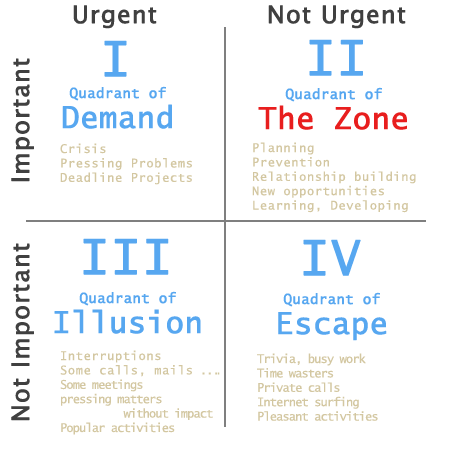
When you go to time management training, they always tell you about the important vs urgent matrix. Some things are important but not urgent, others are urgent but not important etc. The idea is that you identify the not important or urgent tasks and get rid of them. Then you allocate your time to the three other groups of tasks ensuring that the important gets done and you don’t end up focusing solely on the urgent. 

Surely there must be some 'pleasant activities' in The Zone?
Emergencies hardly ever happen in research. Which, for me, is part of the attraction. Lots of important deadlines exist – grant applications, conference submissions. But fair warning is generally given, meaning that it is theoretically possible to stop these becoming too urgent. Many, many other things that need attention crop up all the time. Quite often I find these are of the urgent and certainly important to someone else, but not massively important to me variety.

My – not entirely effective – approach to this is to routinely work at home on a Friday. The idea is that this provides me with one full day per week to focus on extended important but not urgent tasks that matter to me – writing papers, reading and commenting on large documents, catching up with the literature. The reality is that I mostly spend Fridays catching up on urgent and some-what important tasks that have accumulated through the week - nudging my me-tasks to next Friday at the earliest.

Sometimes, when my to-do list gets overwhelming (which is admittedly more often than not), I protect other time too. I schedule in a few hours to do a peer review for a journal, half a day to prepare teaching, 30 minutes to make a phone call that absolutely must happen. At the very least this makes me feel slightly calmer that there is definitely time available to do everything. It might also make me slightly more efficient by reducing the number of times I get to my desk with a few free hours ahead of me and have to work out which of the tasks on my list to do next.

But, like making the most of Fridays, the problem with protected time is the self-discipline required to actually do the scheduled task at the scheduled time, and not get distracted by apparently more urgent things. I find this is massively facilitated by having a secretary deal with meeting arrangements and I know that I am exceptionally lucky to have the luxury of even part-time secretarial support. Every time someone asks me directly for some of my protected time I feel I have to weigh up the pros and cons, wonder if their thing is more important than my scheduled thing, make a decision about when the scheduled thing is going to be re-scheduled, feel bad if I ‘choose’ to say no. A secretary, on the other hand, is slightly more remote. Obviously they want to be helpful and will try and fit people in as soon as they can. But they genuinely seem to be consummate experts in just saying no – without explanation or guilt.

This leads me to those pesky people who have worked out that if they ask me, instead of the secretary, they’re more likely to get a yes than a no.

What are your time management solutions?

Thursday, 13 February 2014

52 weeks of public health research, part 6

Posted by Lorraine McSweeney and Bronia Arnott

From Lorraine McSweeney: submission!

From Lorraine McSweeney: boxing up left over study materials from a study about nutrition in pre-school children.

From Bronia Arnott: When the going gets tough...the tough make colourful reminders of their recruitment totals to date!

From Bronia Arnott: Getting some physical activity at work - to counteract all of that sedentary behaviour due to sitting around in meetings.


------------------

Just to remind you:

Each Thursday of 2014 we’ll try and post around four pictures on the Fuse blog that capture our weeks in public health research, from the awe-inspiring to the everyday and mundane. Given that more of the latter than the former exists in my life, I foresee problems compiling 208 images worth posting on my own. So this is going to have to be a group project. Send me an image (or images) with a sentence or two describing what aspect of your week in public health research they sum up and I’ll post them as soon as I can. You don’t have to send four together – we can mix and match images from different people in the same week.

Normal rules apply: images you made yourself are best; if you use someone else’s image please check you’re allowed to first; if anyone’s identifiable in an image, make sure they’re happy for it to be posted; nothing rude; nothing that breaks research confidentiality etc.

Also, this doesn’t mean we wont also be posting words. You word-based posts are, as always, much appreciated.

Thursday, 6 February 2014

52 weeks of public health research, part 5

Posted by Bronia Arnott, Beki Langford and Sarah Sowden


From Bronia Arnott: The scale of the problem. As part of some research projects that I have been involved in I weigh and measure children, as part of the development of interventions to reduce overweight and obesity in young people. This is an abstract photo of a set of scales! Today I got a letter at home from the National Child Measurement Programme saying that my daughter will be measured soon. It feels strange to be on the other side of public health data collection!

From Beki Langford: On a night out in Stokes Croft (Bristol) I stopped my friends so I could take a photo of this sign. I'd just given a lecture about health inequities and obesogenic environments and this photo seemed to illustrate it perfectly.

From Sarah Sowden: I’m currently scoping a project around evaluating the use of outdoor gyms.  During a weekend trip to London I stumbled across another one…my three year old enjoyed trying out the treadmill but no other takers on a rainy January Saturday in Eltham.

From Sarah Sowden: Dashing home from work the other night, I saw this pinned up on the railings outside the medical school.  How about a free makeover as an incentive to exercise?

-------------------

Just to remind you:

Each Thursday of 2014 we’ll try and post around four pictures on the Fuse blog that capture our weeks in public health research, from the awe-inspiring to the everyday and mundane. Given that more of the latter than the former exists in my life, I foresee problems compiling 208 images worth posting on my own. So this is going to have to be a group project. Send me an image (or images) with a sentence or two describing what aspect of your week in public health research they sum up and I’ll post them as soon as I can. You don’t have to send four together – we can mix and match images from different people in the same week.

Normal rules apply: images you made yourself are best; if you use someone else’s image please check you’re allowed to first; if anyone’s identifiable in an image, make sure they’re happy for it to be posted; nothing rude; nothing that breaks research confidentiality etc.

Also, this doesn’t mean we wont also be posting words. You word-based posts are, as always, much appreciated.

Tuesday, 4 February 2014

Better together?

Posted by Jean Adams

As I think I might have pointed out before, I am a fairly (very) introverted person. Mingling and networking and parties are not my default setting at all. In fact, it is possible that these are the things most likely to trigger all sorts of odd avoidant behaviour in me.

My introversion, and the general advice to focus on small grants at the start of one’s career, means that I have mostly been involved in projects with a few close collaborators that I know how to work with and who I know I work well with. But it seems that you can’t hide under your desk your whole life and I now find myself taking part in quite a few big projects, involving collaborations across and beyond Fuse.

Surprisingly, these collaborations don’t fill me with too much horror. It turns out that I’m fine with the sort of structured interaction you get at project meetings. But as I get involved with more and more big collaborations, it’s interesting to observe how they all work differently – and inevitably some work better than others.

Learning to work with people you haven’t worked with before sometimes feels like an odd little dance. You understand where you need to get to. But you’re not absolutely sure you’re managing to convey that to everyone else. The ways of working that seem natural to you, turn out to be a little too anal, or a little too flying-by-the-seat-of-your-pants, to everyone else.

To make a tricky situation just a little bit more awkward, there is the added complication of the teleconference.

Part of my introversion is a strong dislike of the telephone. I resisted a mobile phone for quite a lot longer than was absolutely sensible (“I don’t want people to be able to contact me anywhere”); and the task that I always put off longer than anything else is cold calling people – even when it’s become patently clear to everyone that a telephone call is the only way to achieve what I need to do (“what if they don’t want to be interrupted?”).

I’m not totally against teleconferences. In fact, I’d much rather a teleconference than an hour on the road, or three hours on the train, there and back. And teleconferences, like project meetings, tend to be a bit more structured than the cold calling that I struggle with. But still they can be odd, can’t they? Especially when you haven’t ever met the people you’re collaborating with IRL. In fact, despite the wonders of speaking live to countless people who are widely geographically dispersed, I am not absolutely sure that the teleconference is a phenomenon that we should definitely encourage.

Like many (most? all?) researchers I suffer from persistent insecurity about my intellectual abilities. But there’s nothing like a teleconference to bring out my imposter syndrome. And at the same time as worrying that I’m coming across as a numpty, I often find myself wondering if perhaps the people on the other end of the line are numpties themselves. Sure I might be talking nonsense, but I’m starting to get the feeling that you might be too. Or maybe only someone as daft as me would reckon that what you’re saying is daft? Look, let’s make a pact – I wont think you’re a numpty, if you don’t think I am; the problem here is the telephone, not anyone’s numpti-ness.


Happily there are a number of upsides to all of this. When things go well I get to meet interesting people, and take part in interesting conversations, and be involved in good research. And sometimes I even think I might be starting to get some control over my introversion.

Thursday, 30 January 2014

52 weeks of public health research, part 4


From Bronia Arnott: Public health researchers seem obsessed with hot drinks. Even more worrying is: they all seem to drink coffee. I sometimes feel like the 'legal alien' that Sting mentions in Englishman in New York when I say "I don't drink coffee, I take tea my dear". I have drank coffee in the name of science however: as an undergraduate studying Psychology I once participated in an experiment on the effect of caffeine on reaction times. I found myself in the experimental group, rather than the placebo decaf control group, and had to consume the equivalent of a double espresso. I can't remember whether my reaction times were quicker or not, but I do know that they had to scrape me off the ceiling afterwards, so I am sticking with tea.

From Mark Tully: I could not count the number of times I have sent an email with no attachment (usually when pressed with deadlines). Hopefully this new feature of Outlook 2013 will save many apologetic emails and red faces.

From Jean Adams: The most recent Fuse Quarterly Research Meeting was held last Thursday at Teesside University's Darlington campus. We're trying to make the @fuse_online twitter account a bit more interactive and will be actively using twitter more before and during future QRM's. Please join in the discussion, even if you can't be there in person.

From Jean Adams: Teesside University is one of the five partner universities that together make up the academic bit of Fuse. I love the way they never miss an opportunity to remind you where you are.

---------------

Just to remind you:

Each Thursday of 2014 we’ll try and post around four pictures on the Fuse blog that capture our weeks in public health research, from the awe-inspiring to the everyday and mundane. Given that more of the latter than the former exists in my life, I foresee problems compiling 208 images worth posting on my own. So this is going to have to be a group project. Send me an image (or images) with a sentence or two describing what aspect of your week in public health research they sum up and I’ll post them as soon as I can. You don’t have to send four together – we can mix and match images from different people in the same week.

Normal rules apply: images you made yourself are best; if you use someone else’s image please check you’re allowed to first; if anyone’s identifiable in an image, make sure they’re happy for it to be posted; nothing rude; nothing that breaks research confidentiality etc.

Also, this doesn’t mean we wont also be posting words. You word-based posts are, as always, much appreciated.

Tuesday, 28 January 2014

Two cheap ways councils can fight health inequality

By Clare Bambra, Durham University and Danny Dorling, University of Oxford

In the UK today, there are sizeable inequalities in health – and sometimes that gap isn’t just about north versus south. In Stockton Tees in the north-east of England, for example, there’s a 15-year gap in life expectancy between the least and most deprived areas. In London, the gap between such areas is nearly 25 years; and there is a five-year gap between the 10 tube stops between Westminster and Canning Town on the Jubilee Line. Glasgow has an infamous 28-year gap in life expectancy across the city.

It’s clear that the problem isn’t just national but local. And the British Academy has just launched a collection of opinion pieces from leading social scientists with ideas on what councils could do to reduce these inequalities, based on the evidence. They come in the wake of Michael Marmot’s 2010 review into the scale of the problem in England, where people with a better education, a higher income, or a better occupation, experience better health and a longer life.

A US analysis of things that most influence health suggest our physical environment counts for about 10%, clincial care (for example hospital treatment) 20% and health behaviour such as smoking and diet accounted for 30%. But the biggest influence on our health was socioeconomic factors at 40% – these of course also influence health behaviour.

The government has suggested local authorities are best placed to influence these factors. But local authorities have limited powers and are also being subjected to large (up to 50%) budget cuts. So what can they still do?


Claire Bambra: tackle health-related worklessness

Reducing worklessness has had a high profile, but previous policies have failed because they’ve largely ignored the root cause – ill health.

There is a strong relationship between ill health and unemployment and  one of the key drivers of health inequality is health-related worklessness. We know that being sick or disabled greatly reduces an individual’s employment prospects – the employment rates of people with a disability or chronic illness in the UK are around 40% compared to 70% for those with good health.

But being out of work also results in poorer health and health-related job loss is more likely to be experienced by those in lower social groups. There are also substantial geographical inequalities, with rates highest in the north and in the most deprived areas.

There are areas where improvements have come from looking at the issue in a different way. The County Durham Worklessness and Health programme, for example, which was commissioned by the NHS in partnership with the local authority, has been successful in addressing barriers to employment such as debt or housing among those in receipt of incapacity-related benefits by seeing health as the key issue. Over six months an evaluation showed the general and mental health of participants almost doubled and that the intervention was good value for money.

There’s clear potential for this health-first approach. And it could be an important way for clinical commissioning groups, work programme providers and local authorities to work in partnership.


Danny Dorling: replace 30mph zones with 20mph

When asked what single policy I would suggest to improve public health, I always reply “20mph” or, if I’m being a little more verbose: “20’s plenty”.

This normally elicits some surprise. The person I’m speaking to usually expects me to suggest reducing poverty by reducing unnecessary privileges for the rich, narrowing economic inequalities, or improving health services or education; not simply slowing cars down. All these things are very laudable, but if you want to do just one thing, then the thing you can actually do, the thing that makes a difference that you can feel, see and measure straight away, is to stick a sign that says 20mph on a circular piece of plastic over the 30mph signs where you live.

Implementing 20mph speed limits (where 30mph ones have been) could be one of the cheapest and most effective methods for improving public health today. Easily enacted at the local level, this very literal slow-down would reduce the risk of pedestrian – and especially child – fatalities and bring about wider benefits such as less pollution and stronger communities.

The proportion of pedestrian road crash deaths is steadily increasing, and it tends to be in the poorer parts of cities that people are most at risk of being hurt or killed by cars.

Besides reducing death and injuries, a widespread slow-down of fast cars would reduce the indirect harm that comes from them, including that affecting ill health suffered by the family and friends of those who are victims of road crashes.

20mph speed limits have now been implemented in more than 100 local authorities already (including the City of London just last year). Success stories include Burnley in Lancashire where a pilot scheme to introduce 20mph from February 2011 to April 2012 resulted in the overall figures falling from 46 casualties a year, with six deaths and serious injuries, to 25 casualties a year with only two deaths and serious injuries.

At almost the same time in Newcastle upon Tyne it was recently reported: “The number of car-related accidents on Newcastle’s residential streets has dropped by more than half in some areas of the city following the council’s introduction of 20mph speed limits.”

Therefore, I would urge other councils to follow their example. Changing the speed limits in residential areas to help significantly improve public health.
Danny Dorling is a patron of the charity RoadPeace

Clare Bambra does not work for, consult to, own shares in or receive funding from any company or organisation that would benefit from this article, and has no relevant affiliations.
The ConversationThis article was originally published at The Conversation.
          Read the original article.
       

Thursday, 23 January 2014

52 weeks of public health research, part 3

Posted by Bronia Arnott and Martin White

From Bronia Arnott: Waiting at Central Station Newcastle to go to a meeting I thought this represented one of the projects that I am working on, Reflect, which is all about transport behaviour (change).

From Bronia Arnott: Are YOU engaging users and stakeholders in your research? This week has been full of meetings with stakeholders and finding out more about public involvement in research. This photo was taken at Newcastle Civic Centre, the venue of one of the meetings this week. 

From Martin White: I am not a coffee-holic, but I do like a decent cup and will go out of my way to get one. Once a day, mid-morning. Brown powder that transforms into a vaguely coffee tasting hot drink just won’t do (although with a lot of sugar works quite well for a hangover - not that I am alco-holic either, mind). It has to have a real coffee taste and aroma. Some might find this vaguely snobbish, but I don’t care too much about where it comes from, as long as it tastes good. What has this to do with work? Well, there comes a point, usually about 2 hours after my breakfast tea (don’t get me started on tea...) when it becomes genuinely hard to concentrate. My mind starts to drift and I start to imagine the smell and taste of that well-earned cup of morning coffee. Bear this in mind if you have a meeting with me between 10 and 12.

From Martin White: The internet has quite simply revolutionised academia. And I am big fan of open access publishing. However, there is something reassuring about the thud of a weighty package on your desk, signifying the arrival of a real, ink on paper, printed copy of your latest research output. I have been fortunate in the last couple of years to have a couple of articles accepted by Milbank Quarterly, the North American health policy journal. The published output looks and feels like a paperback book. And you receive a nice hand-signed letter from the publishing editor with your copy. All very reassuringly old fashioned.
 

-------------------

Just to remind you:

Each Thursday of 2014 we’ll try and post around four pictures on the Fuse blog that capture our weeks in public health research, from the awe-inspiring to the everyday and mundane. Given that more of the latter than the former exists in my life, I foresee problems compiling 208 images worth posting on my own. So this is going to have to be a group project. Send me an image (or images) with a sentence or two describing what aspect of your week in public health research they sum up and I’ll post them as soon as I can. You don’t have to send four together – we can mix and match images from different people in the same week.

Normal rules apply: images you made yourself are best; if you use someone else’s image please check you’re allowed to first; if anyone’s identifiable in an image, make sure they’re happy for it to be posted; nothing rude; nothing that breaks research confidentiality etc.

Also, this doesn’t mean we wont also be posting words. You word-based posts are, as always, much appreciated.

Tuesday, 21 January 2014

Ladles of Marxism and feminism

Posted by Jenni Remnant

‘It was one of those events full of eminent (and emeritus) professors where I felt slightly out of my intellectual depth. I didn't trust myself to say much. But I tried to listen well.’
– Jean Adams in a Fuse blog post from February last year.

Deciding to write a blog on here is pretty much (for me) an echo of the above, except very out of my intellectual depth rather than slightly. That said, some posts here are about holidays and lots have pictures in, so there’s no harm in writing something. 

Sorry - feeling a tad embarrassed
So, introductions.

I just started an ESRC funded studentship at IHS, that isn’t remotely scientific or epidemiology-y, or even medical really, which kind of makes it feel like the bastard child of the bastard child twice removed of the medical faculty. Alas. The only way is up. And actually it’s a really cool project that has tonnes of really fascinating theory that maps onto current events and has an excellent match in methodology. I appreciate that this is part and parcel of academic projects, but it’s still very satisfying, and very new to me.

The focus of the project centres on work, worklessness and cancer. It fits in remarkably well with the mental health stuff I was involved with as a research assistant before heading to Newcastle to do a masters. This is perhaps due to the patterns of the illnesses involved; symptoms, diagnosis, treatment, recovery, relapse, treatment, recovery…etc – in addition to both being banner titles for a huge variety of illness experiences on a spectrum of severity.

Another similarity is the ESA50 form, and for many the following Work Capability Assessment, and then the exciting wait before finding out if you are Fit For Work (Hurrah), need to join the Work Related Activity Group, or whether you will stay in the Support Group where the ‘big bucks’ are. The really excellent news is people that may not feel that they are fit for work actually are, for example, those with terminal cancer or a severe and enduring mental health problem.

So currently the plan is to explore all this, hook it all together with ladles of Marxism and feminism and then, when something is particularly interesting, or the pathway to get there was particularly interesting (or when I have something I want to shamelessly promote) blog about it. I will attempt not to lament the hardships of a PhD (jokingly referred to in the office as a Permanent HeaDache – which we appreciate doesn’t quite work) to a load of people that already have one and somehow fit in amongst the decent blogs, despite being out of my depth.

Thursday, 16 January 2014

52 weeks of public health research, part 2

Posted by Jean Adams

Thanks for all the positive feedback on 52 weeks of public health research, part 1. Here's part 2:

Ski touring in the French Alps with the most enthusiastic guide ever. When I was a teenager, outdoor adventures were considered totally legitimate transferable and leadership skills development. Should have remembered that when developing my NIHR leadership training programme ;) 

Happy non-Nestle surprise left by a nice person on my desk on the first day back at work after 3 weeks off.

Decided over the holidays (for no particular reason) not to drink quite so much coffee. Lost my resolve after 2 hours back in the office. Probably need more effective goal setting, action planning, coping planning etc.

A trip to Teesside for a Fuse Communications Group meeting.


--------------------

Just to remind you:

Each Thursday of 2014 we’ll try and post around four pictures on the Fuse blog that capture our weeks in public health research, from the awe-inspiring to the everyday and mundane. Given that more of the latter than the former exists in my life, I foresee problems compiling 208 images worth posting on my own. So this is going to have to be a group project. Send me an image (or images) with a sentence or two describing what aspect of your week in public health research they sum up and I’ll post them as soon as I can. You don’t have to send four together – we can mix and match images from different people in the same week.

Normal rules apply: images you made yourself are best; if you use someone else’s image please check you’re allowed to first; if anyone’s identifiable in an image, make sure they’re happy for it to be posted; nothing rude; nothing that breaks research confidentiality etc.

Also, this doesn’t mean we wont also be posting words. You word-based posts are, as always, much appreciated.

Thursday, 9 January 2014

52 weeks of public health research, part 1

Posted by Jean Adams

Sometimes research seems all about words. Grant proposal, papers, presentations, emails, blog posts. This year I thought it might be interesting to try and communicate our lives in public health research using images more than words. So, inspired by similar projects on other themes, I hereby launch the ’52 weeks of public health research’ project.

Each Thursday of 2014 we’ll try and post around four pictures on the Fuse blog that capture our weeks in public health research, from the awe-inspiring to the everyday and mundane. Given that more of the latter than the former exists in my life, I foresee problems compiling 208 images worth posting on my own. So this is going to have to be a group project. Send me an image (or images) with a sentence or two describing what aspect of your week in public health research they sum up and I’ll post them as soon as I can. You don’t have to send four together – we can mix and match images from different people in the same week.

Normal rules apply: images you made yourself are best; if you use someone else’s image please check you’re allowed to first; if anyone’s identifiable in an image, make sure they’re happy for it to be posted; nothing rude; nothing that breaks research confidentiality etc.

Also, this doesn’t mean we wont also be posting words. You word-based posts are, as always, much appreciated.

Here goes. 52 weeks of public health research, part 1:

Trying to catch up on emails during the holidays but getting a bit distracted by knitting and sending parcels.

Packing for skiing and, for the first time in my life, getting the heebie-jeebies from someone else’s story of how dangerous ‘adventurous sports’ are. Stopping to consciously talk myself through the epidemiological principles of how one celebrity ski accident does not make skiing any more or less dangerous for me, or any more or less dangerous than last year. 

Enjoying an early passage in this Christmas present about the self-serving nature of universities providing protection for those who couldn’t thrive elsewhere:

“It’s for us that the University exists, for the dispossessed of the world, not for the students, not for the selfless pursuit of knowledge, not for any of the reasons that you hear. We give out the reasons and we let a few of the ordinary ones in, those that would do in the world; but that’s just protective colouration. Like the church in the Middle Ages, which didn’t give a damn about the laity or even about god, we have our pretences in order to survive.”

Sneaky three-in-one from Martin White: having to work a rainy day of the holidays in order to spend a sunny work day tidying up one of our trees that had fallen on a neighbour's fence. 

Tuesday, 7 January 2014

An academic post

Posted by Liane Azevedo

When I was asked to write a story about how I managed to move from contract research to an academic post, I realized that my life did not follow this route. Having a research academic post came as a reward from an old wish I’d had since I started my studies in exercise science.

Exercise and sports has always been part of my life, I started as a swimmer and then competed as a triathlete for many years (no one could tell this now when I just manage to sprint to get the train!). Although sport has always been part of my life I decided to do my undergraduate degree in biology.

Then one day I went to a seminar in exercise science from a professor who later became my masters supervisor. That presentation really changed my life and on that day I decided what I wanted to do. I was really intrigued by how my body was responding to exercise and really wanted to learn more. So, I decided to do my undergraduate dissertation in exercise physiology for my degree in Biology and started to explore ways that I could do performance tests with the athletes.

By that time, I had a serious injury and was struggling to compete in triathlon at the level that I was used to. So I had more time and lots of friends that I could count on to be my “guinea pigs” and try the performance tests. I did some courses, started a masters degree and open a little company called “Performance Lab” where we performed tests on athletes, did exercise evaluations at gyms and provided consultancy for a shoe company.

So, I was working long hours and getting lots of practice. However, there came a point where I started to feel that I was repeating the same information to my “clients” every day and wasn’t learning anything new. Until one day I went to a conference, not as an attendee but to work in the exhibitor hall for the shoe company that I was providing consultancy to. There I saw that one of the people presenting was Professor Tim Noakes from University of Cape Town. He is a well-known scientist in our field and an amazing speaker. By coincidence I had his famous book “Lore of Running” with me that day, which I used a lot to help me with prescriptions for running shoes. I was sooo excited when I saw him that my friend asked me if I had seen Brad Pitt! I said almost…

I filled myself with courage and went to talk to Prof. Noakes and ask for an autograph on my book. He was amazingly kind and the conversation went on and he asked if I was interested in doing a PhD in South Africa! You can understand that that night I didn’t sleep and the next day I started drafting my e-mail to his department. To make the story short I was accepted for the PhD in the area of biomechanics and I lived in South Africa for an amazing 3 years.

However, jobs in South Africa are not easy to get, especially for foreigners, so I started to look for jobs across the world. I saw a post for a lecturer in the UK that I thought it would really fit well with my expertise as the university had a biomechanics lab and were providing consultancy work. So, I applied and worked as a lecturer for 3 years. I enjoyed my time there but I was mainly teaching 9am to 5pm and I really missed the research atmosphere that I had had in South Africa. So, I kept my eyes open until I saw the Fuse post at Teesside.

Without going on too much about my own experience, I think some important advice that I could give people who are completing a PhD and want to move to a academic research post is that you might not get to where you want straight away. You might need to go for a teaching post for some years first. But if an academic post is really what you want you shouldn’t loose sight of it. Look for posts that are more research orientated and more importantly try to publish, attend conferences and if possible be involved in grants - which might be able to “buy out” some of your teaching and give you more opportunity to be involved in research.

I think being involved in practice has also helped me in my career. In public health this could mean trying to do applied work with practice partners that could maybe turn into a research project so you could slowly move yourself slowly towards a research academic post.

Tuesday, 24 December 2013

Christmas Geekery

Posted by Peter Tennant

'Do scientists get days off at Christmas?'

So asked school pupil Avril Kings during a recent run of the online engagement event I'm a Scientist Get me out of here. Like most things that have nothing to do with my PhD, it got me thinking.

Most scientists, thank goodness, wouldn't dream of working on Christmas day. That's just silly. Christmas is for over-eating, trashy TV, and drunken arguments about the 'true meaning of Christmas'. Besides, as much as we scientists may consider our work to be absolutely life-changingly vital; the outside world can usually afford to wait a few weeks - or decades. Even for those with no choice (i.e. those poor Biologists who have to feed their cells), coming into work on Christmas day isn't made very easy. Most UK Universities shut down between Christmas and New Year, so don't expect a nice greeting. Or heating, for that matter. 

Do geeks get days off at Christmas
But is 'not working' the same as having a 'day off'? Or are we all, to some extent, trapped in our ways of thinking? Do public health practitioners, for example, start Christmas with a bowl of fruit, before having salad for lunch, going for a brisk 30 minute stroll, and finishing with no more than two small glasses of wine in the evening? My own scientific training is tyrannically apparent (or so I'm told) when I cook the Christmas dinner, which I like to organise with laboratory-like precision. And I'm not just talking about my need to weigh-out every ingredient to the last gram. Nope. For me, every good Christmas dinner has a Gantt diagram. In theory, this is supposed to reduce the risk of project slippage (where the meal overruns and 'ruins Christmas'). In practice I'm always outwitted by the roast potatoes.

OK, so I may be confusing being a scientist with being a geek. With so few scientists in the public eye, it's probably not very helpful for me to just trot out the same tired stereotypes (which, by the way, have been excellently satired in this valentine's guide on, 'how to woo a scientist'). Since the abysmal Science: It's a girl thing video, the ScienceGrrl movement has made great strides showing that, contrary to popular belief, science is not exclusively populated by geeky men. More recently, scientists were also central to Twitter-sensation #OverlyHonestMethods, which not only helped to reveal the people under the lab coats, but was also one of the funniest things on the internet.

Which is all very nice, but - scientist or otherwise - I am a geek. And this Christmas, I have some fantastic geekery for you. In the form of another Twitter movement called #XmasSongsAsPapers. The idea was simple (if indeed, there was an idea) - try to make a Christmas song (either the title or content) sound like the title of an academic article. The result: a fantastic collection of mini brain-teasers that makes for an excellent Christmas quiz. Merry Christmas everyone! 

TWEET-TEASERS (answers below):

1) Awareness of Major Christian Festivals Among Populations of Sub-Saharan Africa, by B. Geldof and M. Ure (by @pingulette) – incidentally, this is the tweet that kicked it all off.

2) Ostracisation of an Infant with Congenital Scarlet-Nose: A case-study in a population of flying reindeer (by @Peter_Tennant)

3) Briggs,R. 'Hypothermia and nocturnal levitation hallucination in young boys. A phenomenological study' (by @HeatherTricky)

4) MacGowan & MacColl (1987) Alcohol in domestic disputes: an ethnography of Irish economic migrants in New York City bars (by @sadieboniface)

5) Michael & Ridgeley: Previous cardiac transplant rejection associated with increased donation specifications one year on (by @BroniaArnott)

6) Trapp et al. Rhythmic Repetition and Obsessive Compulsive Disorder: A Case Study of One Boy and his Drum (by @pwhybrow)

7) Favourably regarded, unelected feudal overlord observes cold & clear climatic conditions facilitate biofuel collection (by @DrJPritchard)

8) Gardner D. (1944) “Orthodontics as the facilitator to the individual perceptions of contentment” (by @FuturesSarah)

9) Rea, C. (2007) Use of sedentary modes for seasonal commuting: an ecological momentary assessment of subjective well being (by @BroniaArnott)

10) Impact on childhood perception of family structure following inadvertent witness of suspected maternal infidelity (by @gingerly_onward)

11) Carey, M. (1994) Comparative perceived satisfaction of singular romantic attachment during the festive period (by @dr_know)

12) Cole (1946). Dry heat instigates pericarp rupture and increasing endosperm palatability in the true nut Castanea sativa (by @Aristolochia)

13) Lords-a-leaping: Dismantling hereditary nobility and privilege to demonstrate duodecimal number systems (by @CSUFoE_Research)

14) Sedentary travel using a novel 'one-horse-open-sleigh' is associated with an increase in self-reported well-being (by @Peter_Tennant)

And finally, the picture round:

15) Fig. 1 (Gruber & Mohr, 1818) (by @mc_hankins)


ANSWERS
1) Do They Know it's Christmas?
2) Rudolph the Red Nosed Reindeer
3) I'm Walking in the Air
4) Fairytale of New York
5) Last Christmas (I Gave You My Heart)
6) The Little Drummer Boy
7) Good King Wenceslas
8) All I Want for Christmas is My Two Front Teeth
9) Driving Home for Christmas
10) I Saw Mummy Kissing Santa Claus
11) All I Want for Christmas is You
12) The Christmas Song (Chestnut's Roasting on an Open Fire)
13) The Twelve Days of Christmas
14) Jingle Bells
15) Silent Night


Tuesday, 17 December 2013

Forgive me father for I have sinned…

Posted by Louis Goffe

Although I am not a man of faith I have been shouldering some of my wife’s catholic guilt for a while and I have chosen the church of the Fuse blog to repent my sins. My shame for which I deeply wish to apologise for is that I was a fattist. I don’t mean this as a glib remark, I feel genuinely remorseful and embarrassed.


As with many –isms their spread is the result of mistruths and manipulation. On a search for the aetiology of my own previous held prejudicial views I realised that they were born out of a combined biblical belief in “the energy balance” and “a calorie is a calorie is a calorie”. The zeal to which many of us hold these two principals up as beyond reproach has blinded us to the wealth of research into the role of leptin, insulin and satiety in response to each of the macronutrients, the thermic effect of food and the overwhelming influence of our genetics in our predisposition to gaining weight. As a result the failure of this regulatory process is not blamed rightly on the foods we eat but the twin sins of greed and sloth.

I have always been thin, but instead of viewing this fortune as the luck of the genetic hand that I was dealt I smugly believed that it was down to my excellent constitution. But arrogance is the preserve of the misinformed and I was content in my protective shield of ignorance and happy to vilify those overweight as lacking in that intangible latent variable of ‘will power’.

This shift of focus from a physiological to a behavioural discipline has not only resulted in a generally accepted persecution, and in many cases resultant self-loathing in overweight individuals, but it also plays into the hands of the food companies that got us there in the first place. A blatant disregard for some quality science has led us down the path of poor food regulation and as a result we have become addicted to the most toxic dietary substance, that of sugar and we are left fighting an almost unwinnable battle.

The saccharine fortified tentacles of these confectionary and soft drinks companies have become entwined in all aspects of our lives to the point in which we cannot untangle. They are promoted by the world’s biggest stars, i.e. the most powerful role-models, to the young and easily influenced. We‘ve allowed them to sponsor school programmes and our national game although “there’s no nutritional need or benefit that comes from eating added sugar”. And how do they get away with this crime? Because we have all colluded behind the excuse that they can be enjoyed “as part of a calorie controlled/balanced diet”. This shows a total disregard to both their addictive properties and the resultant metabolic response.

These companies are smart. They haven’t just been one small step ahead of us but one giant leap. They were acutely aware of physiologist John Yudkin’s work linking sugar consumption to heart disease and started a campaign not only to discredit him but also crucially buy them time. The intervening years have bought these companies great wealth and substantial lobbying power. But finally, it seems that the sweet tide is starting to turn and there is greater acceptance that sugar is the silent assassin in our diets. Unfortunately our love of their products runs deep, this combined with their formidable defence force has meant that any meaningful change will be incredibly difficult, as demonstrated by the New York soda ban. Therefore to win this war over the health of our hearts we must present a strong, clear message to win over people’s minds.

As much as the prejudices are born out of an oversimplification the excuse for a fix are blamed on an over-complication. Many a toothless smile would have beamed across the boardroom of Sugary Drinks Ltd. on the release of the Foresight obesity systems map. As this incomprehensible, impenetrable and unvalidated model was held up as highlighting the innumerable potential pathways to obesity. So instead of being the Ace of Spades in the most wanted list they quietly disappear into the ether as one minion amongst millions. As a result there are now too many competing interests in the quest to tackle the obesity epidemic and we have to filter the wheat from the chaff, or more appropriately the raw sugar from the harvested cane. There should be an increased focus on the metabolic effects of the macronutrients so that we have the full backing of the scientific community when we next have these companies backed into a corner so that we are able to disarm them of their twin-barrelled attack of ‘calories’ and ‘complexity’.

A further symptom of our collective inability to target the sugar-daddies is the perpetuation of the futile debate of whether obesity should be classified as a disease. All this does is to further stigmatise those that are suffering. Now whatever your personal opinion the clear fact remains that those of us that are clinically defined as obese are significantly at greater risk to a huge number of illnesses many of which are fatal. But instead of showing compassion a quick glance to the magazine rack would imply that we are happier in the role of Mr Nasty on a real-world talent show judged exclusively on weight status.

The sensation of hunger is paramount to our survival, but there is a catastrophic failure of our current diet to satiate and provide the appropriate nutrition for a sustainable lifestyle. But instead of pointing the finger at the food, the individual and their supposed ‘weak will’ has become the object of our ire. The shocking fact is not that one third of all adults are obese but how some still remain thin in an environment so predisposed to making us fat.

Feelings of distain towards the obese might provide you with some fleeting sense of misplaced superiority but crucially they contribute nothing to the solution. Chastising the victim of any given disease is never the basis to formulate effective public health policy. Ridiculing those of us that are overweight will not reverse the trend but just serve to elevate the level of infighting while those pumping the noxious substances into our bodies continue laughing all the way to the bank.

Tuesday, 10 December 2013

I am not a Doctor: Part 2

Posted by Heather Yoeli

Shortly before this blog’s summer campervan trip, Jean wrote about her experience of not being a doctor. She is and she isn’t a doctor. Jean is a doctor in that she graduated from the MBBS course at medical school with a string of stellar accolades, and she is also a doctor in that she has an epidemiological PhD in something I don’t quite understand. However, Jean is not a doctor in the practicing medical sense of doctor that you’d go to see with a worrying cough or a sore toe – and that’s the sort of doctor members of the public tend to think of when they hear the term ‘doctor’, which is where things get complicated. I’m not a doctor either, though not in any sense of the term – my pre-public health degrees are in Religious Studies and Creative Writing, my PhD is still two years from completion, and the only people who call me Dr Yoeli are the endless PPI insurance call centre operatives who think they’re speaking to my husband. Nevertheless, it’s often the case when I try to members of the public what I do within Fuse that people assume that I am a medically-qualified and practicing doctor, and sometimes the case that I’m asked for advice on the basis of this assumption, too. I always feel that I’m disappointing people by telling them I can’t help. But really, most of us in Fuse would tell you that they couldn’t help, either. I thought I’d write this blogpost to explain why not.

1. We study public health, not illness. We try to make populations healthier, not sick people better. There are many fine lines and commonalities and contested territories between public health and medicine. However, we won’t necessarily know much, if anything, about the illness you’re describing. Although we may be able to explain why and how you should stop smoking to lessen your chances of getting lung cancer, we probably won’t know enough about cancer itself to be able to comment on whether your father-in-law is receiving the appropriate chemotherapy regime for his stage and grade of tumour. So given that we know there are others more qualified to answer the question than ourselves, we’ll probably advise you to contact one of the relevant charities or advocacy groups with helplines dedicated to supporting and informing carers.

2. We do academic work, not clinical practice. We deal with people as research participants rather than as patients – and many of us deal with statistics or qualitative data rather than with people at all. As Hippocrates wrote, being a doctor requires not only knowing about illnesses but about patients. Although we may know that the blood glucose reading of Nmmol/l you got from borrowing your neighbour’s monitor is abnormally high and almost inevitably indicative of diabetes, we probably won’t have enough awareness of your personal medical history or sufficient experience of others presenting with similar blood glucose levels to know how likely you are to suddenly fall into a coma. So given that we probably know that untreated diabetes can be extremely serious and sometimes fatal, we will almost inevitably simply advise you to seek immediate medical help from a practicing clinical doctor.

3. Doctors are insured for giving medical advice; we’re not. Medical doctors in clinical practice are indemnified by specialist medico-legal practitioners which underwrite the risk of them giving incorrect advice or doing harmful things to patients. So if you sue a doctor for giving your father-in-law the wrong chemotherapy drug or for erroneously reassuring you that you don’t have diabetes, the doctor’s insurers will pay. If you were to sue us for offering dodgy advice, our university’s insurers would not pay. And because our university’s insurers would not pay, our universities would immediately fire us for the very grossest of gross misconduct, probably at rather massive cost to our career standing. So given that we know that we won’t necessarily be able to offer you good advice, and given that we could face catastrophic consequences for offering you bad advice, we tend not to offer any advice at all.

Most people in Fuse wont offer medical advice, because they don't want to get sued...
This three-point explanation aside, however, there’s a lot of theory about when, why and how ‘lay referral networks’ function to determine the circumstances people might or might not seek medical advice for a particular illness or symptoms. My anecdotal impression is that some people do seem to gain some validation or comfort from having academics tell them that they’re really not able to provide the medical advice requested. Has anyone ever studied the phenomenon or role that academics might play within this process? I would be interested to know.