Tuesday, 3 June 2014

The day Fuse duck came to town

Posted by Jean Adams

So you might remember that Fuse duck is going on a road trip around the North East region trying to find out what it is that Fuse researchers do all day. He is not, as some might have you believe, the new ‘marketing intern’ at Fuse. And he is certainly not an unpaid intern. No, you can rest assured that Fuse duck is very well recompensed for his labour. Mostly in cake, only rarely in stale bread.
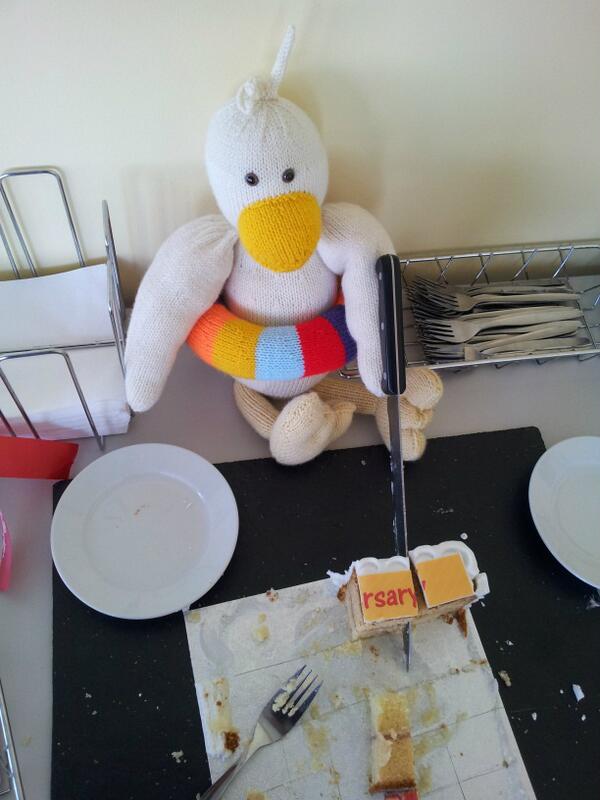

It was right at the start of May that Fuse duck came to Newcastle to visit the Institute of Health & Society. I looked after him. I quite enjoyed having him. He dragged me around the place desperate to meet everyone and I ended up saying hi to a bunch of people I hadn’t met, or had only half met, before.

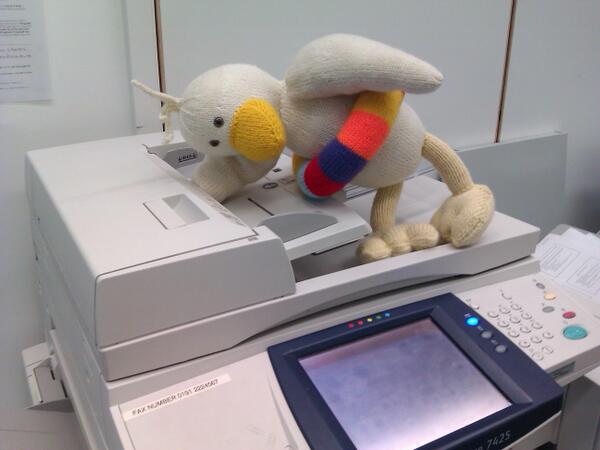
After a brief argument with the photocopier preparing for the ‘big meeting’ later in the day, we started out with a brainstorming/planning meeting for the 2015 CREATE workshop that I’ve been asked to co-ordinate. I have got myself a reputation for teaching writing skills. I’m not sure this is in any way justified. Sure, I’ve done a lot of writing and sure, bad writing sometimes annoys me. That doesn’t mean I’m any good at teaching people how to do it well. See Twitter during any football match/episode of Question Time/Strictly for more on this. But, when you’re offered a trip to Cyprus, the 2.5 days of workshop you need to prepare and deliver in exchange sometimes doesn’t feel too much of a drag. It’s more than a year away. It’ll be fine. In the course of an hour my co-facilitators and I worked through three or four different ideas for the workshop, before settling on an outline programme that we hope will be acceptable to the organising committee. We’ll find out in June. 

Next up was a project meeting for the YouCook project. This is a pilot evaluation of Jamie Oliver’s Ministry of Food cooking classes. Very exciting in principle, but harder than it looks in practice. Mostly, surprise, surprise, because recruitment is not that easy. And before you ask, Fuse duck didn’t get to meet Jamie on this occasion. But the main researcher on the project has done. 
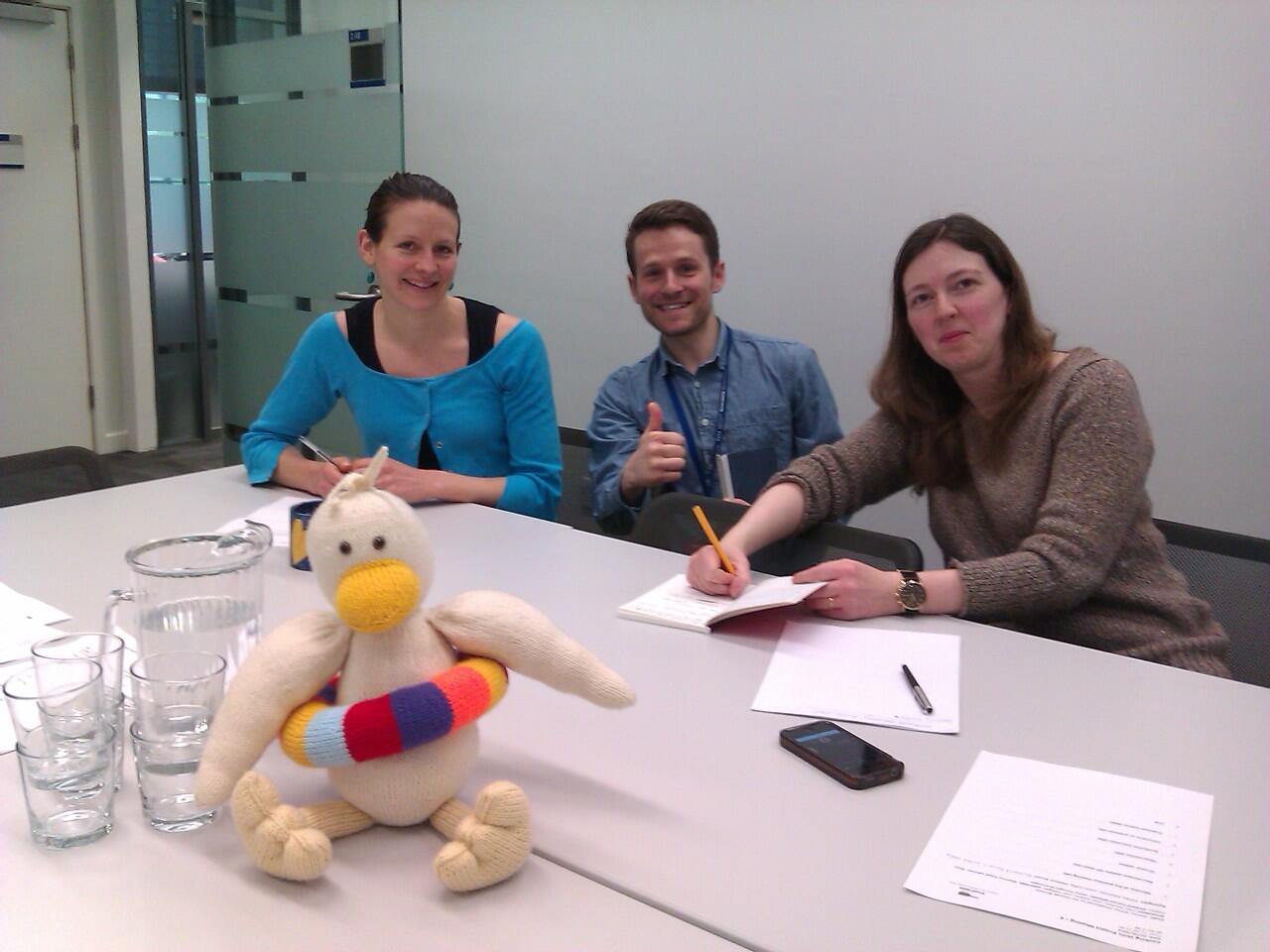

Ten minutes to nip to the toilet and swap one pile of papers for another, and before we knew it the ‘big meeting’ was upon us. This was the second of three meetings of the steering group for our project on using parental incentives to encourage uptake of pre-school immunisations. Which astute readers might remember is where this whole blog thing began. The meeting was ‘big’ in that there were at least 10 people around the table. But also ‘big’ in that it involved people from London, Glasgow and Aberdeen - both in person, and on the phone - and clinicians as well as academics and researchers. One of those meetings where you are very aware how much of an effort people have made to come and take part, and how much you’d better make sure that you don’t waste their time.

The ‘big meeting’ went well. The project is going well and generating interesting findings. The discussion was engaging and lively. There were some good suggestions made for future directions. But chairing a two and a half hour meeting that you have been subconsciously worrying about for the last week is exhausting. So after that was done, Fuse duck and I went up to our coffee room and just hung out for half an hour to get stuff back in perspective. But somehow the conversation drifted into food porn and how naïve I was to think that food porn=Nigella Lawson and it felt time to leave.
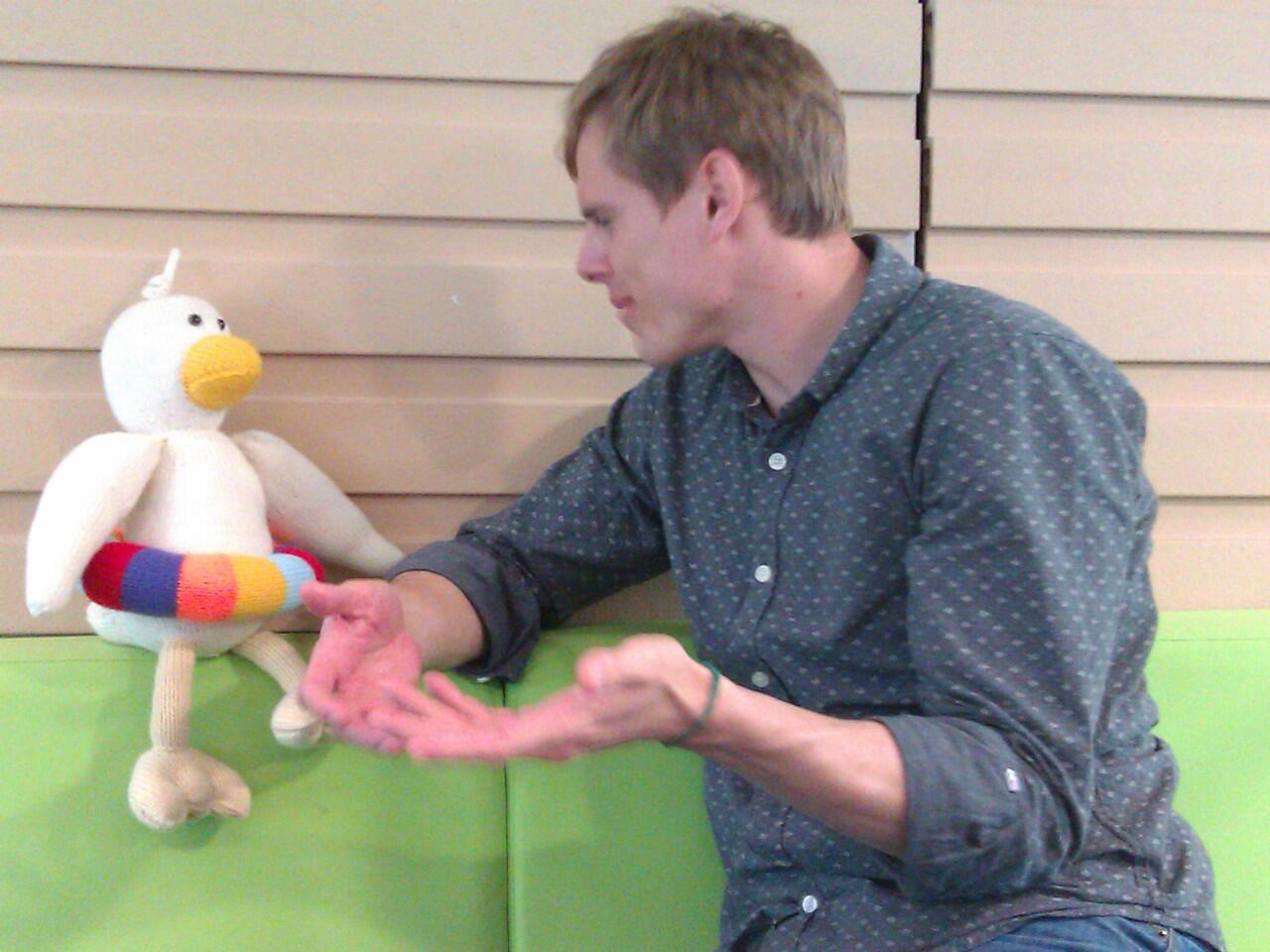

The last meeting of the afternoon was a one-to-one with a researcher to chat R, data, and Foodscape. Although we do have lots of meeting rooms in IHS, we also have three ‘informal’ tables where both planned and impromptu meetings take place. Contrary to expectations, an informal table is not a post-modern representation of a table that only very loosely resembles the typical structure of a formal table. No, the informal tables are distinctively table-like, with grey rectangular tops and at least four sturdy legs. Their informality comes from the fact that there are not bookable, and not restricted within their own rooms. In fact they are placed in what is essentially an aneurytic corridor - a place that is as important for getting from A to B as it is for housing meeting spaces.

As it turns out, holding a meeting attended by a stuffed duck at the informal tables attracts a little more attention than some other meetings. Before we knew it, students, researchers and even the institute director were chatting to Fuse duck and not about Foodscape work package 4. So we called it a day, packed up and headed for home.

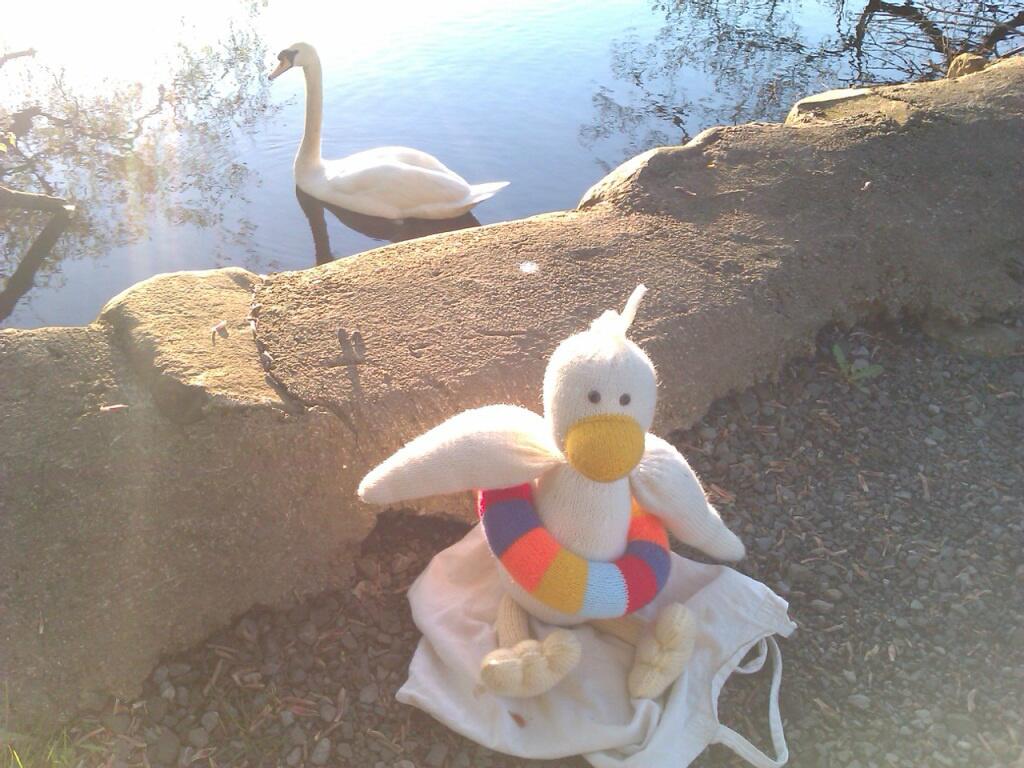
That was the end of the work day, but not the end of the whole day. We still had our 30 minutes of moderate to vigorous physical activity to get in. Fuse duck is sadly lacking in bones, ligaments, tendons and muscles, making his running style fairly floppy. I didn’t mind carrying him and we went for a little plod around the park, stopping to see if there were any ducks around to say hello to in the pond. But all we could find was a prissy swan who just hissed at us and swam off. 


Thursday, 29 May 2014

52 weeks in public health research, part 21

Posted by Jenni Remnant and Jean Adams

From Jenni Remnant: Durham Cathedral taken on the walk back to the station after an excellent panel discussion on 'Communicating and Understanding pain'.

From Jenni Remnant: Just in case there is an unexpected outbreak of hygiene.

From Jenni Remnant: a reasonably healthy summer lunch all  ready to go.

From Jean Adams: outdoor office all set up. Luckily it's pretty easy to dismantle when the electrical storms arrive. That pink elephant bean bag was made on commission for my littlest step-girl when she was about 10. Now she's wrapping up a foundation course in textiles herself.


-------------------

Just to remind you:

Each Thursday of 2014 we’ll try and post around four pictures on the Fuse blog that capture our weeks in public health research, from the awe-inspiring to the everyday and mundane. Given that more of the latter than the former exists in my life, I foresee problems compiling 208 images worth posting on my own. So this is going to have to be a group project. Send me an image (or images) with a sentence or two describing what aspect of your week in public health research they sum up and I’ll post them as soon as I can. You don’t have to send four together – we can mix and match images from different people in the same week.

Normal rules apply: images you made yourself are best; if you use someone else’s image please check you’re allowed to first; if anyone’s identifiable in an image, make sure they’re happy for it to be posted; nothing rude; nothing that breaks research confidentiality etc.

Also, this doesn’t mean we wont also be posting words. You word-based posts are, as always, much appreciated.

Tuesday, 27 May 2014

Life is pain

Posted by Jenni Remnant

To avoid only writing (read complaining) about the difficulties of care, and in contradiction to the misleading title, I thought I’d write something uplifting-ish about a couple of events I’ve attended over the last couple of weeks.

The first was ‘Communicating and understanding pain; a multidisciplinary approach’ and the other was ‘Applied qualitative research in health; where now?’.

Both, I’m glad to say, were great.

I’m a bit of a pessimist about these events, not because I think they’ll be naff, but because I don’t have a lot of faith in my ability to maintain my mojo and absorb/impart any quality information over an entire day, especially post-lunch. I also get pre-event guilt about having inconvenient dietary requirements, and pre-event nerves that I will have to make small talk. I’m even worse at small talk than I am at big talk.

And....sometimes I worry that events will be as boring as hell and exercises in back patting, navel gazing and academic out-rankery.

Fortunately these two were totally great. The one on pain was split across two days; first an evening event at Durham University with three speakers Clare Roques, Suzannah Biernoff and Rachael Gooberman-Hill, and then panel discussion. The three talks were totally different, but all really engaging – totally outside of my area of study, but at the same time useful and relevant in terms of ordering thoughts, and seeing the wider picture. It was followed with a day of discussion, discussion and more discussion, with a free lunch lobbed in the middle (thumbs up to a free lunch). The basic premise of the day was to find an ‘answer’ (or at least more questions) in response to the ‘problem’ that in the north east the prescription of analgesics is 5x that of the national average.

I was sat in a room discussing this with neuro-scientists, clinicians, pharmacists, students, social scientists and an art historian. How fantastic is that? I don’t know if it was a lucky collection of people, or whether my expectations had been unfairly low, but the collaborative aim of the process was totally achieved; the discussions were varied, as were the ontologies of the attendees – but somehow it worked.

One group discussion I was in did travel further into philosophical thinking than my brain usually lets me travel; whether representation is representation, or whether representation is reality...etc, but mostly we kept on task and kept it real – we talked about GP consultation, hospital treatment, where pain came from and what relationship un/employment has with pain.

We talked about the dehumanisation of patients, and then over lunch with a pharmacist and clinician, about the potential necessity of that practice sometimes to avoid dehumanising clinicians; for example, if someone witnesses a lot of pain and death in their line of work, there may be utility in being a ‘body mechanic’, rather than engaging in the reality of all that sadness.

By the end of the day I got the impression we all felt energised rather thant comatose, and had truly given our brains some exercise, while also beginning to contend with a pressing public health issue.

The second of the two events was the British Sociological Association applied qualitative research in health symposium. Back on home turf in the Research Beehive in Newcastle, which was a good start.

This one was predominantly presentations, but included break out groups in the afternoon and a key note talk by Carl May. Also, to my delight, tweeting was encouraged with the hashtag; #AQHR.

The presentations were fantastic, a moving presentation was delivered using videos of patient narratives, one on the use of qualitative research to support randomised controlled trials, in addition to fascinating presentations on linked-up interviews, researching sensitive and distressing topics and various ways in which applied qualitative research in health has filled in the gaps left by more traditional health research styles.

The day was also, at times, very funny, certainly the quotes from research conducted in Glasgow around sexually transmitted infections in middle-aged adults had most of the room smiling.

The hashtag was well used – and the keynote speech was fantastic. Though I lost track a couple of times, on winding, but ultimately entertaining tangents, it was a pleasantly natural and informal talk from Carl.

In the break out groups I joined a group that focused on PhD student specific issues and was reminded of all the challenging parts of completing a PhD, though our group was fairly pragmatic – we identified that things that we thought were huge and bowled us over (criticism from supervisors…etc) were likely to be forgotten instantly by busy academics who probably have to rush off to another meeting or to teach…etc. We also highlighted the excellent use of a managerial tool used in academia and no doubt more widely in public health; ‘the sh*t sandwich’, whereby your criticism is sandwiched by positives, only we decided that it was more akin to a ‘sh*t pitta’, in that the bread is very thin, and the filling fairly substantial.


Rather typically – having spent both events listening and scribbling down notes as I’d realised they were going to overflow my brain’s capacity – on beginning to type them up, I gestured slightly too emphatically when describing what a great week I’d had and sent my full cup of coffee cascading across said notes rendering them illegible (see image above).

So can we do them again please? ;)

Thursday, 22 May 2014

52 weeks in public health research, part 20

Posted by Jean Adams, Martin White and Jenni Remnant

From Jean Adams: some days I look up from desk and am startled to find the whole office (of about 40 desks) suddenly empty. Can you guess which desk is mine? Hint: it's the one with the crochet bunting ;)

From Martin White: askFuse, our responsive research facility, is now almost 1 year old. We celebrated at a recent Fuse members' meeting with this cake featuring a still from the animation we commissioned to launch the service last year.

From Martin White: This stunning portrait of Charles Darwin is in the National Portrait Gallery in London. Sometimes when you've done three hours of work on the train down (starting at 7am), delivered two hours of teaching, and know you'll do another three hours of work on the train home it's okay to spend an hour in a gallery.

From Jenni Remnant: this hedgehog followed me home the other day. Again: not particularly public health-y, but still damn cute.

-------------------

Just to remind you:

Each Thursday of 2014 we’ll try and post around four pictures on the Fuse blog that capture our weeks in public health research, from the awe-inspiring to the everyday and mundane. Given that more of the latter than the former exists in my life, I foresee problems compiling 208 images worth posting on my own. So this is going to have to be a group project. Send me an image (or images) with a sentence or two describing what aspect of your week in public health research they sum up and I’ll post them as soon as I can. You don’t have to send four together – we can mix and match images from different people in the same week.

Normal rules apply: images you made yourself are best; if you use someone else’s image please check you’re allowed to first; if anyone’s identifiable in an image, make sure they’re happy for it to be posted; nothing rude; nothing that breaks research confidentiality etc.

Also, this doesn’t mean we wont also be posting words. You word-based posts are, as always, much appreciated.

Tuesday, 20 May 2014

Using social media for building an academic & professional network

Posted by Lynne Forrest

As part of a general session within our Institute on using social media for research, I was recently asked to talk about using social media for building a professional network. It was a good chance to reflect on why I think Twitter is such a good tool for doing this, particularly for those at the start of their academic career, who are lacking in publications, a wide academic network and an established reputation.

I first joined Twitter at the beginning of the second year of my PhD and, initially, I really couldn’t quite see the point. It wasn’t until I wrote a couple of posts for the Fuseblog and starting picking up some followers that I began to realise what a useful tool it could be. Now, over two years later, post-PhD I have a twitter network of around 600 people (large enough, but not too big as to be unmanageable), am on 23 Twitter lists ranging from Women in Science to Academics at Newcastle and Tweeting Epidemiologists, contribute regularly to the Fuseblog, and am a total social media convert.


Twitter has been a brilliant medium for connecting with other PhD students (and now early career researchers) in order to ask questions, get advice and generally provide moral support during what can be quite an isolating experience. It’s also been of practical support in highlighting interesting epidemiological and public health research I might never have found myself (the fabulous @SCPHRP is great for this), advertising jobs and conferences, sharing resources (a list of viva questions has done the rounds of my twitter network), raising my profile, and connecting me with a wide network of like-minded people in public health and beyond.

As someone who can come across as quite reserved in real life (despite the fact I am actually fairly stroppy and opinionated), I do find the whole networking thing quite stressful. I realise it’s a necessary part of academia and I need to get better at speaking up more, but in the early stages of academia it’s easy to think you’ve got nothing useful to contribute, as well as the worry of saying the wrong thing and looking stupid. But Twitter has again been an excellent tool for this sort of thing. Blogging has given me an academic voice and Twitter has allowed me to interact with senior academics that I’d be far too terrified to approach blind at a conference. As a recent member of my Twitter network said ‘Twitter is networking for people who hate networking’ (thanks @PhDGeek for allowing me to pinch this for my talk!).

So, if you do plan to use twitter to build an academic network what should you do? I’d advise keeping your personal and professional identities mostly separate. I do tweet non-work related stuff but decided fairly early on to stop following David Tennant, various members of Duran Duran and the cast of Merlin (no-one needs to know about my love for dodgy 80s bands and kids’ tv programmes). Use your profile to detail your research interests and help others find you. And use a sensible twitter name. I initially just planned to lurk so chose a daft name that I’ve now changed. Also, if you’re using other academic resources such as Researchgate and google scholar citations it seems sensible to have a consistent professional online identity.

The best way to build up a twitter presence is to start interacting and not just re-tweeting. If you are going to re-tweet then occasionally add some comment or opinion. Tweet from a conference or seminar. If your Institute or department has a blog then contribute to this. There’s only so much you can say in 140 characters and a blog post allows you to talk about your research or other aspects of the research process in a lot more detail. Reply to interesting tweets, start conversations and, most importantly, engage. There’s a great network of academics out there, you just need to find them.

Thursday, 15 May 2014

52 weeks in public health research, part 19

Posted by Dominika Kwasnicka, Jenni Remnant and Jean Adams

From Dominika Kwasnicka: Respect. No litter please.

From Dominika Kwasnicka: This 'smokefree' bin and its cigarette butts are outside the antenatal care and delivery suite at our local hospital.

From Jean Adams: Fuse duck and I went on a little road trip over the bank holiday weekend. Here he is enjoying all the many healthy (not) options at the MandS at Weatherby Services. Is there a word that describes massive heaps of unhealthy stuff at the entrance to shops?

From Jenni Remnant: on the way to and from uni there are currently baby geeses (aka goslings). Not particularly public health-y, but damn cute.

-------------------
Just to remind you:

Each Thursday of 2014 we’ll try and post around four pictures on the Fuse blog that capture our weeks in public health research, from the awe-inspiring to the everyday and mundane. Given that more of the latter than the former exists in my life, I foresee problems compiling 208 images worth posting on my own. So this is going to have to be a group project. Send me an image (or images) with a sentence or two describing what aspect of your week in public health research they sum up and I’ll post them as soon as I can. You don’t have to send four together – we can mix and match images from different people in the same week.

Normal rules apply: images you made yourself are best; if you use someone else’s image please check you’re allowed to first; if anyone’s identifiable in an image, make sure they’re happy for it to be posted; nothing rude; nothing that breaks research confidentiality etc.

Also, this doesn’t mean we wont also be posting words. You word-based posts are, as always, much appreciated.

Tuesday, 13 May 2014

The ‘C’ Word IV: Challenging (behaviour)

Posted by Jenni Remnant and Libby Morrison

So, the word ‘challenging’ is used primarily to describe aggression in learning disability and mental health settings. It keeps the focus on the service user, as is standard (see ‘Person centred planning'). But I would like to consider ‘challenging behaviour’ in terms of being a carer, and in terms of public health and public health research.

Though ‘challenging behaviour’ tends to describe a certain type of behaviour, personally I find a lot of behaviours challenging as a carer – and I expect that others sometimes find my behaviour challenging.

In 9 years of caring for people I have had excrement thrown at me (once an absolute money shot got me square in the face), I have had my hair pulled with such force my scalp ripped, my car has been attacked with a plastic tennis racket, I have been threatened with a kettle of boiling water and a hammer, in addition to being spat at, chased and verbally abused. In many of these roles I was paid a higher hourly rate (one motivation for working in these services) of up to a couple of pounds over national minimum wage. Peanuts to cashews if you will.

This of course is challenging, but I knew exactly what I was signing up to, and if I’m honest, I like it. I imagine this is wrong on a number of levels, but I liked it when people were angry, because a lot of the time I felt they were justified in it. What an oppressive system they live in and are forced to submit to. Admittedly, I like it less when the anger is directed at me, but personally, I find it easier to feel genuine respect for those who fight.

There are two levels to what I personally find challenging. One is a collection of behaviours from service users. The other challenge comes from being angry at myself and feeling guilty that though I can understand and rationalise on a theoretical level that I shouldn’t judge or feel negatively towards people, I can’t feel it. I get so frustrated when I’ve suggested someone goes to the toilet and they say that they have when they haven’t, defecate instead on their bedroom floor and laugh while you clean it up. I feel humiliated when someone starts to masturbate when I try to give them support cleaning their bedroom, go to the supermarket or cook their breakfast. I feel disgusted when someone accesses porn that simulates rape. I feel scared when I’m lone working and a service user follows me around a service. I feel angry when I get a service absolutely spotless and someone tips instant coffee all over the side and doesn’t wipe it up and it goes into those horrible rock hard little lumps on the side… the list, I’m sorry to say is endless.

I worry that it is obvious when I am getting frustrated. A service user once announced to me “I have rights” when I asked, for the fifth or sixth time that day, to use the toilet as he hadn’t been for over 8 hours. He spent around 30-45 minutes in the loo each time, but didn’t use the toilet, with me outside the toilet issuing instructions. I agreed with him – I told him about Maslow’s hierarchy of need, and took from my pocket a summary of the universal declaration of human rights (I always have it on me at work), and in that tired, frustrated, trying-to-maintain-the-appearance-of-calm way, that absolutely patronised him and highlighted that in this situation I ultimately held the balance of power – went through them and explained how trying to support him in hygiene was not relieving him of his rights. I was angry at him, I was angry at myself.

The other challenge is where to go with the above information; who wants to hear that carers are human and get challenged? Which local authority wants to hear that a *free* informal carer finds it challenging to look after a husband who no longer recognises them? What manager wants to hear that you were woken up 6-7 times through the night on your sleep in shift and so feel too tired and drained to work through the following day? Your mental health as a carer is under strain. I currently do less than one shift a week and still sometimes struggle.

Then there’s your physical health – despite meticulously clean staff teams where I have worked, I have often worked with people that for whatever reason do not wash. People that I have worked with have often not washed their hands, don’t shower, and don’t do their dishes. Sometimes when they do their dishes, they don’t do an amazing job. It is patronising and disempowering to re-wash people’s dishes for them. I take in my own cutlery and crockery – and have been pulled up on it a number of times because it’s insulting and stigmatising.

There is a huge amount of surveillance around caring, in addition to judgement. Sometimes it feels so hopelessly fruitless – permanently rolling a stone up a hill for it to roll back down again a la Sisyphus.


What does this mean for public health and public health research? To me it means a necessary interrogation of the homogenising of service users, and the black and white dichotomy between informal and paid carers. An interrogation of the system that removes power and control from a huge number of people – and that’s not even starting on the lack of decent union representation and zero hour contracts – but how?

What are the right questions? I don’t know what the desired outcome is other than that beautiful idea of health equality and social equality for service users and carers – or how as public health researchers we would approach this messy and difficult area and do it justice – but we probably should.

I was very excited to see that Fuse has been advertising a PhD studentship that focuses on carers, and will be fascinated to see what is learnt from that.

Thursday, 8 May 2014

52 weeks in public health research, part 18

Posted by Catt Turney and Jean Adams

From Catt Turney: One of the things I like about the DECIPHer's Cardiff office is that pretty much everyone, staff and students alike, is based in the same building. This means the dark alleys of email can often be avoided in favour of face-to-face talking, and the PhD students feel just as much a part of the centre as the staff. This tomato plant is one of eight brought in by a PhD student at DECIPHer, all of which (plants, not PhD students) were quickly adopted and are now accessorising various windowsills. I'm now facing the dilemma: take it home and protect it from the sub-zero conditions of the office over the weekend, or leave it open to the elements and allow it compete with the others in the Great DECIPHer Tomato Plant Competition 2014?

From Jean Adams: after convincing myself there was absolutely no way to explain the concept of an escalating financial incentive to research participants, I came across this perfectly simple example of how it could be done at the supermarket. Thanks for the advice, Waitrose.

From Jean Adams: I rarely meet real-life research participants. When I was early enough in my career that that would have been my bread-and-butter, I was entirely involved in secondary data analysis. Now that I'm doing more research involving primary data collection, I have 'people' who do the actual work. So it was nice to meet the members of our Parent Advisory Group the other day on a rare field-trip out of the office to a local Sure Start Centre.

From Jean Adams: It was great to welcome two new members to the most recent meeting of the Fuse Communications Group last week: Peter van der Graaf, and the #fuseduck. I think they'll both make really valuable contributions.

-------------------
Just to remind you:

Each Thursday of 2014 we’ll try and post around four pictures on the Fuse blog that capture our weeks in public health research, from the awe-inspiring to the everyday and mundane. Given that more of the latter than the former exists in my life, I foresee problems compiling 208 images worth posting on my own. So this is going to have to be a group project. Send me an image (or images) with a sentence or two describing what aspect of your week in public health research they sum up and I’ll post them as soon as I can. You don’t have to send four together – we can mix and match images from different people in the same week.

Normal rules apply: images you made yourself are best; if you use someone else’s image please check you’re allowed to first; if anyone’s identifiable in an image, make sure they’re happy for it to be posted; nothing rude; nothing that breaks research confidentiality etc.

Also, this doesn’t mean we wont also be posting words. You word-based posts are, as always, much appreciated.

Tuesday, 6 May 2014

10 top tips for getting published (tips 6-10)

Posted by Jean Adams

A little while back I wrote about a presentation I gave to the Institute of Health & Society’s new Early Career Researcher group on getting published. I only managed to cover tips 1-5 in that post. As promised, here are tips 6-10.

6. Do unto other as you would have them do to you


Tip number 5 was ‘review, review, review’. Tip number 6 is a direct follow up and really comes down to ‘be nice’. Everyone knows how crushing it is to receive a damning review of a piece of work that has taken years to complete. Don’t be fooled. These horrid reviews are blueprints in how not to do it – not templates for your next review. Reviews have to be critical to be useful, but they don’t have to be harsh, personal or unkind. There are ways and ways of saying your whole research programme is scientifically unsound and you need a wholesale re-think. 


7. Don’t make a rejection easy


Most assistant editors at most journals are unpaid volunteers. If they don’t do journal work in their ‘spare’ time, they do it in their ‘in-between’ time, around the edges of their real jobs. Online editorial management systems are good, but not great and it can sometimes be a bit of a struggle to keep track of all the documents associated with any one paper (original cover letter, original manuscript, two reviews of original manuscript, first response to author, revised cover letter, revised manuscript, two re-reviews of revised manuscript…). I am sure that most assistant editors have been tempted by the ‘reject’ button when they just can’t find what they’re looking for. You can reduce the chances of this happening by reading and following all the guidance provided. In particular, don't assume you know what the form letter inviting a revision says - read it carefully.

8. Expect rejection & find a (healthy) way to cope with it


A little while ago I was at a seminar delivered by a very well respected professor. The research they were presenting was just about to be published in The Lancet. During questions, the speaker told us about some follow-up work that was “currently doing the rounds of the journals”. This was a real reminder to me that everyone has papers that they struggle to get published: even important professors doing fantastic work that they think is really important. ‘Doing the rounds’ is normal. So you have to learn to deal with it – well. My personal preference is to ignore rejections for a few days. I see the email. I feel the sting. Then I let that dissipate before planning a time to read through the details and prepare the paper for the next place.

9. Don’t stop at publication


Getting published can be exhausting. After the research itself, the many rounds of drafting and redrafting, the formatting for endless different journals, by the time your paper is finally available for the world to see, the project has often long ended and the staff scattered. Despite this, publication in a peer-reviewed journal is just the start of the dissemination journey. If you really want people to read your paper, and find out about your results, you have to let them know about it. During your project you can keep a list of people who’ve said they’d be interested to read your results and send them the paper when it’s published. If your work might be of interest to the media, you can get in touch with your press office to talk about a press-release. You can present your results at academic conferences, and meetings of other people who you think might be interested. If you’re affiliated with Fuse, you might think about writing a blog post, or an evidence brief.

10. Enjoy the ride


If you work in university research, getting published is a core activity. Some people seem to be able to avoid winning grants, some people avoid much in the way of teaching, but you don’t come across many people who can wheedle their way out of getting published without attracting negative attention. If you’re going to do it, you might as well enjoy it. Enjoy the craft of writing, enjoy winning the battle with the reviewers, enjoy seeing your name at the top of the printed page, enjoy celebrating with your co-authors, enjoy how proud your grandma is of clever you.


As I said before, these might not be the toppest of top tips - just some things I thought worth thinking about. What are your top tips for getting published?

Thursday, 1 May 2014

52 weeks in public health research, part 17

Posted by Jenni Remnant and Jean Adams

From Jenni Remnant: the contents of a cleaning cupboard in a community healthcare setting- where I was about to start cleaning.

From Jenni Remnant: giving blood.

From Jean Adams: once a month, IHS hosts a coffee morning to celebrate all the staff birthdays happening that month. The ratio of fruit:cake supplied seems to be slowly changing. Either way, there is never anything left by the time I get there. This month I got there early to take pics, but didn't want to disrupt the display by eating anything. By the time I got a chance to go back, there was a half eaten cookie and three blackberries left.

From Jean Adams: sometimes the best way to solve a tricky research design problem seems to be with a dry marker and a white board. After two hours with this particular problem and white board (and white board eraser), our conclusion was that our proposed solution was possible but probably wildly impractical. A lot of reading and talking later and it seems that the only real solution is to use a computer...


-------------------
Just to remind you:

Each Thursday of 2014 we’ll try and post around four pictures on the Fuse blog that capture our weeks in public health research, from the awe-inspiring to the everyday and mundane. Given that more of the latter than the former exists in my life, I foresee problems compiling 208 images worth posting on my own. So this is going to have to be a group project. Send me an image (or images) with a sentence or two describing what aspect of your week in public health research they sum up and I’ll post them as soon as I can. You don’t have to send four together – we can mix and match images from different people in the same week.

Normal rules apply: images you made yourself are best; if you use someone else’s image please check you’re allowed to first; if anyone’s identifiable in an image, make sure they’re happy for it to be posted; nothing rude; nothing that breaks research confidentiality etc.

Also, this doesn’t mean we wont also be posting words. You word-based posts are, as always, much appreciated.

Tuesday, 29 April 2014

The C word: consent

Posted by Jenni Remnant & Libby Morrison

This is quite personal as it is about my brother James, who has Down syndrome. In terms of consent to me blogging about this – I have discussed it with him at length and he has no issue about being identified. We decided that it was important the fact that he is my brother stays in, because this isn’t a story about ‘other’. 

Given what I have said above, I can see the contradiction/irony in that this post is, at least in part, about my brother’s lack of understanding of the word ‘consent’. Said in the right tone of voice and body language, my brother would say yes, or no, to almost anything; ‘you don’t want to do that do you?’, or ‘to be really independent* you need to….’, ‘now it’s your choice, but if I were you…’. He is totally and utterly committed and invested in the language of societal norms and government rhetoric – unsurprising when you consider that though much of the improvements gained for disabled people have been led (quite rightly so) from the front by people with physical impairments, the steps for learning disabled adults have been half hearted and almost entirely state-orchestrated.


Often I hear my brother and his friends say things like ‘real men drink beer/have girlfriends/ [insert hetero-normal masculinity based stereotype here]’. When out with him, women have cooed over him, leading him to believe that he is a ‘ladies’ man’. He believes Del Boy is a role model and style icon and has not understood that he is a comedy character that people laugh at. He has had no other option than overtly straight masculinity by which to define himself.

It’s strange, because actually I’m not sure that in another life he would be any of those things. Though I wouldn’t dream of conflating being camp with being gay, he is nevertheless flamboyant, adores musicals and, more significantly, has only had enduring meaningful companionships with men. The relationship he has with his ‘girlfriends’ involve being chaperoned maybe once or twice a month on ‘dates’, and perhaps bumping into them at day services or social clubs. One thing that can be said for the social world provided for learning disabled adults is that it is virtually defined by an obscure heteronormative asexuality (see Murphy 2003, Brown 1994, Yar & Rafter 2014 for more on this) that has resulted in James being a homophobic chauvinist that is terrified of his genitals and what they do. He also desperately wants to get married and have children. I wonder what consent means in terms of his sexuality. Tokenistic as it is.

To give meaningful consent to sexual acts, research participation or medical treatment has some requirements. It requires that those in the position of power (everyone else if you are someone with a learning disability) ask for it. They have to value you enough as a human being to support you in decision making, and provide you with the knowledge necessary to be informed.

James would probably be considered a ‘hard to reach’ participant in public health research. Which is ridiculous – he’s an extrovert – he’d leap at the chance to be involved in anything, he is desperate to be valued. It would take time and resilience on the part of the researcher to peel back the layers of rhetoric he is so programmed to regurgitate, ethical clearance would probably take some time – or would certainly have that presumption made about it, and perhaps this is why he, and the diverse, interesting and knowledgeable population of learning disabled adults is so neglected in public health research. ‘Hard to reach’ is ill-fitting, ‘easy to ignore’ is what he is.

*increase in ‘independence’ often equates to a decrease in support hours for adults with learning disabilities which can be a difficult concept to balance.

Thursday, 24 April 2014

52 weeks in public health research, part 16


Posted by Dorothy Newbury-Birch and Jean Adams

From Dorothy Newbury-Birch: I've been working at home for the week going through lots of reviewers comments for a report. The report is larger than my PhD was - 55,000 vs 36,000 words! I have everything I need - coffee, my little bit of India hanging from the window, flowers (got to have for writing) and the little pot is my pot of motivation - this is the pot where the pink paper tabs go when I've finished that point - there is only six in the pot at the moment and 37 left to go but seeing the pot get fuller will be fantastic.

From Jean Adams: I spoke at a lunchtime seminar at ScHARR, Sheffield University a few weeks ago. It was pouring rain when I left Newcastle and I got soaked on the way to the station. By the time I reached Sheffield it was a beautiful day made a little happier by finding some interesting things on the walk from the station up to the university. This poem on the side of a Sheffield Hallam University building is by Andrew Motion. I couldn't read without hearing his voice in my head.

From Jean Adams: this fountain is just outside Sheffield station. I took lots of pictures of it, but my favourite was this selfie. #ego

Hang on...is that the #fuseduck doing some active commuting?


-------------------


Just to remind you:

Each Thursday of 2014 we’ll try and post around four pictures on the Fuse blog that capture our weeks in public health research, from the awe-inspiring to the everyday and mundane. Given that more of the latter than the former exists in my life, I foresee problems compiling 208 images worth posting on my own. So this is going to have to be a group project. Send me an image (or images) with a sentence or two describing what aspect of your week in public health research they sum up and I’ll post them as soon as I can. You don’t have to send four together – we can mix and match images from different people in the same week.

Normal rules apply: images you made yourself are best; if you use someone else’s image please check you’re allowed to first; if anyone’s identifiable in an image, make sure they’re happy for it to be posted; nothing rude; nothing that breaks research confidentiality etc.

Also, this doesn’t mean we wont also be posting words. You word-based posts are, as always, much appreciated.

Tuesday, 22 April 2014

Introducing Fuse duck: coming to a university near you to save Albert Park’s pond

Posted by Avril Rhodes and Peter van der Graaf

Remember when there was a brief outbreak of blog posts on knitting? Remember branded goods and the debut of the Fuse gloves? The gloves flopped spectacularly, strangely no one wanted them, at all. I have the world’s only pair. That was not terribly good news as I still had a wool mountain at home and a one pair of Fuse gloves didn’t make so much as a small dent in the mountain.

Undeterred and still working my way through the mountain, three years on, the latest product is the Easter Fuse duck. Easter Fuse duck is inspired by the brave ducks of Albert Park, who live just across the road from AskFuse HQ, Parkside, Teesside University.  These outstanding ducks co-exist with a number of environmental challenges. These include, without any trace of exaggeration, fishermen with their trailing lines (and a nice line in swearing), large quantities of unsuitable food thrown at them by passers-by, rubbish of all kinds floating around (humans are behind this too), unruly groups on outsize fowl shaped pedalos, and noise pollution from many sources including a café, play park, a roller skating track, and seasonally, a full size funfair. Otherwise it’s a rural idyll.

Albert Park duck pond, Middlesbrough
It’s a tribute to the persistence of nature that despite everything so-called sophisticated humans do to disrupt duck life they continue, and even flourish. Pollution might be one thing somewhat out of our hands (although  not entirely), but why do we keep dropping litter, paying others to tidy it all up, and making it difficult for wildlife? It’s such a commonplace public health hazard (especially in urban areas) spoiling everyone’s enjoyment and consuming resources in the clean-up.

Fuse duck decided it was high tide (boom-tish!) for action; luckily, Fuse duck recognises the value of collaboration wearing the life-belt featuring our combined University colours. He is appealing to all Fuse researchers for help in finding a new home for him after all the public health dangers he faced and to learn more about how to combat these dangers for his fellow feathery friends in Albert Park. With all the expertise in Fuse on tangled-up fishing lines (complex systems), unruly groups (behaviour change), healthy eating in the face of austerity (health inequalities), play parks and roller skating tracks (early life and adolescence), hearing aids (healthy ageing) and knowledge of duck language (translational research), Fuse duck is keen to meet the researchers that can save his pond!

Fuse duck hard at work
So our environmental warrior would like to go on a road trip to visit all the Fuse Universities and public health researchers within them: to sit in on their fascinating meetings, experience their randomised controlled trials (RCTs) first hand, join their physical activities, share coffee mornings and indulge in the latest evidence review with long and incomprehensible titles. If you would like Fuse duck to visit you for a week, please let us know and he could be winging his way in your direction. All we ask is that you let us know how he is getting on in your public health wonderland by writing about his adventures and posting photos on the blog.

After his tour de force, Fuse duck has plans to fly further afield to see our friends in practice and policy land, so watch this space!

Can you give Fuse duck a good home?  If so then email Avril Rhodes on Avril.Rhodes@tees.ac.uk

Thursday, 17 April 2014

52 weeks in public health research, part 15

Posted by Lynne Forrest and Martin White

From Lynne Forrest: Having recently passed my viva and officially become Dr Forrest, my thesis has joined a colourful selection of other theses in the bookcase at our Institute, available for others to borrow. I’m not sure how often the hardcopy version will actually be read but it also gets published online 6 months later, which will hopefully increase access (the delay is to allow publication of papers from the thesis first).

From Martin White: This appealed to me on several levels. Fuse partners are working with collaborators across Europe to submit an application for a ‘Marie Skłodowska-Curie action’ – an application to the European Community for an Innovative Training Network (ITN), which will fund 25 PhD studentships. The acronym for our application is ÉTUDE (European Training hUb on behavioural Determinants), hence this musical quote and explanation of its relevance, which serves as frontispiece to our application.

From Martin White: Long delays are part and parcel of journeys on the East Coast mainline, which, if you work in the North East occupy a lot of our time, regularly commuting to and from meetings which inexplicably always have to be in London. On a recent journey, my train was ‘terminated’ at Peterborough and three train loads of people fought to secure a place on the only train going to London. I found a premium spot in the service area of First Class, where I set up my office and returned to reading a PhD. I was two hours late for my meeting…

From Martin White: When you spend 6-7 hours on trains in a day (see other references to East Coast mainline…), you need to seal yourself off from the rest of the carriage to focus on getting work done. My working day always starts (usually at 07.10) with Johan Sebastian Bach. Often a cantata, but sometimes solo cello or violin suites, or the incomparable keyboard works, such as the Goldberg variations. The rhythmic and harmonic structure of Bach makes it perfect for concentrated work.
-------------------

Just to remind you:

Each Thursday of 2014 we’ll try and post around four pictures on the Fuse blog that capture our weeks in public health research, from the awe-inspiring to the everyday and mundane. Given that more of the latter than the former exists in my life, I foresee problems compiling 208 images worth posting on my own. So this is going to have to be a group project. Send me an image (or images) with a sentence or two describing what aspect of your week in public health research they sum up and I’ll post them as soon as I can. You don’t have to send four together – we can mix and match images from different people in the same week.

Normal rules apply: images you made yourself are best; if you use someone else’s image please check you’re allowed to first; if anyone’s identifiable in an image, make sure they’re happy for it to be posted; nothing rude; nothing that breaks research confidentiality etc.

Also, this doesn’t mean we wont also be posting words. You word-based posts are, as always, much appreciated.

Thursday, 10 April 2014

52 weeks of public health research, part 14

Posted by Michael Heasman, Martin White and Lynne Forrest

From Martin White: The MRC has this jigsaw-like object in its 13th floor stair lobby. I think it celebrates 100 years of the MRC (Centenary last year). I attended two meetings: the Population Health Sciences Research Network board, which has overseen ‘methodological knowledge exchange’, including the hugely cited MRC Guidance on the development and evaluation of complex interventions; and the Public Health Interventions Development panel, which funds competitive, small scale research.

From Martin White: At the Public Health intervention Development research funding panel we reviewed 29 applications in less than 3 hours. Two panel members per application. You do the maths. The applications are short (a couple of pages) and the stakes not high (maximum of £150k over 18 months). But, only few will get funded. The MRC assessment criteria demand a high level of rigour and innovation. Only an agreed score of 8 or more can be considered for funding. There is no room for error as an applicant.

From Michael Heasman: no description required.

From Lynne Forrest: This poster appeared in the 3rd floor coffee room at IHS recently, urging us all to take the stairs for health and fitness reasons and also to ‘avoid awkward silences’ in the lift! I do wonder if it might be more useful if the notice were stuck beside the lift on the ground floor? And, as public health evidence is what we’re all about, is anyone evaluating its effectiveness?
-------------------

Just to remind you:

Each Thursday of 2014 we’ll try and post around four pictures on the Fuse blog that capture our weeks in public health research, from the awe-inspiring to the everyday and mundane. Given that more of the latter than the former exists in my life, I foresee problems compiling 208 images worth posting on my own. So this is going to have to be a group project. Send me an image (or images) with a sentence or two describing what aspect of your week in public health research they sum up and I’ll post them as soon as I can. You don’t have to send four together – we can mix and match images from different people in the same week.

Normal rules apply: images you made yourself are best; if you use someone else’s image please check you’re allowed to first; if anyone’s identifiable in an image, make sure they’re happy for it to be posted; nothing rude; nothing that breaks research confidentiality etc.

Also, this doesn’t mean we wont also be posting words. You word-based posts are, as always, much appreciated.

Tuesday, 8 April 2014

10 top tips for getting publishing (tips 1-5)

Posted by Jean Adams

The Institute of Health & Society at Newcastle University has recently set up an Early Career Researchers group. I was invited to speak at their inaugural meeting on ‘publishing’. The brief was to speak for about 20 minutes and cover 10 top tips. I think I was an ECR just on the edge of the time when the phrase started being used, and the research community started to recognise ECRs as a group worthy of attention and nurturing. Sometimes the younger researchers at conferences were invited to pub crawls (not really my thing), but I don’t remember much in the way of encouragement to organise and support each other. The attendance at the IHS ECR meeting was huge and there was a definite buzz in the room. I felt quite excited, and flattered, to be there.

‘Publishing’ is a big topic and so much of how to do it seems to be about experience, working out what works in what situations, and a mixture of good luck and persistence. But I managed to come up with 10 things that felt worth saying – maybe not the toppest tips of all, but some things worth thinking about. The first five are here. I’ll cover the next five sometime in the next few weeks.

1. Know what your paper did (aims) and what it adds (message)


I think there are two sentences that almost all peer-reviewed papers hang on – the aims and the message. The introduction justifies the aims, the methods describe how the aims were achieved, and the results describe what the ‘answer’ to the aims were. You probably know what the aims were (perhaps you shouldn’t have started the research if were clear what you were trying to achieve?). The message might be harder. This is the one thing you want people to remember from your paper. The ‘what this study adds’ box; the ‘citable sentence’. The message is what drives much of the discussion and in some cases may be open to interpretation. So you might have to discuss it with your team to get it clear.

Knowing your aims and message are about knowing where your paper's come from and where it's going; map by Max Roberts

2. Write a detailed plan as a team


I think I have only written a paper plan as a team once in my career. So I can’t promise that this works. But I get the feeling that much drafting and re-drafting could be avoided if a detailed plan for each paper was agreed within the team before the real business of writing got underway. If we all agreed the general argument put forward in the introduction, the sub-headings required in the methods, the crucial tables/quotes/figures to include in the results, and the three or four main points under each sub-heading of the discussion, then perhaps there would be little more than re-wording required at the comments stage. Perhaps?

3. Pay attention to your laziness


We are all lazy. Different people just express it in different ways, and hit the point of can’t be bothered at different points. I’m sure we all do that thing of arguing there is a good scientific reason not to do something, when the truth is we just really cannot find the will to do it. There is a lot of self-discipline required in lots of areas of research, and sometimes you run out. This is okay, understandable, and expected. But it feels to me worth noticing and being truthful – at least to yourself – about when the real issue is laziness and when there is good scientific justification for stopping. Then at least you know what the problem is and how you should address or justify it.

4. Know when good enough is good enough


Which brings me to knowing when to stop. Because hardly any (no?) piece of research is perfect and there does come a point where you have to agree that what you have is good enough for what you are trying to achieve. This point might be different for different things. But you do have to be able to draw a line and move on or else you'll never get to the next project - which is always more exciting/interesting/likely to change the world than the current one.

5. Review, review, review


Papers in peer-reviewed journals are remarkably formulaic. I think the best way to learn to write them, is to read others. And the best way to make yourself pay attention to how other papers are written as you read them is to do so as a peer-reviewer. If you aren’t routinely asked to peer-review for journals (and generally you need a publication record for this to happen), the more senior people you work with probably are. It’s fairly normal either to pass reviews officially on to a colleague via the journal office, or to do a review together with a less experienced colleague. So ask if you want more experience of this. Informal peer-review can also be very valuable – to reviewer and reviewed. We all know that feeling of being too close to a piece of work and needing someone with fresh eyes to notice the glaring mistakes.


OK. That’s it for today. I promise to get around to writing up tips 6-10 in the next few weeks. In the meantime, what are your top tips for getting published?

Thursday, 3 April 2014

52 weeks of public health research, part 13

Posted by Melanie Rimmer, Emily Henderson & Martin White

From Melanie Rimmer: Reminds me of the old days of searching journals by hand, card index files, the smell of old books, dusty shelves festooned with dead flies, and the volume you needed was always the one missing from the shelf. Without doubt computer searching is better, but somehow sterile. I miss the romance (but not the dead flies).


From Emily Henderson: Celebrating our new status as a WHO Collaborating Centre! The Centre for Public Policy and Health at Durham University is now a WHO CC on Complex Health Systems Research, Knowledge and Action, which links with Fuse’s new Complex Systems Research Programme.


From Martin White: It never ceases to amaze me how the irony of juxtaposing public health stories (this one courtesy of our very own Blog Editor) with junk food promotions entirely escapes newspaper editors. Nowhere more than in the free dailies that litter our public transport. This piece about a systematic review on financial incentives is rather good, which makes me think it may even have been written by Dr Adams.


From MartinWhite: When a small glass of coke contains 9 teaspoons of sugar, it is hardly surprising that the Coca Cola Corporation is investing heavily in ‘changing the conversation’. Coca Cola wants us to forget about the sugar and do exercise instead to burn it off. Their marketing is widespread in the Alps, as well as in professional sport, leisure and educational settings. Someone tell them why this isn’t the answer please…

-------------------

Just to remind you:
Each Thursday of 2014 we’ll try and post around four pictures on the Fuse blog that capture our weeks in public health research, from the awe-inspiring to the everyday and mundane. Given that more of the latter than the former exists in my life, I foresee problems compiling 208 images worth posting on my own. So this is going to have to be a group project. Send me an image (or images) with a sentence or two describing what aspect of your week in public health research they sum up and I’ll post them as soon as I can. You don’t have to send four together – we can mix and match images from different people in the same week.

Normal rules apply: images you made yourself are best; if you use someone else’s image please check you’re allowed to first; if anyone’s identifiable in an image, make sure they’re happy for it to be posted; nothing rude; nothing that breaks research confidentiality etc.

Also, this doesn’t mean we wont also be posting words. You word-based posts are, as always, much appreciated.

Tuesday, 1 April 2014

Today the ‘c’ word is – choice.

Posted by Libby Morrison & Jennifer Remnant

Choice is a buzz word, much favoured by politicians. We are continually being offered ‘real choices’! In learning disabilities, choice can be a difficult and complex thing, often linked to other ‘c’ words like ‘capacity’ and ‘consent’ These other ‘choices’ will be examined in further blog posts. But today I will be considering every day, common or garden choice.

When I first began working in the Health and Social Care sector 16 years ago, I very quickly became aware that many service users chose the same things. Of the nine residents in the first care home for adults with a learning disability that I worked in, ALL watched Coronation Street AND Emmerdale. In the next care home with three adults with a learning disability, again all watched Coronation Street and Emmerdale. In fact by the fourth and fifth place I worked in I had realised that it wasn’t just soap operas that all the service users watched, it was specifically ITV – unless it was Strictly on BBC1,  obviously! So despite the ‘choice’ word being used all the time – it was a key area in the 2001 Valuing People white paper – I began to suspect that television viewing might have been more to do with the carers' choice, rather than the service users.

Call me a cynic if you will.

It was the same with music, cinema, theatre and shows. If I look through my local theatre’s programme of events, I can tell you exactly which shows all the people in my area with a learning disabilities will be at. Because it is a FACT that adults with learning disabilities ALL love Elvis Presley and Abba tribute bands! Yes they do. Also all people with Down syndrome are very happy and smile all the time – especially when they are taken to see Abba tribute bands!

Call me a cynic if you like.

I worked for 10 years with a remarkable woman, who had a mild learning disability. I thought that I knew her quite well – her likes and dislikes etc. By chance one day in my car I put on a classical music programme. Almost immediately she began humming along to a Beethoven piece. I asked her how she knew it, and she said ‘oh my Dad used to play it on the piano. I love that sort of music’. I had had no idea. I began to take her to see some classical concerts – which she loved, especially pianists. She recognised a piece of music one time as coming from Swan Lake – I asked her if she had ever seen a ballet. She hadn’t, so we went – she loved that too. I asked another carer if she would like to accompany this service user to the ballet – ‘Ballet? – bally awful more like’ she said. 

Call me a cynic if you must.
I was guilty myself of limiting this service user’s choice. Not knowing a great deal about classical music myself, I generally suggested well known pieces of music, thinking that she would not enjoy more modern and perhaps challenging composers. In fact it was me that struggled with modern classical music. When at one concert there was some Benjamin Britten and Peter Maxwell Davies, she turned to me with shining eyes and said ‘I could have listened to that all night’.

Real Choice.