Friday, 29 July 2022

Part-time work can be a game changer for families and a smart strategy for organisations

Posted by Belinda Morgan, flexible work expert & author; Amelia Lake and Helen Moore, researchers from Fuse at Teesside University

Part-time work has the potential to change lives. Done well, it can drive hugely positive outcomes for individuals, families and society. But its potential isn’t widely understood, so part-time work still sits largely on the sidelines of organisational strategy – under-rated and under-utilised.

And even organisations who are leading the way with the accessibility and implementation of part-time work, are rarely doing it well at all levels. It’s still very uncommon to see senior leaders working part-time.

Amelia Lake, Fuse Associate Director, and Helen Moore, Fuse Associate, at Teesside University are bucking this trend. Both work in senior level roles in public health research, leading teams and both work part-time.

Amelia and Helen were two of the senior leaders I interviewed when writing my book Solving the Part-Time Puzzle: How to decrease your hours, increase your impact, and thrive in your part-time role. They shared their stories about how they make their part-time arrangements work, and the benefits they experience from working in this way.

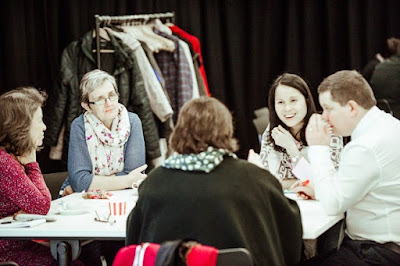
Helen Moore (left) and Amelia Lake (right) both work part-time in public health research
Amelia said, “When I first started working at Teesside University, I would frequently get asked what was my ‘side hustle’ when I wasn’t at work and people were surprised to hear that I was doing family activities with my (then) young children. While I appreciate working part-time is a privilege, it allows me a better work-life balance and time with my children.

“During the pandemic, and post-pandemic, childcare has been difficult to access, and being part-time means some days of the week can be less stressful in terms of childcare. Working part-time means I work even more collaboratively with colleagues as their support when I am not at work is important. It can be hard to switch off emails and alerts on non-working days, and I don’t always do it, but I know it is important.”

Helen said, “It was, and is, important for me, as the primary carer of young children (I have two sets of twins) with a husband who works away in the Merchant Navy, to be able to have some flexibility around when and how I work. This supports me in being able to take them to, and pick them up from, school several days of the week, and to not have to rely all of the time on either family help (which can feel like an imposition) or paid childcare (which is both expensive and difficult to find when you have four children).”

So why is it so rare to see senior leaders working part-time? Largely because there’s an embedded belief that senior leadership roles are the most challenging to do part-time. Many people will tell you it’s impossible – and that it’s not even worth attempting.

Stories of leaders like Amelia and Helen are hugely important, because we badly need more senior leaders leading the way and working part-time. When senior leaders do so it demonstrates to others that part-time work is acceptable and encouraged, and that it’s possible to keep growing a career while working part-time.

The individual and family wellbeing benefits are quite clear, and should be reason enough for organisations to start creating more part-time work opportunities. But the reality is that more encouragement may be required.

The good news is that there are some other big reasons for organisations to get on board with this.

A clear and highly relevant advantage for employers is talent attraction and retention. In the context of the ‘great resignation’ of 2022 this is a critical consideration for organisations looking to find creative ways to solve the talent shortage.

Firstly, it allows employers to retain their talented people who reach a point where they want or need to work part-time.

In Amelia’s words, “We need to see more people in leadership roles working part-time. I was promoted to Professor in my part-time working pattern which illustrates that it is possible to do high quality impactful work building capacity and also doing research, while working part-time. Teesside University has both promoted me and supported me in my part-time role.”

It also enables employers to tap into a hidden talent pool of highly qualified people who either can’t or choose not to work full-time. They include people with caring responsibilities, people with health issues, and people at retirement age who would stay in the workforce longer if given the opportunity to work part-time.

Helen said, “I strongly believe that working part-time doesn’t equate to a reduction in performance, and that it is demonstrated by my promotion to Associate Professor and being one of two Teesside University Star Award Research Excellence finalists in 2021.

“Being supported by Teesside University to work part-time in a senior role enables me to both lead the work of the University’s successful Evaluation and Impact Team, and to be able to be present and care for my four children.

“Having managers who were willing to try something new, even take a risk, and recruit a person to work part-time hours to establish and lead a new team has paid off and worked well – it has enabled me to grow significantly as both a researcher and a research leader.

“Roles similar to mine which I have previously considered, have been strictly full-time hours only, and did not feel open to someone with other commitments like me. There are a lot of talented people who for various reasons would like to work less than full-time hours, and I’m hopeful that my experience shows it is possible.”

This is also, of course, about inclusion. The consulting firm Timewise warns that if a company’s diversity, equity and inclusion (DEI) programmes aren’t underpinned by a commitment to flexible working that includes part-time, they will struggle to be fully inclusive. 'This will not only have a negative impact on their gender pay gap, but is also likely to impact their employer brand'

As well as the talent related benefits, there are also productivity benefits to be reaped by organisations who are willing to introduce more part-time roles. Organisation for Economic Co-operation and Development (OECD) data confirms that productivity (defined as output per working hour) improves with shorter hours. Across the world’s richest countries, higher productivity correlates with lower working hours.

The power and potential of part-time work really is huge. It can be a game changer for families and a smart people strategy for organisations.


Friday, 22 July 2022

Going hybrid: The best of both worlds?

Posted by Helen Moore, Associate Professor (Research), Teesside University

Since 2012 my ability to attend in-person and participate in seminars, conferences and workshops has been significantly reduced. This was partially due to a change in my mobility while I was pregnant with twins twice (!) (2012, 2015), and then after my pregnancies, due to the challenges of arranging childcare for four small children. It has become easier as they have got older, but after my second maternity leave, I returned to work but remained the primary carer for four children under the age of four as their father (my husband), was (and still is) a Merchant Navy captain, which involves working away for half of every year.

Make an enquiry about getting professional technical help as soon as you conceive the idea
 – don’t assume it will be prohibitively expensive
During this time, I had always felt very grateful to any event organiser who took the time to release the slides after their events or, as time progressed and technology moved on, to run an additional online version as this enabled me to participate, albeit in a less than perfect fashion, but I viewed it as certainly being better than nothing. I hadn’t really appreciated how many other people were also often unable to attend events in-person, due to other factors in their lives, but this was brought into sharper focus for me with the Covid-19 pandemic when I started reading, and joining in with, conversations on social media around event accessibility that had never been on my radar.

I’m sure everyone remembers that when lockdowns were imposed, initially events were completely cancelled but as time progressed and it became clear this was not going to be a ‘flash in the pan’, the planning stages of events began to include considerations of how best to run them entirely online, with many people having to rapidly learn and develop skills around using technology to engage with the maximum number of participants possible.

Between January-April 2021, I was part of a team that worked on a project commissioned by the Office for Health Improvement and Disparities (OHID) which looked at the impact of Covid-19 on the hot food takeaway planning regulatory environment in North East England. As the project drew to a close the team thought that this, alongside other work we had been involved in, or were aware of, would make an excellent Fuse Research Event, and my colleague Professor Amelia Lake and I decided we would work together to make it happen.

I was keen to explore the possibilities of having a, in my view, truly hybrid event, where participants could choose to attend in person or via a real time remote video stream, and where presenters could choose to be in the room or present via a MS Teams link. I had previously worked with the team from Teesside University’s Aurora House on other projects, and Amelia had worked with them to create the live stream of her inaugural professorial lecture, so we were confident that they possessed the skills, the technology and the will to ensure this could happen.

It took a lot of organisation to get this to work, and having organised many events pre-Covid, it was definitely more work than if we had decided to run a traditional event with in-person attendance only. I spent significant amounts of time thinking about how we could include the remote audience and presenters in the discussion in the most effective way. The entire event was live streamed on the Fuse YouTube channel, with a technician ensuring that the virtual audience saw a mix of angles and information during the session. We used sli.do to allow the remote audience to submit questions during each presentation, and then one of the organising team asked the questions using the same microphone that was used for questions from the room so everyone could hear.


We only had one minor hiccup, in that we used my personal Teams account to allow the external speakers to present, and I forgot to decline meetings that were scheduled to run at the same time – and, of course, the other meeting used the chat function, which meant everyone could read their messages! We managed to get a message to the other meeting and they quickly stopped using the chat function!

As usual, we asked for feedback on the event, and the comments were extremely positive, including the fact it was hybrid, with “Ability to attend online”, mentioned in more than one response.

I would absolutely encourage people to think about making the effort to run hybrid events. it widens your audience and opens up different avenues for discussion – posing a question via an online function is, for most people, less scary than standing up and speaking into a microphone! 

My top tips for running a hybrid event

While I was writing this blog, I thought about what my top five tips would be for anyone considering running a hybrid event in the future:
  1. Make an enquiry about getting professional technical help as soon as you conceive the idea – don’t assume it will be prohibitively expensive;
  2. Ensure you communicate with the presenters and attendees, before and during the event, about how they can interact and engage during the event;
  3. Use interactive apps such as sli.do.
  4. Avoid using personal accounts for external events, such as Teams or Zoom (or make sure to decline any other meetings scheduled at the same time!)
  5. Always ask for feedback to improve future events.

Tuesday, 12 July 2022

The Fuse conference in four Public Partner poems

How to capture the essence of a conference about setbacks, successes and 'brilliant failures' in public health research - an event report, a news story, the results of a survey?  What about in the prose of our public partners who provided their expertise as panellists?  That is what they suggested and here they are.

The 5th Fuse International Conference on Knowledge Exchange in Public Health took place between 15-16 June 2022 in Newcastle upon Tyne.  Find out more about the event, speakers and panellists on the conference website.


..the Fuse experience

PJ Atkinson, public member of Gateshead Poverty Truth Commission

PJ in the centre of a fishbowl conversation
Recently I was Invited to chat with Fuse.

Well it was a Wednesday, had nowt to lose.

They numerify and storify researching for Public Health.

And let me tell you, with very little wealth.

We had main stage speakers, panels, and side room topics, it was never droll, even sat in a fish bowl!!!

We discussed, pyramid breaking, old ideas smashing, and reforming, these people are fun never boring.

But most of all, they turn setbacks into learning, with passion and resolve.

Fuse and its people, want to adapt, grow and evolve.


Knowledge Flow

David Black, Fuse public partner and hospital governor 

(r-l) David and Irene providing their expertise on how to turn setbacks in knowledge exchange into successes

After waiting too long the day came along and it's off to the conference for me.

Knowing where I'm going, despite the traffic slowing, I'm knowing I'll be on time.

Must listen today then whisk my thoughts away to plan what I'll say tomorrow.

A script's what I need after taking heed of the need for brevity.


We're off and running, the introductions are made and it's welcome to one and all.

A programme, like life, which can be subject to change.

Reflections on knowledge mobilisation and mistakes.

Evidence of local knowledge exchanged at place.


Amid the plethora of parallel sessions and plenary panels.

The exchange of views over coffees and teas.

The paper presentations and interactive poster sessions.

Fishbowls of hot topics and Cabaret of dangerous ideas.


A modicum of the local and a smorgasbord of internationalism.

I entered to play at the start of the day, full of eagerness to learn.

To share a thought and to be taught a lesson by all in attendance.

Public health, its impacts and strength of this particular human endeavour.


Day two is here and I'm ready, with no fear.

Up on the stage, knowing what to say and trying to keep it brief.

Then before you know it's off, we go and ending with applause all-round.

To have a voice and speak it out, it's a great place to be.


Good feedback I'm feeling, plenary speaking's appealing.

Networking and knowledge sharing, I'm doing.

A supportive, safe space, it's a real great place.

For setbacks and solutions to be shared.


So, to the end game, the main themes and learning all noted.

My highlight, the brilliant afternoon keynote.

Institute of Brilliant Failures with celebration, laughter, a new way of thinking.

A refreshing concept, informing my future knowledge sharing and learning.


My First Fuse Conference

Margaret Ogden, Patient and Public Involvement (PPI) representative from County Durham

Margaret (right) sharing her experience of the importance of setbacks in knowledge exchange in public health

I went to the Fuse conference in mid June 22

PPI members were invited, I met more than a few

The focus was knowledge exchange, so meaningful to me

In presenting I’d soon see how dynamic I could be

I loved the international element to this annual conference

Diversity was a theme that would get so much reference

Seldom heard communities, always a huge challenge

Dissemination of info too, a challenging thing to manage

Just how effective can knowledge exchange be

With the right expertise, it can be achieved quite easily.


I began my talk with detail of a planned PPI event

That didn’t go well, in spite of the hours which we spent

Planning, collaborating, finding the right venue

But with few attendees present, it can all go askew

We’d do better next time, was our overriding thought

For on that occasion, limited data was caught

I also referred to a further memorable meeting

Where conflict had arisen, it could have been defeating

It was really a clash of people with strong wills

I had to dig deep for new negotiating skills.


As a panel, I felt we made a great team

This experience had totally elevated my self esteem

My first face to face high profile event

At a nearby location, that was heaven sent

My mobility had worsened in the last two years

Confidence had been dented, I now had fears

I needed to get stamina back and level of fitness

I imagine my struggles were hard to witness

But as I move forward with determination and fortitude

I thanked my hosts for the invite which I’d accepted with gratitude

I didn’t make the second day of this interactive event

That had been a real shame, was my only lament.


Knitting out the Knots 

Irene Soulsby, Fuse public member from Gateshead
 

We talked a lot 

Knitting out the knots 

We talked and talked and talked 

A LOT! 

Knitting out the knots 

Comparing designs 

Line by line 

Reknitting stiches  

Holes and lines 

Redesigning our designs 

Comparing setbacks and successes 

Knitting them into things that would impress us  

Learning from each other 

With enthusiasm and sharing 

Creating our new designs.


Many thanks to our public partners for taking the time to write their fantastic poems for this Fuse Open Science Blog. 

If you are interested in joining the Fuse Public Partner Network please visit the dedicated Public Involvement section on our website.

Monday, 20 June 2022

Father's Day is a reminder that men’s mental health is everyone’s concern

Posted by Heidi Stevens and Katie Webb, Researchers from the Department of Health Sciences at University of York.

** Content/trigger warning: mental health, depression, suicide **

It cannot have escaped your attention that Sunday was Father’s Day (happy belated wishes to all the dad’s out there!), but did you also know that it was the culmination of Men's Health Week?

The campaign run by the Men’s Health Forum encourages men everywhere to give their bodies and minds an MOT and includes resources to boost mental wellbeing.


This and other campaigns like Movember try to raise awareness that, for our sons, fathers, brothers, partners…for wider society… men’s mental health is everyone’s concern. Sadly, men’s mental health in general is looking quite poor.

Having just completed work as a research associate on an NIHR Applied Research Collaboration North East and North Cumbria (ARC NENC) funded project focused on severe mental illness, I started a fresh project in a completely different area of mental health at the University of York. Namely, men’s mental health.

Until I applied to work on this research, I had honestly never considered men’s mental health as I had generally always been female gender focused. Traditionally, women’s poor health is viewed as a product of social circumstances, while men’s poor health has been seen as a product of men’s ‘bad behaviour’. Working on this research has revealed a completely different perspective and as such I have developed a lot more empathy towards men’s health.

In England, suicide is highest among men and is the leading cause of death for men aged 20-34 (Men's Health Forum). Similarly, records within NHS ambulance services indicate that the risk of suicide amongst paramedics who are men is 75% higher than the general population (Mars, 2020). Other industries also show higher rates of depression amongst workers who are men, such as construction workers and utility workers, sometimes due to long or unsociable work hours.

Despite this poor picture, only 36% of referrals to psychological therapies are men (Mental Health).


So why is this?

גברים אמיתיים לא אוכלים קיש
Sjustdoitright, CC BY-SA 4.0, via Wikimedia Commons

Barriers to improving men’s mental health relate to hegemonic ideals. Although men range in class, age, sexuality and ethnicity, the theory of hegemonic masculine identity in western society embodies shared attributes of stoicism and restriction of emotions to which many men may have been socialised or expected to conform. As such, some men may find it challenging to express or take action in response to ill health as they feel this may make them appear weak or not masculine (Galdas, 2005 )

For example, 38% of employed men with mental health concerns feel that their employer will think badly of them if they take time off for a mental health appointment (Men's Health Forum).

Then there is the use of coping strategies such as substance misuse. Generally, men tend to deal with health problems by seeking refuge in addictions or ignoring treatment needs, as such common mental illness such as depression often remains undiagnosed. In the UK, since 2001, rates of alcohol-specific deaths for men have consistently been more than double those for women (ONS).

The World Health Organization (WHO) states that achieving gender equality requires men to be engaged in transforming patterns of care, including self-care. This may include tailoring health interventions to men and involving men from all backgrounds in the role of mental healthcare co-production and promoting the positive aspects of masculinity such as humour and goal-orientation.

This year in the UK, the All-Party Parliamentary Group (APPG) on men and boys’ issues have been urging the Government to develop a men’s health strategy with a focus on inequalities stating that this would benefit not just men and boys but also women and girls. So, for our sons, fathers, brothers, partners…for wider society, let’s promote a wider understanding of men’s health issues.


Our research in the Mental Health and Addictions Research Group (MHARG) at the University of York aims to prevent the development of common mental illness among male frontline NHS workers. With funding from Movember, we will deliver a brief Behavioural Activation intervention which will be carefully tailored to men with guidance from our consensus group of NHS staff from diverse roles. Behavioural Activation is an evidence based talking therapy which aims to break the cycle of avoidance created by low mood or anxiety, by reinstating valued and meaningful activities.

To find out more please see our links below or feel free to contact us.


Images: 
  1. 'FVHjjxFXEAAaBos' with thanks to Men's Health Forum.
  2. Sjustdoitright, CC BY-SA 4.0, via Wikimedia Commons.

Tuesday, 31 May 2022

Are we really aware of the harm Big Tobacco causes our planet?

Posted by Ailsa Rutter OBE, Director of Fresh and Balance on World No Tobacco Day

The annual World Health Organization (WHO) campaign highlights the many harms of tobacco. This year’s theme explores the growing threat to our environment.


We know that smoking is the worst thing that we can do for our health – 8 million people around the world lose their lives from it each year.

Many of us are already taking action to do our bit in tackling climate change. But do we ever think about how tobacco is polluting our world globally, nationally and here in North East England?

As we face a climate emergency, our fragile ecosystems are being put under even more pressure by the tobacco industry. Tobacco damages the environment, from growing and production, distribution to waste.

Reflecting on my 24 plus years in tobacco control, I’ve seen many appalling tactics from Big Tobacco (the largest global tobacco companies who make billions in profit from killing people and destroying the planet) – including ploys to get kids hooked on a life-long addiction.

It takes a lot to shock me these days, but even I am shocked to read the things that the tobacco industry is doing to our environment.

What we see on the surface is just the tip of the iceberg. Some of the mind-blowing statistics every year:
  • 600 million trees chopped down for tobacco.
  • 84 million tonnes of C02 released into the air, raising global temperatures.
  • 22 billion tonnes of water used to make cigarettes.
  • 4.5 trillion cigarette butts not disposed of properly across the globe, generating 1.69 billion pounds of toxic waste and releasing thousands of chemicals into the environment.
Big Tobacco ‘greenwashes’ its impact on the environment through sustainability corporate social responsibility and marketing initiatives, designed to make people and investors think it cares.

Every day we see its impact on our streets and beaches. Cigarettes are the most commonly littered item in the world.

Cigarette butts are made of cellulose acetate, a man-made plastic material, which takes years to degrade and dump a toxic mix of nicotine, arsenic and heavy metals into our water, soil and oceans before turning into microplastic pollution. It makes me so sad to think what this toxic waste is doing to our marine and river wildlife.

Eight out of 10 (81%) North Easterners in a YouGov poll commissioned by Action on Smoking and Health (ASH) want to see plastic in cigarette butts banned. As part of our World No Tobacco Day activity, we’re joining forces with environmental campaigners to protect the region’s beaches from plastic cigarette butts.

Beyond our region, in the developing world, deforestation for tobacco plantations is happening on a vast scale. Around 3.5 million hectares of land are destroyed for tobacco growing each year. That’s the equivalent of over 1.4 million football fields!

The environmental burden is falling on the countries which are the least able to cope with it. Farmers in low- and middle-income countries are left in debt, with widespread poverty and illness among farm workers. Meanwhile the global tobacco companies continue to make billions in profit.

I reflect on when I attended a world conference in 2006 and heard about young children being exploited for child labour by tobacco companies; picking tobacco leaves and exposed to toxic pesticides and hazardous working conditions. The consequences are life-long and this is happening around the world, as shown in the devastating 2016 Human Right Watch report “Harvest is in my Blood”.

As a mother, with children and grandchildren, I am extremely concerned about the future impact.

The question I think we should ask ourselves is – are we really aware of the harm that the tobacco industry is causing to the environment? If the answer is no, then let’s pledge to read some of the fantastic resources on the issue, including those on the WHO website. Talk to people about it, call for action. Learn more about the tobacco industry; the harm it causes.


We are supporting national colleagues Action on Smoking and Health in calling for a levy on Big Tobacco, to clean up the harm and to further reduce smoking to reach the Government’s target of a Smokefree 2030 (5% by 2030).

In the North East we’ve seen smoking rates fall faster than anywhere else in the country, thanks to the hard work and dedication of colleagues in the region.

But as the major threat of climate change looms, it’s vital that we go further and faster than ever to reduce the tobacco industry’s destructive impact and make smoking history for the next generation.


Ailsa Rutter OBE, is Director of Fresh and Balance, the North East’s combined alcohol and tobacco programme, working to reduce the harm, the death and disease caused by smoking and alcohol.

Tobacco is still the biggest cause of premature death in the UK, with an estimated 74,000 deaths each year in England and over 113,000 deaths from smoking in the North East since the year 2000.

Friday, 13 May 2022

Planning for a healthier future?

Posted by Tim Townshend, Professor of Urban Design for Health, Newcastle University

Can we plan for a healthier future by intervening in the built environment? You may be surprised to find out this is not a new idea! Indeed, the very concept of Town Planning emerged in the last quarter of the 19th Century out of a concern for public health and to help prevent the spread of infectious diseases such as cholera.

Ebeneezer Howard - ‘slumless, smokeless’ garden cities

The resulting Victorian terraces, with fresh water supplies and internal toilets may seem unimaginative, but they were a huge improvement on what went before - and did indeed prove a boon to public health. What’s more many still provide decent homes today.

Early planning thinking was also dominated by a vision that the physical health attributes of the countryside – access to open space, clean air and fresh food could be combined with social and economic (mental health) benefits of the city – including opportunities for education, access to culture and wider social contacts. Such thinking is typified by the Garden City Movement associated with Ebenezer Howard and realised - at least in part - in towns such as Letchworth in, Hertfordshire.

Health was at the core of planning for much of the 20th century, however, in the post-war period it became eclipsed by other issues - particularly the need for economic regeneration. Consequently, the health and well-being impacts of the way our towns and cities were developing was not considered carefully enough.

“...primarily designing around the needs of the private car - rather than humans - has been a disaster.”

In retrospect, primarily designing around the needs of the private car - rather than humans - has been a disaster.  Busy roads now cut noisy polluted swathes through communities; poorer neighbourhoods find themselves served by ‘toxic high streets’ – a deadly mix of nutritionally poor food, subprime financial services, betting shops and other potentially harmful outlets; and vast tracts of poor-quality new build housing - devoid of adequate open space, or local services - have been constructed in the suburbs.  At the same time rates of obesity (and associated health/well-being consequences), respiratory and so-called ‘lifestyle’ diseases have all soared. Moreover, these impacts are not felt equally across all neighbourhoods, and health inequalities unjustly burden the poorest in society.   

 Interlinked themes explored in Healthy Cities? Design for Well-being
It does not have to be this way, however. We can plan for a healthier future and create places that support individuals and communities to take healthier lifestyle choices. In ‘Healthy Cities? Design for Well-being’ I explore five inter-related topics and the ways in which the goal of a healthier future can be achieved.

There is for example a large and robust evidence base around our need for urban greenspace (as was highlighted so graphically during the COVID-19 lockdown period). Green (and blue) spaces in our cities not only facilitate physical activity and socialisation (positive for physical health and mental well-being) but can mitigate against issues such as, air and noise pollution, ‘heat islands’ (the significant heat increases in urban areas as compared to their surroundings) and alleviate flood risk. Crucially, however, greenspaces have also been shown to reduce stress levels and help restore cognitive capabilities - for example concentration levels - just by being there.  

Planning policies can also be used in conjunction with public health goals to tackle specific health issues. A great example of this, is the development of planning guidance and regulation to tackle the further spread of hot food takeaways – a key component of my ‘toxic high street’ concept, which I explore in more detail in the book.  While planning cannot tackle existing businesses it can limit further spread, especially in sensitive areas – for example near schools, as research has proven the link between hot food availability and overweight/obesity in older children. Issues we will explore at the Fuse Research Programme Meeting “Planning for a healthier future: Priorities and Practicalities” on May 18, 2022, at Teesside University (and available online).

Therefore by encouraging those aspects of the built environment that support healthy lifestyle choices, while constraining those aspects we know are linked with less healthy lives, healthier places are within our grasp – but this can only be achieved if we collaborate across disciplines and garner the political support required to make it happen!


Healthy Cities? Design for Well-being is available to order now


Image:

1. Howard, Ebenezer. "Diagram of a group of slumless smokeless cities.". 1898. From Ebenezer Howard, "To-morrow: A Peaceful Path to Real Reform" [London, 1898]. https://www.aaeportal.com?id=40518. Web. 12 May. 2022.

Friday, 1 April 2022

Breaking down barriers in End of Life care

Posted by Colette Hawkins, Consultant in Palliative Medicine, South Tees NHS Foundation Trust

Health research achieves extraordinary things. There are countless examples of life-changing, disease preventing or curative treatments. These are rightly celebrated and have shaped our society, as well as our expectations, around health and illness.
Break Through 1995 "Walls break hearts, hearts break walls" by 
Pierre Marcel via Flickr © 2011 (CC BY-NC-ND 2.0)


But what about people living with a life-limiting illness and those approaching end of life? Health professionals often struggle to move away from an interventional, disease-focussed approach to a more holistic, person-centred approach. This risks unwanted intervention and missed opportunities for choice. This is mirrored by health research. In the UK, just 0.21% of health research is focussed on palliative and end of life care.

The reality is that people living towards end of life really struggle and whilst this may be directly related to ill-health, it is often issues of daily life which incapacitate them. These are generally overlooked by health professionals.

Since 2017, I have been involved in running research on legal needs in life-limiting illness. One element of this is social welfare legal needs (SWL): matters of daily life for which the law defines rights, entitlements and protections. In the context of life-limiting illness, the ‘big three’ are issues relating to money, employment and housing. These are prevalent, impacting most people in some way. However, their greatest impact is on people who are already disadvantaged, for example those experiencing homelessness, financial insecurity or debt, socially excluded or marginalised groups and people with multiple physical and/or mental illness. These people experience the most SWL needs, are most affected by them and are least likely to access support successfully.

Social welfare legal needs will often be presented to health professionals, wrapped up in a person’s physical complaints, but missed in favour of a focus on disease. So where else could they go? Our foundation research scoped the system of support for these issues. A wide range of services beyond health and social care provide advice and support for SWL needs, including charities, community groups, advice sector, legal services, social services, Jobcentre, housing groups, social prescribing, statutory organisations and more.

But if we took months to map the system (and it’s still growing), can we expect people in vulnerable and difficult situations to find their way?

Funded by the NIHR Applied Research Collaboration (ARC) North East and North Cumbria (NENC), our research has engaged members of the public with lived experience, as well as service providers in Gateshead, to find an effective system response to social welfare legal needs. We used Human Learning Systems, an approach which accepts the complexity of a system and supports co-produced responses to need founded on continuous learning.

Engagement of people with lived experience of life-limiting illness and SWL needs proved critical to the value of this project. Focus group discussions revealed the scale of the challenge to manage SWL needs. The walls they faced included not feeling heard, not knowing where to go for help, lack of information to help themselves, lack of responsibility from professionals or services, poor communication between services and long delays to resolution (or non-resolution). These insights, along with those of service providers, told us that the ideal system response should be founded on relationships and offering information, problem solving and a joined up approach. This seems quite obvious and appropriate, so why are there so many walls?

Attitudes and structures 

The walls come from two main sources: professional attitudes and structures. Attitudes obstruct when they use labels, stereotypes or assumptions, treat illness, not people, miss opportunities for honest discussion, restrict choice through failing to listen to priorities and wishes, overlook responsibility for holistic needs and forget to work in partnership. Structures maintain silos and fragmentation of care with the lack of clear routes to advice and support, boundaries to access through geography, referral criteria or social context, expectations that patients and carers will self-advocate and navigate themselves and missed opportunities to capitalise on the expertise of others. These walls obstruct identification and management of social welfare legal needs and amplify inequalities in care towards end of life.

We believe interprofessional learning is a route to breaking down these walls. We use short stories of experience instead of ‘sterile’ clinical cases, and facilitate discussion to explore what matters most, and the approaches to meeting needs in an inclusive, respectful and effective way. Initial pilots have shown that this is a route to closer integration of services, although the latest pilot, within the ARC project, also highlighted the challenge of engagement with online learning, accentuated by the pressure and workplace fatigue linked to COVID-19. Feedback showed that people felt too busy to attend or just didn’t turn up on the day.

We have secured a NIHR End of Life Partnership grant which we are using to co-design a research strategy for evaluation of system-wide learning around SWL needs in life-limiting illness. We are re-evaluating what we mean by ‘end of life’, pushing beyond traditional views and including people at risk of premature death. We are broadening our insight into the inequalities and prejudices embedded within care of people who may be living towards end of life. We can see the walls; our task is to break them down.


This project ‘Integrating care to meet social welfare legal needs in life-limiting illness. Qualitative investigation of a multi-agency, complexity-informed intervention’ has been funded by by the National Institute for Health Research (NIHR) [Applied Research Collaboration North East and North Cumbria (NIHR200173)]. The views expressed are those of the author(s) and not necessarily those of the NIHR or the Department of Health and Social Care.


Image: Break Through 1995 "Walls break hearts, hearts break walls" by Pierre Marcel via Flickr © 2011: https://www.flickr.com/photos/21063155@N06/5409729627 (CC BY-NC-ND 2.0)

Friday, 25 March 2022

Is a picture truly worth a thousand words?

Posted by Emma Adams, NIHR ARC NENC Mental Health Fellow at Newcastle University, and Experts by Experience from Fulfilling Lives Newcastle Gateshead & #HealthNow Newcastle

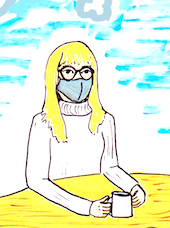
An illustration of me! Taken from one of the images
below created by Siân from More than Minutes
We have all heard some variation on the saying “a picture is worth a thousand words”, and yet often information is shared through large reports with thousands of words and few images. A 2019 paper published in Nature Communications highlighted that with all the information people can read, gaining people’s attention is increasingly difficult.

Take the image of me (right), it tells you about my hair colour, glasses, outfit, that I'm partial to a tea or coffee and that I am sitting at a table. If I had written a description of everything that you can get from the picture, it would have likely taken up far more space. If it were me, I would probably only have skimmed the text. As a public health researcher, part of my job is finding ways to share research findings in a way that will engage people to want to learn more and have a conversation (something we in Fuse like to call knowledge translation).

Alongside my Experts by Experience (individuals with lived experience of homelessness, mental ill-health, and/or substance use) we began to ponder how to share what we learned from our NIHR School for Public Health Research (SPHR) funded study exploring access to community based mental health and substance use support during the COVID-19 pandemic for individuals experiencing homelessness and those providing support. We had finally reached a point where there was a light at the end of the tunnel, as we moved away from understanding to sharing the findings. Yes, we figured we would write a couple of papers, attend some conferences, and likely write a report, but the bigger question was would the people in policy and practice and individuals experiencing homelessness read those documents? While trying to be nice, one person levelled with me and said Emma, “I’m probably not going to share a PowerPoint with a friend” and another said, “I don’t even know what that journal is”. Quickly the realisation sunk in that we were going to have to come up with a better solution for sharing our findings.

I began to think about visuals but realised my failed attempts at drawing stick people meant I probably would not be able to do this on my own. Two of the Experts by Experience spoke about a visual they had seen designed by More than Minutes for a peer research study around barriers to accessing care and treatment for people experiencing homelessness (#HealthNowManchester). I realised in that moment we had found our answer. Suddenly the Zoom call was abuzz with energy as everyone got excited about what story our visual might tell. As one person said, “it’s aimed at people who can’t read or write, or have a disability - someone like my brother”. Perhaps even more insightful was the comment that, “it [a visual] could have a different meaning for each person depending on their own experience”. 

We met with Siân (an illustrator from More than Minutes) and began planning the image and figuring out how to depict our endless pages of ideas into a visual that was engaging without being overwhelming. Over the next few months, we had a bit of back and forth on what we were envisioning. When the initial pencil sketch arrived, we were shocked at how the images captured so much of what we wanted to share without being a visual overload. Like kids at Christmas, we sat in suspense waiting to see what the final colour version would look like. We knew it captured exactly what we wanted when we saw the coloured versions. It was the physical depiction of everything we had learned and would proudly adorn our homes and offices! Through working with Experts by Experience and having input from colleagues in practice, we believe we have created a poster that depicts the experiences without some of the stigma we often see. Each of us saw something a little bit different in the poster, and we could not wait to share it with friends, colleagues, and providers. 

Created by Siân from More than Minutes; See the full images on the NIHR School for Public Health Research website.

Having had the experience of seeing words and quotes come to life, I cannot wait to do it again. Although we will continue to write papers and reports, the ability to share the images from our phones or by email with anyone has made us think about other creative ways to communicate research in the future.

So, I end this post with a question for you, do these pictures tell a better story of the findings than a one-page summary would have? Between you, me, and our Experts by Experience, we will be returning to this visual time-and-time again whereas the paper and report might not have the same reach and engagement. 

-----------------------------------------------------------------------------------------------------------------------------------------------------------------------------------------------------

To make this visual freely accessible, we would welcome organisations printing their own copies. If you are printing the poster, please print it in its entirety and email Emma Adams emma.adams@newcastle.ac.uk so we can see all the places sharing our findings. A limited number of printed posters are available directly from Emma for pick up from Newcastle University.

Initial findings from Emma’s study have now been published in the International Journal of Environmental Research and Public Health.

A Fuse Research Programme Meeting is planned to share more information about Emma’s study. Stay tuned for the save the date and further information. 

-----------------------------------------------------------------------------------------------------------------------------------------------------------------------------------------------------


Emma is a Mental Health Fellow for the NIHR Applied Research Collaboration (ARC) North East and North Cumbria (NENC) and a previous NIHR School for Public Health Research (SPHR) Pre-Doctoral Fellow.  Her study 'Exploring and understanding access to community-based mental health and addiction services in Newcastle and Gateshead' is NIHR SPHR ResNet funded.

This project is funded by/supported by the National Institute for Health Research (NIHR) School for Public Health Research (SPHR) (Grant Reference Number PD-SPH-2015-10025). Emma was supported by the NIHR SPHR Pre-doctoral Fellowship Funding Scheme (Grant Reference Number PD-SPH-2015). Emma is now supported by the NIHR Applied Research Collaboration (ARC) North East and North Cumbria (NENC) (NIHR200173). The views expressed are those of the author(s) and not necessarily those of the NIHR or the Department of Health and Social Care.

Friday, 11 March 2022

Universal Credit experiences and research co-production

Introduction by Mandy Cheetham, Research Fellow in the Applied Research Collaboration North East and North Cumbria (ARC NENC), Northumbria University

I contacted David in my role as public involvement lead for the NIHR funded study on Universal Credit. As a research team, we made a commitment to include the views of people with experience of claiming Universal Credit as part of our public involvement and engagement activities. David very kindly offered his assistance and has been one of the contributors who have helped shape the study so far.

------------------------------------------------------------------------------------------------------------------------------------------------------------------------------------------------------

Posted by David Black, Fuse Public Partner and Expert by Experience

David takes part in a wide variety of public involvement and engagement activities  
I had noted many observations during my experience of engaging with the Universal Credit system and had a little experience of welfare benefits in a previous roll assessing applications for legal aid. As I'd been involved in co-production work relating to clinical research and healthy ageing in a number of patient and public involvement roles, I knew what would be expected of me in terms of sharing my perspectives about Universal Credit with the research team. Preparation prior to the initial meeting was key to getting my messages across, so I made some notes and checked out dates and relevant facts about the benefit online.

The messages I wanted to share about Universal Credit related to my direct experience and also what I'd see at local libraries when other people had been trying to use computers to apply for the benefit and respond to requests from the Department for Work and Pensions (DWP) that were expected to be done online. Some of the people trying to use computers were clearly struggling and I found myself and the librarians were regularly asked for assistance. I'm a helpful kind of person, so I would try my best to assist. Many of the people I met did not have the basic computer skills necessary to complete what was requested and with a time limit on computer access at the library, it was often a struggle.

As part of my co-production work I shared my experience of the initial application process and explained to the researchers that I had to go to my local library with all of my personal data in document form in order to complete the online application. It took me an hour and I was concerned that I had all the information to complete the form in full in one go. One of the frustrations I had related was the process of proving your identity via an online checking tool. Having initially been relieved once I'd got the main online form completed and saved, I found myself beaten by the simple process of proving who I was! The system simply did not work for me in this regard and after going home and phoning the DWP I was given an appointment to go to a Jobcentre to complete this process manually.

It was clear to me what information I wanted to share with the researchers and the fact that they were good listeners and gave me the time and space to explain my experiences helped a great deal. In the past I'd always found the process of seeking help from the unemployment benefit system to be relatively easy, but Universal Credit was a disaster for me. Not only did the DWP assume all claimants had access to the internet all of the time - something that I did not have until the pandemic started, which was years after my experiences of Universal Credit - but a constant stream of text messages in relation to Universal Credit created a state of panic and worry for me.

An important message I got across to the researchers was that ultimately I was deemed to not qualify for Universal Credit and left without any help or assistance. Something I'd never experienced when I'd previously reached out for help from the state system. Continuing my co-production work with researchers in this area of study has given me an immense sense of pride and satisfaction. I hope that in working on this research in some small way I can assist in the future understanding of how changes to benefits and the wider government welfare system can have real impact on the lives and wellbeing of people.


If you are interested in becoming a Fuse Public Partner, please visit the Public Involvement page on the Fuse website.

Friday, 11 February 2022

Dressing as a tomato and meeting the CMO - all in a day's science

Elsie Widdowson, British nutritionist
Posted by Amelia Lake, Professor of Public Health Nutrition at Teesside University and Associate Director of Fuse

In this blog on International Women's Day, Amelia tells us about the pioneering female scientist who inspired her career in nutrition science.

When I was at University studying for my degree in Human Nutrition and Dietetics in the mid 1990s our ‘food tables’ were in books – actual books that you held.

We worked out nutritional content of food using books and calculators. Now-a-days this is all done by software without the need for the hard copy of the books. The book we all had was a copy of the ‘McCance and Widdowson’ Food Tables. I still have my well thumbed copy and the book is the the basis of the modern software systems that nutritionists and food scientists use.

Although as an undergraduate I didn’t really give the names McCance and Widdowson much thought it was later on in my career, thanks to the British Nutrition Foundation and my colleagues, that I really learned about Elsie Widdowson. She was born in 1906 and died in 2000 having spent a long and productive life as a pioneering female scientist. Along with her colleague Robert McCance, Elsie Widdowson was at the forefront of the Nutrition effort after World War II.

Elsie studied Chemistry at Imperial Collage London and in 1931 completed a PhD in Chemistry also at Imperial. Elsie met Robert McCance in the kitchens at Kings College Hospital in 1933, when she was studying to become a dietitian and he a junior doctor. Here, in the hospital kitchens, began a partnership that would last for 60 years!

It was at Cambridge, where they both worked, that the book I mentioned earlier was developed: a publication pivotal to nutritional science. But it wasn’t just for the development of this book that she has my respect - it was for the pioneering work around vitamin and mineral fortification, the rehabilitation of severely starved individuals and malnourishment around the world and important work on infant diets. This was an incredible female scientist who paved the way for nutrition scientists like me.

 
                           My inaugural Professorial lecture - challenging the food environment

I recently spoke about today’s nutrition challenges in my inaugural Professorial lecture. Preparing for this lecture I had to reflect on the work I have been doing in the field of nutrition research starting from 1998, looking at ‘the influence of Western Food on a Traditional Diet’ in Western Sumatra Indonesia for my first degree, through to my PhD studies on longitudinal dietary change and then finding my field around Obesogenic Environments and Food Environments. Similar to the ever changing Food Environment, which I study, the field of nutrition science is ever changing - in line with our changing diets and behaviours. There remain many challenges not least around food insecurity which, according to a new report by the Food Foundation, continues to increase. The current cost of living crisis puts food and eating into the spotlight. 

One of the challenges of Nutrition Research is around communicating. Doing this clearly around the noise of misinformation about food or food products is a challenging job! Throughout the twenty-three years that I have worked in nutrition, I have spent a significant amount of time communicating. Sometimes, that involves dressing as a tomato for a public lecture to children (see picture) and sometimes that involves meeting the chair of The House of Commons Science and Technology Committee (Sir Norman Lamb) or even the Chief Medical Officer (Professor Chris Whitty). But most of the time it is about exchanging knowledge between professionals and communicating to the public about the ‘latest’ nutrition fad or ‘superfood’ (spoiler - there is no such thing as a superfood).

Dialogue is important, food is important and nutrition science has much to do. I think I am going to be kept busy in my line of work for a few more years!

The other issue I reflected on during my inaugural lecture was my career breaks (3 in total) and the fact that I have worked part time (3-days per week) since having my second son Auden in 2012. My eldest son David died from a rare disease called Alveolar Capillary Dysplasia in 2011 and, along with my husband we run a charity called The David Ashwell Foundation raising money for research into this usually fatal lung condition affecting newborns. In 2020 I was recognised by TimeWise as a Power Part-Timer. Since doing my lecture, I have received a number of emails thanking me for talking about working part-time and for acknowledging the army of helpers it requires to be a working parent.

If you want to help make a difference in people’s lives I can recommend a career in nutrition science….

#InternationalWomensDay #IWD2022 #BreakTheBias


Now that's what I call blogging 2021

Posted by Mark Welford, Fuse Communications Manager, Teesside University

Let’s all channel British novelist E.M. Forster and play a little game of Only Connect. What connects the things below?


“Yes of course, they can all be a type of list” (said in the friendly yet ever so slightly patronising manner of host Victoria Coren Mitchell)
I think it's fair to say that we all love a list. I mean, the premise of another very popular BBC gameshow is basically to list pointless stuff.

So here again (a little later than advertised) is our annual list of the most-viewed Fuse blog posts of 2021!

You'd be forgiven for thinking that this would be dominated by Covid and the pandemic as we saw in the 2020 list.

Obviously, we had our fair share of pandemic related posts. Blogs about misinformation, food insecurity, malnutrition, obesity and what children made of it all. How it impacted on work and engagement with public partners, parents, decisionmakers, practitioners, policy-makers and commissioners. How it affected our mental health, our liberties and even inspired a song and a cat-scale of wellbeing!

But as you can see from the list below it didn't dominate the top 5 chart-toppers of 2021. Perhaps a little escapism goes along way...

------------------------------------------------------------------------------------------------------------------------------------------------------------------------------------------------------

Katsushika Hokusai: The Great Wave off Kanagawa
5. The other third wave: a mass epidemic of very individual pain

Posted by Jack Nicholls, Lecturer in Social Work at Northumbria University

Lockdown restrictions were beginning to ease in the UK. But after the jubilation, what if you don't feel the way you think you should?

A very personal post by Jack Nicholls on the long-term mental health consequences of the pandemic, of lockdown and social restrictions, and of its easing. 

*Content/trigger warning: mental health, depression, suicidal feelings.

Page views: 938
Published: 16 April 2021.

------------------------------------------------------------------------------------------------------------------------------------------------------------------------------------------------------

4. Patient and Public involvement with Parents during a Pandemic: the four ‘P’ challenge


Posted by Hannah Batten, Food and Human Nutrition undergraduate student at Newcastle University. Hannah was on a placement year with the Population Health Sciences Institute, as part of the MapMe study aiming to help parents assess child weight.
Body image scales on the MapMe website are being updated for MapMe2
"Most importantly, is to say to our participants that we are extremely grateful for their time and input, particularly during these uncertain times."
Hannah tells us how she and the MapMe study team met the challenges involved in recruiting and running an online Parent Involvement Panel (PIP) to help review documents and study materials, when parents were already dealing with a global pandemic. 

Page views: 1,029
Published: 5 March 2021.

------------------------------------------------------------------------------------------------------------------------------------------------------------------------------------------------------

3. Should pregnancy 'be incentive enough' to quit smoking?

Posted by Susan Jones, Research Associate at Teesside University

In this blog post on #NoSmokingDay, Dr Jones explored deprivation, guilt, shame, stigma and the complex web of reasons behind smoking behaviour.

Page views: 1,155
Published: 10 March 2021.

------------------------------------------------------------------------------------------------------------------------------------------------------------------------------------------------------


2. Things I wish I’d known when I started my PhD… (part 1)

Posted by members of the Population Health Interventions Programme at the MRC Epidemiology Unit


Research doesn't happen overnight, avoid comparison and channel your inner Arsène Wenger ("Le Professeur"). In our second most popular blog post, the early, mid and senior career researchers at University of Cambridge share their tips for PhD survival.

Here is part 2 which interestingly received only half as many views despite including a High School Musical reference.


Page views: 1,347
Published: 4 June 2021.

------------------------------------------------------------------------------------------------------------------------------------------------------------------------------------------------------

1. Can Forest School inspire the next generation to be happy & healthy?

Posted by Katie Beresford, undergraduate student at Durham University

With more than 2,700 views this is our most read post of 2021 by some distance!

In it Katie explores growing up in the Lake District, embracing nature, finding school restrictive and struggling academically in her early years.

Nearly two decades later she is completing a Fuse summer internship with the NIHR School for Public Health Research and is tasked to review literature discussing the effectiveness of Forest School as a public health intervention.

Why not grab a coffee and take a walk with Katie into the woods to find out what she discovered...

Page views: 2,746
Published: 8 October 2021.

------------------------------------------------------------------------------------------------------------------------------------------------------------------------------------------------------

So there you have it, the top five Fuse blog posts of 2021. Congratulations to Katie who wins a rare and coveted Fuse paperweight!  

Fantastically both Katie and Hannah's blog posts were part of our Fuse blog Student Series which we launched last year! This showcases posts by students who have been challenged to write a blog as part of their studies. The authors may be new to blogging and we hope to provide a 'safe space' for the students to explore their subject and find their voice in the world of public health research. Hopefully this will encourage other students to take the plunge!

As always, many thanks to our loyal readers and fantastic contributors.

Can we do any better in 2022? If you fancy giving it a go, please find out what we are looking for and how to take part here. All contributors receive a much sought-after Fuse badge.


Images:
2. Image: Katsushika Hokusai, (CC0 1.0), via Wikimedia Commons
4. Mr. Alexander Ottesen, CC BY-SA 2.5, via Wikimedia Commons