Thursday, 23 October 2014

52 weeks in public health research, part 42

Posted by Peter Van Der Graaf and Mark Welford


From Peter Van Der Graaf: The Fuse stand before the maternal, infant and child health conference held in the Legends Lounge at The Riverside Stadium, home of Middlesbrough Football Club.


From Peter Van Der Graaf: The audience for the event was broad: from pharmacy, marketing and child nutrition to maternal mental health, smoking and alcohol misuse, and immunisation.  Key message: we need clear and consistent messages across all health professionals.  But what about 'pleasures' of unhealthy behaviours and structural inequalities in accessing opportunities to change behaviours?

Meanwhile in Sheffield...


From Mark Welford: A sister Fuse stand at the National Institute for Health Research School for Public Health Research (NIHR SPHR) Annual Scientific Meeting.  The ASM showcases the School’s research priorities and themes and sets out the School-wide programmes of research. 


From Mark Welford: Established in April 2012, the SPHR is a partnership between eight academic centres, including Fuse, with excellence in applied public health research in England. The School aims to build the evidence base for effective public health practice.  


Bonus pic from Mark Welford: No '52 weeks...' post would be complete without the obligatory food image.  It's a close run thing between the muffins and fruit in the refreshment break popularity contest.

------------------
A reminder from the Fuse blog group:

Each Thursday of 2014 we’ll try and post around four pictures on the Fuse blog that capture our weeks in public health research, from the awe-inspiring to the everyday and mundane. Given that more of the latter than the former exists in most of our lives, we foresee problems compiling 208 images worth posting on our own. So this is going to have to be a group project. Send an image (or images) with a sentence or two describing what aspect of your week in public health research they sum up and we’ll post them as soon as we can. You don’t have to send four together – we can mix and match images from different people in the same week.

Normal rules apply: images you made yourself are best; if you use someone else’s image please check you’re allowed to first; if anyone’s identifiable in an image, make sure they’re happy for it to be posted; nothing rude; nothing that breaks research confidentiality etc.

Email your posts to m.welford@tees.ac.uk or contact any member of the Fuse blog group.


Tuesday, 21 October 2014

Getting going in knowledge exchange: part 1 of the KE blog series

Posted by Avril Rhodes

This is the first in a series of three posts on knowledge exchange and translational research.

How do you explain and sell knowledge exchange in public health? This is a minefield. Definitions are legion. Hard words, like “translational” act like bumps in the road to trip up the unwary. And there are many harbingers of doom, talking about barriers at every turn. Wizards fret (rightly) about how long it takes to get research findings into practice, what counts as evidence, and how to engage with and keep people working in the field interested in projects and their results. It would seem that no sooner are research partners identified and engaged then they are spirited away by a re-organisation, a change of role or a new job entirely.  

AskFuse is shedding light on practice driven research and evaluation
Unfortunately, there is a dilemma at work here. The drivers of academic life (grant applications and production of papers) are activities that may not be of high priority to potential research partners. Researchers research the questions that funding bodies will support, publish in the most prestigious journals available, and present at the most significant conferences in the field. Curiously despite best efforts in the process taken to identify what will be researched by funding bodies, it seems it is still possible to end up with topics and questions that don’t resonate widely, and the sheer volume of publications holds no great incentive for extensive reading. An early casualty of any funding crisis can be training, reducing the number of people who might be interested in research results attending conferences, and those that do are open to criticism for appearing to take time out. The constant stream of short term operational pressures, new policies and initiatives, targets and deadlines will come first, and given the pressures in the practice environment, research soon fades into the background. The pace of events can be just too fast and too pressing.   

There is light at the end of the tunnel – and it’s not an approaching train. The experience of AskFuse over the past year has shown that there is a healthy appetite for practice driven research and evaluation, demonstrated in the number of queries raised (over 100 at the last count) and the breadth of topics from lifestyles and behaviour to system transformation has been both encouraging and enlightening. This has shown that research activity led by service providers can provide useful work for academic researchers. In addition, some of the elves in Fuse-land have produced a concise, handy Q&A resource, full of ideas and tips for working alongside people in the field, from the outset of thinking about a project. Thinking about it though, the key to this must be putting yourself (as an academic) in the shoes of the service partner, finding contact(s) in the service environment who are prepared to say what the realities of life are like for them so that the project and engagement with service partners is both realistic and rewarding. This may seem like a big ask, but what you’re really doing is asking your potential partners about their working life – and most people like to talk about themselves. It might even be therapeutic for both parties. Get into listening mode and prepare for new and exciting research territory.

Thursday, 16 October 2014

52 weeks in public health research, part 41

Posted by Amelia Lake and Mark Welford


From Amelia Lake: Is it really 19 years since I started my first degree in human nutrition & dietetics at Glasgow Caledonian University?? It is! Three years were spent living on Byres Road completely in the central hub of a vibrant neighbourhood. I was there last week reflecting on changes good and bad but mainly missing the buzz of the west end of Glasgow.


From Amelia Lake: New Fuse Director Prof Ashley Adamson presents about public health nutrition at the Human Nutrition Research Centre (HNRC) Newcastle University 20 year anniversary event.


From Mark Welford: I saw this illustration by Cartoonist AndrĂ© Carrilho on The Independent newspaper's website under the headline "What's wrong with how the West talks about Ebola in one illustration".  Coincidently a day earlier, Professor Eugene Milne had used the same image in his guest lecture "How Fit For Purpose Is The New English Public Health System?" at Durham University to illustrate his point about the response to Ebola.  


From Mark Welford: Martin White and Jean Adams use twitter to thank everyone in Fuse and the Institute of Health & Society at Newcastle University for a great send off (they're both heading to the University of Cambridge).  They were particularly impressed by the Fuse branded draft excluder/snake created by Avril Rhodes, our resident knitter extraordinaire!  But what's this got to do with public health?  Well this extract from the letter introducing Fuse snake to the pair might shed some light on the matter:

"We snakes have had a bad reputation since the Garden of Eden which I’m working to improve constantly. For example, I’m not without academic qualifications myself – I am a Graduate of the Royal Academy of Draught Excluders and have the letters GRADE after my name (at every opportunity). GRADE members have undertaken a number of prestigious and tough draught excluding assignments, including, the Castle of Mey, Wormwood Scrubs, the House of Lords, York Minster (brrgh – chilly one that!) and Parkside.

"GRADE members are at the cutting edge of public health. We know cold kills (statistics demonstrate this unequivocally) and that Winter warmth campaigns make a real difference – please, we don’t need a four year evaluation or a meta-analysis to tell us. Consequently, GRADE members are constantly rushing to new assignments.

"I am working tirelessly to get a minimum level of insulation in all British homes and compulsory inclusion of solar panels in all new builds, running a special competition to improve the aesthetics of these panels (don’t they look awful??) in conjunction with the Royal Institute of British Architects. I’m no stranger to slithering my way into the boardrooms of Wimpey, Persimmon, Councils up and down the land, and current party conferences to make my point, and present them with incontrovertible evidence without any reference to “p” values, and whilst speaking with forked tongue. I’ve worked personally with Everest (and all the rest) to improve window draught proofing – even though it could put me out of a job."


------------------
A reminder from the Fuse blog group:

Each Thursday of 2014 we’ll try and post around four pictures on the Fuse blog that capture our weeks in public health research, from the awe-inspiring to the everyday and mundane. Given that more of the latter than the former exists in most of our lives, we foresee problems compiling 208 images worth posting on our own. So this is going to have to be a group project. Send an image (or images) with a sentence or two describing what aspect of your week in public health research they sum up and we’ll post them as soon as we can. You don’t have to send four together – we can mix and match images from different people in the same week.

Normal rules apply: images you made yourself are best; if you use someone else’s image please check you’re allowed to first; if anyone’s identifiable in an image, make sure they’re happy for it to be posted; nothing rude; nothing that breaks research confidentiality etc.

Email your posts to m.welford@tees.ac.uk or contact any member of the Fuse blog group.

Tuesday, 14 October 2014

First week as a public health researcher

Posted by Christina Cooper

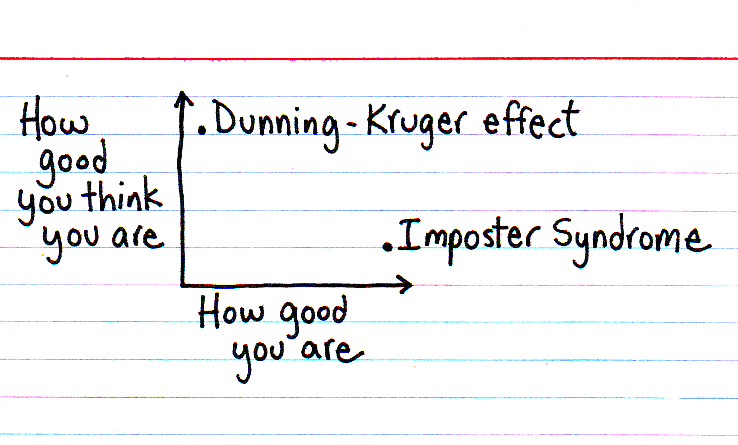
The week begins with a feeling of curiosity and excitement; looking forward to new challenges and working alongside new colleagues; and, a healthy dose of 'imposter syndrome'! It has been nice over the summer, telling friends and family that I am undertaking a PhD in public health, but now the day is here I am fairly sure they will realise very quickly, they have made a mistake, and I will be sent back to the job queue.
 
Broadly speaking, the Dunning-Kruger Effect is defined as "a cognitive bias in which unskilled individuals suffer from illusory superiority, mistakenly rating their ability much higher than is accurate.

I am housed within the Early life and adolescense branch of Fuse, investigating prevention straegies for risky behaviour in adolescence. The first step is attendance at the Fuse members meeting, where academics, students and other practitioner guests come together to discuss issues from the current ongoing research. It all sounds very intelligent and I am convinced that as a newbie I will stick out like a sore thumb! On arrival I feel a strange mixture of comfort from the familiarity of being back in Newcastle at my old university, and fear of the unknown, the realisation that I am an independent research student and nobody is going to tell me where I should be or what I should be doing over the next three long years.

I am thrilled to see one or two friendly faces amongst those gathered; fellow research students I met during orientation, lecturers from my previous course, and my supervisor among them. Fairly early on in the proceedings it transpires that it is not just my first day, there are many of us beginning this journey together; PhD students, postgraduate research associates, supervisors, program leaders and a new director. All of us finding our feet and settling in to our new role together. Each of us are welcomed as members of the ‘Fuse family’ and, by the end of the day, that is just how it feels, an extended family ready to reach and lend support to any one of us.

Following this well-timed glimpse into life as a public health researcher comes the first day proper. Meetings with supervisors and fellow students; finding our way around the university buildings; and receiving the coveted student cards, fob keys, and other small necessities which say ‘this will be your home for the next three years’. Go!

In the post graduate research room I find a desk, and take a seat. There is a quiet hum of concentration from second and third year students as they work. I turn on my computer, register my name for postgraduate induction and check my emails. I open the web browser and stare at the white screen in front of me, the cursor flashing patiently, and waiting for instruction. I feel a little overwhelmed and wonder if I will ever get to the stage of my colleagues around me. One of them looks over, knowingly and says ‘don’t worry, the first day is always like that’. I’m so grateful.

Today is the beginning of my second week and I have so many ideas I don’t know where to start.

Thursday, 9 October 2014

52 weeks in public health research, part 40

Posted by Greg Rubin, Amelia Lake, Mark Welford


From Greg Rubin: Seen in a Luxembourg motorway service area. Vive le free market in smoking related diseases (not).


From Amelia Lake: Scotland is not renowned for its healthy cuisine however today I enjoyed a vegetarian haggis at a well established vegetarian restaurant in Edinburgh - and it was very, very lovely!


From Amelia Lake: A whole new meaning to farm fresh... Enjoying beautiful free range eggs laid by very happy hens on a farm we are staying at. Plenty of food for thought regarding sustainability and food miles!


From Mark Welford: CEDAR's Dr Esther van Sluijs and Fuse's Liane Azevedo pose for the obligatory (cheesy) photo with the Fuse banner at the Third Physical Activity Workshop. Esther kindly travelled from Cambridge to give her keynote address. These events bring together professionals with an interest in physical activity and are open to delegates from academia, private, public and the voluntary sector. In keeping with the theme there was an optional lunchtime 'network walk' through Middlesbrough's Albert Park; unfortunately I forgot to take a photo as I was jointly leading the line.

------------------
A reminder from the Fuse blog group:

Each Thursday of 2014 we’ll try and post around four pictures on the Fuse blog that capture our weeks in public health research, from the awe-inspiring to the everyday and mundane. Given that more of the latter than the former exists in most of our lives, we foresee problems compiling 208 images worth posting on our own. So this is going to have to be a group project. Send an image (or images) with a sentence or two describing what aspect of your week in public health research they sum up and we’ll post them as soon as we can. You don’t have to send four together – we can mix and match images from different people in the same week.

Normal rules apply: images you made yourself are best; if you use someone else’s image please check you’re allowed to first; if anyone’s identifiable in an image, make sure they’re happy for it to be posted; nothing rude; nothing that breaks research confidentiality etc.

Email your posts to m.welford@tees.ac.uk or contact any member of the Fuse blog group.

Tuesday, 7 October 2014

Context, complexity, mixed methods and multidisciplinarity

Posted by Emily Henderson

As the new Research Associate lead on Fuse’s Complex Systems Research Programme, I was funded by Fuse to attend a training course on Evaluating Complex Public Health Interventions in Cardiff, 25-27 June. It was delivered by our partners in DECIPHer (Development and Evaluation of Complex Interventions in Public Health), one of five UKCRC Public Health Centres of Excellence (PHCoE). As we know from Prof Simon Murphy’s lecture, presented at the Complex Systems Research Programme’s inaugural event last May, DECIPHer have a successful record of doing localised, translational research. So it struck me and Prof David Hunter (Programme Leader, Complex Systems Research Programme and Fuse Deputy Director) as a great opportunity to exchange experiences with other PHCoE.

As a mixed methods medical anthropologist, I was hoping on this course I would 1) make new and interesting acquaintances, which I did, and 2) learn about how the diversity of methods can be best used in addressing complex public health issues. The three-day course, which followed its two-day counterpart on Developing Complex Public Health Interventions, covered: process evaluations, feasibility studies, large-scale effectiveness studies and alternatives to randomisation and data linkage. The DECIPHer approach was clearly outlined as adopting 1) the MRC Framework on developing and evaluating complex interventions; 2) Ecological Thinking, 3) Co-Production Models and 4) Complex Systems Thinking. And echoing the MRC Framework on process evaluation - coming to a theatre near you - that, despite the range in methods that can be adopted, there is “no hierarchy of evidence”.

This was welcome news - given the diversity of methods adopted within Fuse, e.g. embedded ethnography, realist evaluation, economic evaluation of trials - excepting that the focus of the training was exclusively on trials. In certainly what was not an unusual experience for me, I was the odd-(wo)man-out at this event (emphasis on odd). But this lonely position has its rewards, as participant-observer:

“The magic of anthropology is precisely its ability to self-critically live with the almost schizophrenic contradiction of adhering to two worlds simultaneously”. Messac et al. Soc Sci Med 2013. p185
 
It seemed my chummy classmates were by-and-large RCT researchers, and many told me they left the course wanting to re-read the notebooks to apply what they learned to their research. Pfft, over-achievers. The task I left feeling that I needed to address, was to consider in greater depth this question:

‘In adopting socio-ecological models, how can we as public health researchers, if at all, adequately consider context?’

Just last week, I was asked by a medical anthropology PhD student from the University of California Los Angeles to use my PowerPoint slides as a complement to a podcast of a talk I gave at the University of Oxford, which, dear reader, I wouldn’t shamelessly draw your attention to here. This bright and motivated student wanted to illustrate to her undergraduates how anthropologists can address “real world” problems using mixed methods approaches.

 Induced to dig out my own mixed methods lecture (delivered for Durham’s Methods and Analysis anthropology module), I was reminded of the premise I taught: *only* use mixed methods when the sum of methods reveals more than the methods as parts, or some such or other. I used Durham City’s biennial Light Festival as an analogy of how mixing unrelated media (a cathedral, a slide projector and spooky music) can enhance one’s experience of learning about Durham’s history. But why the proviso “only”? Why not have a light festival every night? Indeed Durham City, why not? Because mixed methods approaches also have many drawbacks. They require: added time, added expertise and multidisciplinary working, to name but a few, not to mention the added funding all this entails. 
 
'Lumiere' - Durham Light Festival
 
No, it’s not possible to create time - we as academics know this all too well - but somehow the latter point - multidisciplinary working - seems more challenging. The debate on ‘Realist RCTs’ for example raises the important issue of the researcher’s epistemological lens. The what? That is, the researcher’s understanding of knowledge and how knowledge is constructed. Do you believe reality can be objectively measured, or rather that reality exists only as a subjective experience, or something in between? Disagreements on this fundamental of doing research can make combining methods - for example embedding ‘qualitative’ methods within trials to provide context - a challenge and at times implausible. However, as with epistemological views, there is a continuum of mixed methods approaches, including triangulation - no, not strangulation - where methods complement each other but retain their disciplinary roots.

Given the range in my own multidisciplinary background, from neuroscience to biocultural anthropology to health policy, my tendency is to at least consider, albeit critically, the range of approaches to researching humans and human health. As social animals we are, after all, complex beings (or at least we’re quite happy to get ourselves into a muddle over what it all means), thus one perspective surely cannot paint the entire picture. Enter multidisciplinarity. However, as with all disciplines, multidisciplinary working itself requires skills, training and experience, especially interpersonal skills to facilitate collaboration, or to recognise when this is impracticable. 

All views expressed are exclusively those of the author.


Thursday, 2 October 2014

52 weeks in public health research, part 39

Posted by Amelia Lake, Mark Welford and Jean Adams


From Amelia Lake: At the Fuse members' meeting new Director Ashley Adamson thanks Martin White for his leadership of the Centre and wishes him well in his new role with the Centre for Diet and Activity Research (CEDAR) and the MRC Epidemiology Unit at the University of Cambridge.


From Mark Welford: Avril Rhodes reveals the mysteries of being a Knowledge Exchange Broker during her table session at the Public Health Intelligence Northern England (PHINE) network meeting. If you think your event could benefit from a Fuse presence please email avril.rhodes@tees.ac.uk or m.welford@tees.ac.uk


From Amelia Lake: Managing the family actually eating against a busy work schedule means late night cooking! Sweet potato & coconut curry! Looking forward to it already!


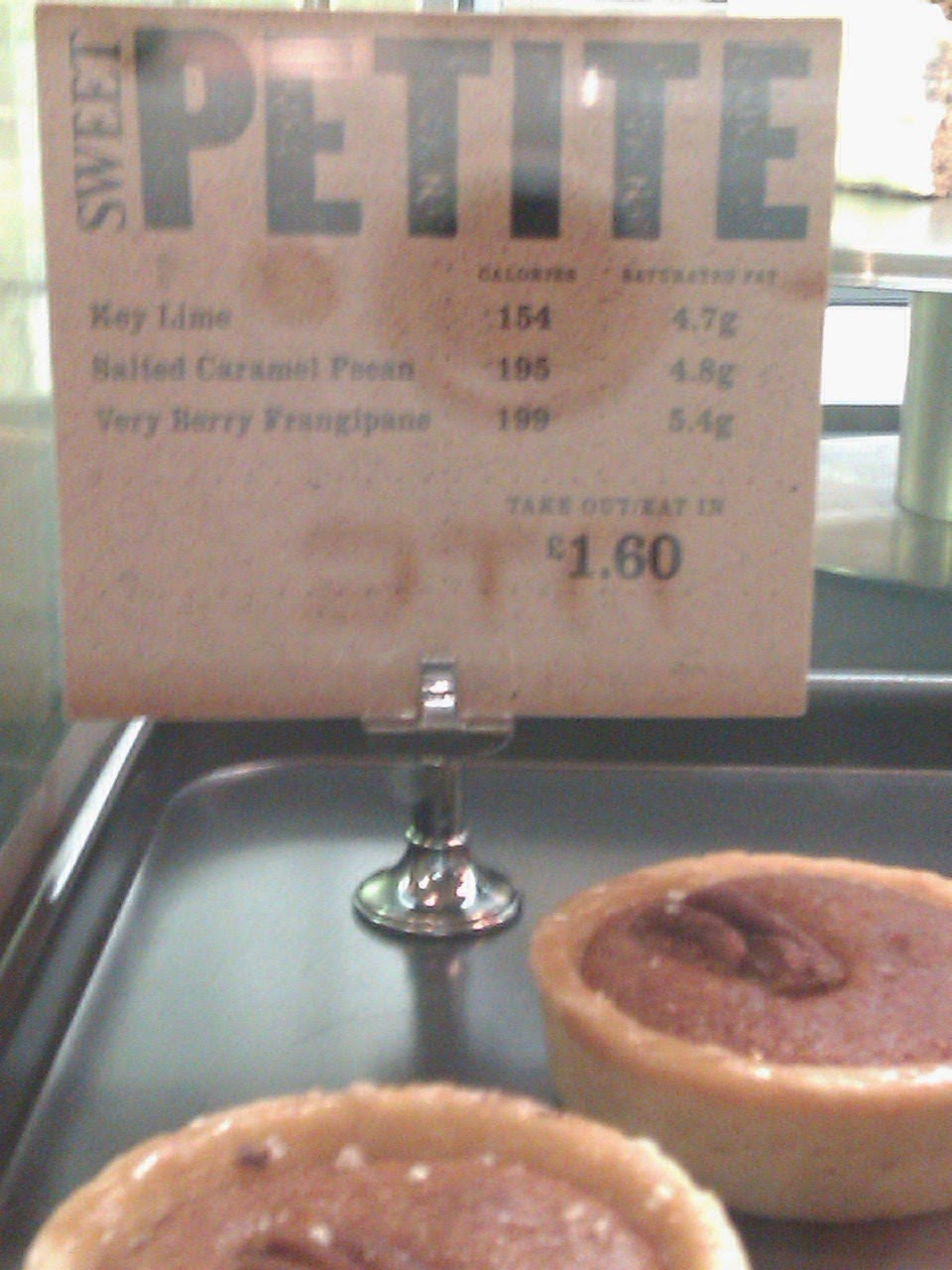
From Jean Adams: Research suggests that calorie labelling works to decrease intake in some people, some of the time. When I found out how many calories were in coffee shop cakes, I was slightly horrified and stopped buying them. It's also been suggested that forcing food companies to come clean on food content may encourage reformulation. So I was interested to see these 'petite' treats at Birmingham New Street, with a slightly more appropriate number of calories for a snack. Would love to know effect of these on choice and consumption.

------------------
A reminder from the Fuse blog group:

Each Thursday of 2014 we’ll try and post around four pictures on the Fuse blog that capture our weeks in public health research, from the awe-inspiring to the everyday and mundane. Given that more of the latter than the former exists in most of our lives, we foresee problems compiling 208 images worth posting on our own. So this is going to have to be a group project. Send an image (or images) with a sentence or two describing what aspect of your week in public health research they sum up and we’ll post them as soon as we can. You don’t have to send four together – we can mix and match images from different people in the same week.

Normal rules apply: images you made yourself are best; if you use someone else’s image please check you’re allowed to first; if anyone’s identifiable in an image, make sure they’re happy for it to be posted; nothing rude; nothing that breaks research confidentiality etc.

Email your posts to m.welford@tees.ac.uk or contact any member of the Fuse blog group.


Tuesday, 30 September 2014

The blog monster

Posted by Mark Welford

You may have noticed that change is afoot in Fuse-land and this includes the blog.

Since its inception in February 2010, the blog has hosted 250 posts and received nearly 105,000 individual page views. Of those 250 posts, Jean Adams - the founder and force behind the Fuse Open Science Blog - has written a whopping 94 or to put it another way, 38 per cent!
 
The blog is a monster that needs to be constantly fed and when food's been scarce on Jean’s watch she's always been on hand to rustle something up.

The ravenous blog monster
It began here with the blog’s first ever post. Since then she has regaled readers with tales of being a media darling, balancing work and life, showing Fuse duck around Newcastle University, her experience as a medical student, and provided advice to PhD, MSc, and research students. She's written about blogs and blogging, knitting, trekking, running, her introversion and fear of the phone … and sometimes even had time to write about research.

So, the news that Jean is moseying out of town in search of pastures new (what’s the second oldest University in England got on Newcastle - gondolas?) leaves a rather large Jean shaped hole, metaphorically speaking!
 
Our solution? Create a Fuse blog working group to fill the gap.

Let me introduce you to the friendly group of Fuse members who now oversee and edit the blog: Amelia Lake, Lecturer in Knowledge Exchange in Public Health at Durham University; Jonathan Ling, Reader in Public Health at the University of Sunderland; Jenni Remnant, PhD Student at Newcastle University; Avril Rhodes, Fuse Knowledge Exchange Broker; Peter van der Graaf, AskFuse Research Manager; and me.

Yes, change is scary but change is also exciting and this is an opportunity for new ideas and new people to keep the blog vibrant.

One of the original aims of this platform was to act as a tool to provide two-way engagement with people from outside of academia in local and regional government and other public, private and voluntary organisations. In its current form, the blog is focused on providing insights into public health research and over time could be said to have evolved into more of an internal resource, with posts often - but not always - written by researchers for researchers.

This isn't a bad thing - after all we are a research centre - and we would like to thank all those who have contributed so far and made the blog the success we believe it is. But we think it can be even better! As well as researchers we want to encourage ALL those working in and around Public Health to contribute to the blog in order to stimulate an open forum for debate that captures the full breadth of population health.  
 
If you work in Public Health then please get in touch. 
  • We want hear about your aims, priorities, and challenges.
  • Which issues need to be brought into the public eye and debated?  
  • Can you provide an insight into your role in Public Health for those not directly involved?
  • Is there a public health related campaign in your area that you want to promote, or could you write a post that coincides with an event or a topical news issue?
Or simply let us know if you have any other ideas on how the blog can be improved.
 
We publish posts twice a week and publicise these via our main twitter account (@fuse_online), Amelia’s account (@Lakenutrition) and Peter’s (@pvandergraaf75). We welcome posts of around 500 words. These tend to be light-hearted takes on the day-to-day joys and frustrations of being involved in Public Health and often spark interesting discussion, both on-line and in person.
 
Email your posts to m.welford@tees.ac.uk or contact any member of the group by following the links above.
 
Finally, a big thank you to Jean for her dedication in feeding the blog monster. We all wish her well in her new position with the Centre for Diet and Activity Research (CEDAR) and the MRC Epidemiology Unit at the University of Cambridge.

Thursday, 25 September 2014

52 weeks in public health research, part 38

Posted by Jean Adams


I noticed this US section in a supermarket in Oxford recently. I’ve seen UK sections in French supermarkets, but never US sections in UK supermarkets. UK supermarkets are hardly a paragon of food virtue, but I was amused to remember quite how silly some of the food in US supermarkets is.

 
These pop tarts proudly proclaim that they’re a ‘good source of 7 vitamins & minerals’. But this claim has been blanked out. Presumably it doesn’t comply with UK/EU regulations on what counts as a ‘good source’!


I love health claims like this ‘fat free’ one on a product that has 90 calories per unit! There is some evidence that these claims have ‘halo’ effects with busy consumers interpreting ‘fat free’ as healthy.

 
This retro Pepsi has real sugar in it! Presumably to attract people who don’t like the nasty sweeteners in diet Pepsi or the ‘natural’ sweeteners in Coke Life. How bizarre that we’ve got ourselves to a place that ‘real sugar’ is now a thing to proclaim.


------------------
A reminder from the Fuse blog group:

Each Thursday of 2014 we’ll try and post around four pictures on the Fuse blog that capture our weeks in public health research, from the awe-inspiring to the everyday and mundane. Given that more of the latter than the former exists in most of our lives, we foresee problems compiling 208 images worth posting on our own. So this is going to have to be a group project. Send an image (or images) with a sentence or two describing what aspect of your week in public health research they sum up and we’ll post them as soon as we can. You don’t have to send four together – we can mix and match images from different people in the same week.

Normal rules apply: images you made yourself are best; if you use someone else’s image please check you’re allowed to first; if anyone’s identifiable in an image, make sure they’re happy for it to be posted; nothing rude; nothing that breaks research confidentiality etc.
 
Email your posts to m.welford@tees.ac.uk or contact any member of the Fuse blog group.
 

Tuesday, 23 September 2014

As long as you can manage to stay awake

Posted by Jean Adams

I was sitting in a meeting the other week when someone started talking about ‘Jamie and Tom’,* in a slightly context-free way, like I would definitely know who they were. It was at this point that I realised I only knew who about 50% of the people around the table were and that we’d got to agenda point 3 without any introductions.

One of the most common activities I did as a medical student was sitting at the back of a clinic. The doctor would do their job, seeing each patient on that morning or afternoon’s list; my job was to learn by observing. It’s not always easy to keep concentrating on this sort of ‘just watching’ learning. Hospitals tend to be warm places and the student isn't actively engaged in the consultation. To help me stay awake, I made a rule that I would try to ask the doctor at least one question after every patient. Sometimes I asked questions I knew the answer to, just to prove to everyone that I was still awake.


"Thomas Eakins, The Agnew Clinic 1889" by Mark Skrobola - note how engaged medical students were in the 19th century
I’m not sure I can remember anything I was actively taught during a clinic. What I really remember is learning what sort of doctor I did, and didn’t, want to be. I wanted to be the doctor who spent a whole afternoon consulting with people with the dreadfully debilitating, but hard to treat, chronic pain syndrome without once loosing their patience. I never wanted to be the doctor who walked out of the door when their patient started weeping, leaving the nurse to 'deal with it'.

As the meeting went on I eventually worked out that Jamie was female, and was a little bit upset with myself for auto-assuming she wasn’t, but a little bit pleased with myself for taking a tiny step towards nailing down her identity. Then someone started talking about GVS-super-TRP**. I looked at the meeting papers for a clue as to what this might be, lost the thread of the discussion, and my brain slipped away to something much easier.

In order to stay awake, I wrote a list of the things that had gone wrong in the meeting. Right there, on my agenda: no introductions, no explanation of GVS-super-TRP. Looking back, I hope that I wrote in enough of a scrawl that the person next to me wasn’t able to witness my impudence. It’s not like I'm some ninja-meeting super-hero. Note: I didn't interrupt to clarify what GVS-super-TRP was, or ask who Jamie and Tom were. Participants not asking for clarification when required was on my list.

The bad meeting experience reminded me of my medical student days and how much you can learn by just watching. How much you can learn about how to do things well and how to do things badly.

I was attracted to medicine partly because I liked the idea that it would take a long time to get any good at it – learning and working at doing it well would keep me busy for a while. Similarly, I like that research is not something I will be done learning soon. You don’t get a piece of paper one day saying “you are now qualified as a researcher: go forth and research”. There is always more to learn and always more opportunities for learning – even from meetings that don't go so well. As long as you can stay awake.


*Obviously not their real names, but definitely one name was one that could be either male or female.

**Whatever it was, I don’t want to compromise the true acronym’s confidentiality, so also not it’s real name.

Thursday, 18 September 2014

52 weeks in public health research, part 37

Posted by Jean Adams

The seminar room and cafe in our building are often used for small conferences by groups from around the university. I snapped this at about 7pm in the evening when one such meeting had well and truly turned the corner from conference to social. We never have beer, tobacco and biscuits at public health meetings. Honest.

This is the 'famine wall' on Beinn Dearg near Ullapool. This part of it is more than 1000m above sea level. It runs for many miles and is more than 8ft wide and 8ft high in places. It was constructed in the 1840s by farmers whose harvest had failed in return for money, or food. There are remnants of many of these 'make work' projects all over the north of Scotland (and I presume Ireland too). It would have been considered unseemly just to give starving people money (as per the modern welfare state). Instead, humanitarian landlords thought up projects such as these to keep their tenants occupied and fed. You can see that it was a beautiful day when we were there, although you can't see the chilling winds strong enough to knock us over at times. The conditions up there are likely to be dreadful more often than not. Despite the problems with the current welfare state, I still think it's better than having people build useless walls at 3000ft in Scottish mountain weather.

I took this picture of lemon cake at afternoon tea time at the recent meeting of the World Public Health Nutrition Association. I was fully intending of making the usual comment about the ironic placement of unhealthy food at a public health nutrition meeting. Turns out most of is was left at the end of the tea break.

This is an interesting development that I noticed at a petrol station recently. It was quite a substantial promotion on Coke Life - sweetened with stevia and with about two-thirds of the calories of red Coke. There's an interesting discussion of the 'natural' and 'low(er) calorie' claim here. Personally, I think two-thirds of the calories of red Coke, is still a lot of calories.

------------------
Just to remind you:

Each Thursday of 2014 we’ll try and post around four pictures on the Fuse blog that capture our weeks in public health research, from the awe-inspiring to the everyday and mundane. Given that more of the latter than the former exists in my life, I foresee problems compiling 208 images worth posting on my own. So this is going to have to be a group project. Send me an image (or images) with a sentence or two describing what aspect of your week in public health research they sum up and I’ll post them as soon as I can. You don’t have to send four together – we can mix and match images from different people in the same week.

Normal rules apply: images you made yourself are best; if you use someone else’s image please check you’re allowed to first; if anyone’s identifiable in an image, make sure they’re happy for it to be posted; nothing rude; nothing that breaks research confidentiality etc.

Tuesday, 16 September 2014

Haste ye back?

Posted by David J Hunter, Professor of Health Policy and Management, Durham University and Fuse Deputy Director

Many in the North East will be wondering how their region will fare if Scotland decides to go its own way on Thursday.

Some may be heard to say: ‘if you’re going can we come with you’?  Others might sullenly fear the worst, with our region caught between a hungry new nation impatient to prosper and chart a different course on the one hand, and an England which seems captive to the huge suction pump that is London hoovering up all before it and drawing in talent and resources from across the UK – or what was the UK.   

Where might health policy figure in the scheme of things post-referendum?  Will it fare better under independence? Or will things remain much the same or possibly deteriorate?

Financially, the Scottish NHS has always fared better than its English counterpart, enjoying higher per capita funding.  But spending on health services is not the only factor affecting health status.  Despite the extra funding, Scotland’s health remains stubbornly poor and generally inferior with higher mortality – hence the label the ‘sick man of Europe’.

Of course, with less funding for health care it might be worse.  But it’s more complicated than that. 
Perhaps liberated from the shackles and centralising tendencies of the UK (or London to be more precise), Scotland will be able to restore the public realm or invest in ways which will demonstrate that an austerity economic model can be replaced by a social model of development.

We know from Marmot’s work and WHO’s health strategy for Europe, Health 2020, that tackling the social determinants of health demands a whole of government and whole of society approach. 

Being able to achieve such joined up thinking and work across a whole system is much easier (in theory at least) in a small country.  And there are certainly signs that Scotland wants to be innovative and tackle health differently with its recently departed Chief Medical Officer, Harry Burns, extolling the virtues of asset based approaches and talking about wellness rather than ill-health.           

The Scottish government has been something of a cheerleader in public health policy having been quick to follow Ireland’s lead on banning smoking in public places long before England.

More recently, it took the lead in introducing a minimum unit price for alcohol although whether the policy will survive the EU single market rules remains to be seen. But where England dithers, Scotland appears willing to take bold action.

The real issue is whether an independent Scotland can do more to improve health and tackle inequalities than it can under current devolved freedoms and from others to come which are promised following a No vote.  

The answer is complicated.  After all, what does independence actually mean in our global world where paradoxically everything is interdependent at a time when nations and regions seek greater freedoms.  Are these opposing forces reconcilable?   Or will independence prove to be a chimera with Scotland even less able to realise its social justice aspirations?

Those voting with their heads will endeavour to weigh up the pros and cons and bring evidence to bear on their decision-making.

Those ruled by their hearts will not be swayed by an evidence base which is fiercely contested and offers no definitive answers.  They will be tempted to take the risk believing they have nothing to lose with the status quo and retention of a 300 year old Act of Union holding little appeal. 

But will the politics and the policies be so different in the end or just their packaging and presentation?   Can an independent Scottish government shake off the neoliberal embrace to which all governments since, and including, Thatcher have been enthral? 

In a global economy, no country is an island and to keep at bay, never mind hold to account, the rapacious transnational conglomerates, including the big consultancies and ‘advisers’ and lobbyists that are busy hollowing out the public realm in England, demands both vigilance and political courage of a kind that will tax the most socially enlightened politician.  

This is the true nature of the experiment underway in Scotland regardless of whether it achieves formal independence after the referendum or some form of ‘devo max’.

Can Scotland break with the Anglo-Saxon tradition and replace it with an ethos marked by collectivism, reciprocity and a commitment to public services? 

Or will it buckle under the pressures of global capitalism and dance to its tune?                

Yes or No, Scotland promises to be a fascinating laboratory for years to come for health policy-watchers.

Thursday, 11 September 2014

52 weeks in public health research, part 36

Posted by Simon Howard and Jean Adams

From Simon Howard: after the photo of the Messi Pepsi can, I thought this one I took on holiday in Naples took the biscuit - the Napoli football team as tins containing chocolate chip cookies! Judging from the end product, I'm not sure they thought too hard about the aesthetics, let alone what the public health consequences might be!

From Jean Adams: In October we are moving to Cambridge and we've been using our East Coast rewards points to house hunt in style. But all that time spent searching property websites during the week means that we are making use of the peace and space of first class to catch up on work.

From Jean Adams: I was in London earlier in the summer at one of those meetings that looks like you are being invited to contribute your expertise, but is actually someone very politely asking you to stop making so much fuss. The meeting ended early and I took the opportunity to visit the V&A's Disobedient Objects exhibit before my train. This Nicholas Klein quote made me feel just a little alone and ignored.

From Jean Adams: the 'big move' means that I have finally had to find the time to clear out my desk and cupboard. After ten years of not looking at any of them once, I am parting with my PhD notes. Both a little bit gut wrenching and a little bit liberating.

------------------
Just to remind you:

Each Thursday of 2014 we’ll try and post around four pictures on the Fuse blog that capture our weeks in public health research, from the awe-inspiring to the everyday and mundane. Given that more of the latter than the former exists in my life, I foresee problems compiling 208 images worth posting on my own. So this is going to have to be a group project. Send me an image (or images) with a sentence or two describing what aspect of your week in public health research they sum up and I’ll post them as soon as I can. You don’t have to send four together – we can mix and match images from different people in the same week.

Normal rules apply: images you made yourself are best; if you use someone else’s image please check you’re allowed to first; if anyone’s identifiable in an image, make sure they’re happy for it to be posted; nothing rude; nothing that breaks research confidentiality etc.

Tuesday, 9 September 2014

You can't ever win

Posted by Jean Adams

Brian McNeil sings a song called Sell you labour not your soul. The chorus goes: “Young and old, true and bold/ Sell your labour not your soul/ Solidarity's your goal - join the union”. It invariably involves a lot of audience foot stamping and fist waving.

I was reminded of this song during a conversation with my ‘leadership mentor’ a few months ago. NIHR sent a guy up to Newcastle to watch me at work, feedback on my leadership style, and discuss my career direction with me. My mentor had worked with lots of people funded by NIHR, so when he asked which UK academics I really wanted to be like, he knew the names I reeled off. “If you want to be like them,” he said, “you’re going to have to work more hours”. Then he laughed at me when I told him the university already got enough of my soul and said, “well you know the old saying: ‘if you’re not a socialist by the time you’re 20, you haven’t a heart; if you’re still one by the time you’re 40, you haven’t a brain’”. I still have a few years left to make the full transition.

All the images on work:life balance were cheesy. But I thought you'd be impressed by this photo of Brian McNeill playing the double-kneck bouzouki
There are people at the university that I strongly feel don’t get paid enough to work more than their contracted hours. But that’s not me – I get paid plenty well enough. And it’s not that I don’t feel passionate about (most of) what I do, or find myself enjoying thinking about it when I’m running or climbing hills, or sometimes get so engrossed in it that I’m still at my desk way past home time. I just think there should be more to life than work. That my life, and work, are both better for there being more to life than work.

I know there are many, many people working in public health research (and in lots of other areas) who work more than their contracted hours. In fact, my contract is a little vague about what my ‘contracted hours’ might be. Sometimes it seems like working all the time is the only way to be successful – somehow ‘good’ means ‘lots’. There seems no way to do everything that you want, or have, to do without working all the hours.

Academia is inherently a competitive venture. There is no absolute benchmark of good enough – it’s only ever relative to what other people manage. When one person starts churning out twice as much as anyone else by working longer and longer hours, it puts pressure on the rest of us to do the same. To keep up. Before you know it, you feel guilty every Sunday afternoon you don’t spend at your laptop.

But I have also come across well respected, and undoubtedly successful, academics who tell me how important it is to them not to start work before 8.30am, and not to leave the office after 6pm. Not just because it makes their lives better, but because this is the role model they want to be to those around them. These are not people who are doing sneaky work at home that they don’t let on about. They just seem to be focused in what they agree to do, to do it efficiently, and then to go home and do something else.

It is this type of person that I really want to be like. For me, the challenge is the focus and efficiency, not finding the energy to stay at my desk until midnight – although I would also struggle with that. Every Sunday afternoon that I spend at my laptop I feel that I have failed. I promise myself that next week I will focus more and be more efficient. I list the ways that I waste time and the things I should never have agreed to do. Instead of feeling guilty when I’m not working, I feel guilty when I am.

You can’t ever win.

Thursday, 4 September 2014

52 weeks in public health research, part 35

Posted by Martin White

Editor's note: Yes, it is possible that we skipped 4 weeks of this project. But I'm making the rules and I say that's okay. 

I am attending a national research leaders course funded by NIHR and hosted by Ashridge Business School in Hertfordshire periodically during this year and some of next. The course itself is very good (the role play on 'difficult conversations' was particularly educational), as is getting to know the class and faculty (some extraordinary people at the top of their game), and the food (!). But the venue and its setting, dating from the 14th century in parts, in the custodianship of the National Trust, is quite special. It feels like a real privilege to spend a few days once a quarter in these surroundings.

During the World Cup it seemed like everyone jumped on the marketing opportunity bandwagon. I'm not sure whether Krispy Kreme was indulging in this opportunity (the picture was taken during the tournament), or whether this marketing at a service station off the A9 in Scotland was aimed at travelling football fans or teams. Whatever, they clearly know how to sell more than one doughnut at once. These babies weigh in at an average of 363 calories (kcal) each (equivalent to 418 kcal/100g), so the exhortation to 'share' these with your team mates might not be such a bad idea.

This Playground Code is probably familiar to many of you as parents, and perhaps as children. I saw it when attending a ceilidh in a school hall to celebrate a very special birthday. I thought we could substitute 'work' for 'play' and, with a little further adaptation, make the world a better place. Just saying...

I seem to be travelling to London a lot more than I used to. I thought I had it all down to a fine art - leaving home 20 mins before my 07.11 train departs from Morpeth Station. I had not reckoned on some of our local farmers herding their sheep into the yard at this time of the morning. Fortunately, I made the train, which was a couple of minutes late.


------------------
Just to remind you:

Each Thursday of 2014 we’ll try and post around four pictures on the Fuse blog that capture our weeks in public health research, from the awe-inspiring to the everyday and mundane. Given that more of the latter than the former exists in my life, I foresee problems compiling 208 images worth posting on my own. So this is going to have to be a group project. Send me an image (or images) with a sentence or two describing what aspect of your week in public health research they sum up and I’ll post them as soon as I can. You don’t have to send four together – we can mix and match images from different people in the same week.

Normal rules apply: images you made yourself are best; if you use someone else’s image please check you’re allowed to first; if anyone’s identifiable in an image, make sure they’re happy for it to be posted; nothing rude; nothing that breaks research confidentiality etc.

Tuesday, 2 September 2014

What's happened to your local?

Posted by Mark McGivern, Specialty Registrar in Public Health, Balance

[Editor's note: this post was first published by Balance. Thanks for letting us repost it here.]

I was recently undertaking some research on behalf of Balance into the volume of alcohol promotions in supermarkets. Whilst doing this that I stumbled upon another interesting area which led me to do some further investigative work into the locations of some of these shops.

The Turnpike in Westerhope, before and after
My original research involved visiting 48 of the 90 convenience stores operated by Tesco and Sainsbury’s across the region. As I was going from store to store I realised that many appeared to be buildings that, in previous lives, were once pubs. It was apparent just by looking at some of these shops that they used to be pubs but others weren’t quite as easy to spot due to extensive renovation work and extensions being added to the original building.

My interest was already piqued and so I decided to take to the computer to do some online investigation. By locating each site on Google maps and looking at historic photographs my suspicions were confirmed at seven of the stores I visited. While that may only be around 15%, I’m certain that number would grow if I were to visit the remainder of the 90 stores in the region.

The seven stores I identified as converted pubs were:

• The Honeysuckle, Coatsworth Road, Gateshead - now a Tesco Express

• The Broadway, North Shields - now a Sainsbury’s Local

• The Turnpike, Westerhope - now a Tesco Express

• The Black Horse Inn, Windy Nook - now a Tesco Express

• The Station Hotel, Seaton Carew - now a Sainsbury’s Local

• The Lodge, Neville’s Cross - now a Sainsbury’s Local

• The Black Swan, Morpeth - now a Sainsbury’s Local

The Black Swan in Morpeth, before and after
It feels strange, as a member of the public health community, to be advocating to save pubs. However, this is a wider problem, with two key issues. Firstly, communities need to feel like they are being listened to when it comes to decisions being made in their villages, towns and cities. Secondly, it’s about the fact that supermarkets make cheap booze more readily available, increasing competition and making it difficult for small community pubs to compete. 

Pubs used to be not just a place for drinking, but for socialising with friends and family. In terms of local history, some of them also used to be impressive local buildings too, which have now been anonymised by the standard, uniformity of the supermarkets branding.

It’s no secret that community pubs up and down the country have suffered in recent times, but this latest trend has resulted in questions being asked of the current law which allows supermarkets to convert pubs without the need to apply for a change of use.

With such loose laws around these types of premises it’s no surprise that former pubs – that were likely once hubs of their communities – are seen as such appealing opportunities for supermarket giants.

CAMRA (Campaign for Real Ale) has spoken out against the loophole and called on government to amend the law so communities can have a greater say in whether local pubs can be converted into these types of convenience stores.

Labour appeared to have listened to these calls and earlier this year shadow small business minister, Toby Perkins, said he wanted to see local authorities and communities involved in the decision making process over planning decisions that centre around pub conversions.

These types of discussions can only be a good thing. It’s important for the issue of local decision making to be addressed at a high level, particularly with party conference season on the horizon and an upcoming general election. However, it’s also important to link it to the wider issues around price and availability of alcohol, particularly the cheap, strong alcohol. Alcohol is 61% more affordable today than it was in 1980 and measures such as minimum unit pricing would not affect sales or prices within local pubs, but would save lives, reduce crime and help cut the £21 billion that alcohol misuse costs the UK each year.

I’m sure there will be many more instances of pubs being converted into convenience stores throughout the region that I haven’t picked up on. If you’re aware of any then next time you’re out and about take a picture of the shop in question and send it to us with details of the location to info@balancenortheast.co.uk or tweet it to @BalanceNE.

Thursday, 31 July 2014

Holidays!

Is it holidays yet? Oh thank goodness.

The blog has spent the last few weeks hanging on to every scrap of work-related motivation it can find for dear life. It seems like everyone apart from the blog is on holiday. Facebook is full of holiday snaps. Twitter is packed with advice from Public Health England on how to cope with hot weather. But the blog has been diligently heading into work every day, ploughing through the to-do list, keeping the in-box under control.

But now it's holiday time!

The blog has a couple of friends who've rented a flat near Chamonix for the summer and the blog's off to join them for a month of rock, glaciers, ropes, crampons, snow in summer, and painstaking deciphering of French weather forecasts.

See you in September.

Photo by Matthieu Lienart